
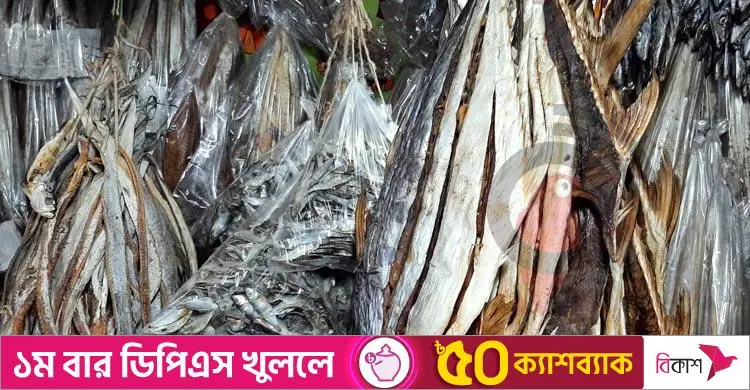
Dried fish (shutki) is made by drying fish in sun and wind. For marketing and storage, water content must be brought down quickly to 16 to 18 per cent, killing spoilage microbes and stopping the fish's digestive enzymes. Water leaves in two stages: first from the wet surface, depending on air humidity, speed and temperature and the fish's surface area; then from inside, depending on fat and water content, thickness and body temperature. Because of the monsoon, fish is dried only in winter in Bangladesh, and even then cloud and fog cause problems.
The insect problem
The main problem is insect attack. Flies lay eggs on the moist fish early in drying; if the fish does not dry fast, larvae hatch within hours and can eat the soft flesh in 6 to 10 hours. Dermestid beetles lay eggs in the gills, belly cavity and eye sockets of drying or stored fish; the larvae hatch in 15 to 30 days and can consume a whole batch within a week, leaving only bones.
To prevent this, most dried fish for the domestic market is treated with harmful pesticides such as DDT, Nogos and Basudin. Long-term consumption can damage the kidneys and liver and even kill. Boiling or cooking does not remove the poison; heat makes it stronger. Using pesticides on dried fish is a punishable offence under public health law.
Box tunnels
No expensive machinery is needed. A low-cost box tunnel can be built on bamboo or wooden posts: a platform 3 feet high, 4 feet wide and 20 feet long, with a sloping roof from which rows of fish hang so each gets equal sunlight. The whole tunnel is covered tightly with mosquito net. Fish are hung before dawn, when flies cannot see to move. Once dry, the fish must go straight into lidded drums or strong polythene bags to keep beetles out.
Ring tunnels
A hanging ring tunnel suits small and medium traders. A 4-5 foot bamboo is split into six or eight strips and shaped with bamboo rings into a cage, with two or three tiers of rings inside for hanging fish, and wrapped in mosquito net. A two-tier tunnel can dry about 20 kg of Bombay duck (loitta) or 25 kg of ribbonfish; with bamboo sieves inside, it can dry 20 kg of small fish. It also works for large fish and at home on a yard or roof.
Step by step
Buy fresh fish by 2-3pm, avoid rotten or bruised fish, transport it on ice, clean gills and guts, wash in tubewell water, rub with 8-10 per cent clean salt (no more than 2-3 per cent for Bombay duck) and keep on ice for 6-8 hours. Rinse for five minutes, slit thick fish, and rub on chilli and turmeric powder, which repel insects; 0.5 per cent dried chilli powder has proved effective. Hang the fish in the tunnel before dawn under fine net. Large pomfret and ribbonfish dry in four days, Bombay duck in three. Cut and pack immediately.
Storing packs in cold storage at 3-4°C, or freezing them at -18°C for two days before sale, kills beetle eggs and larvae. Three or four crushed neem leaves in each pack help keep insects away.
How to tell safe dried fish
Dried fish from fresh fish is glossy, with smooth, bright skin, a pleasant smell, a neutral or salty taste and a shrunken, wrinkled shape. Dried fish from rotten fish is ash-coloured, with cracked skin, a split belly, a bitter taste and a loose, stretched shape, longer than the fresh fish. A bitter taste on the tongue suggests poison.
The writer, Dr Forkan Ali, is a researcher and former college principal.
Source: Jagonews24. First published in Bengali on The Agro News.

Comments
(0)