
In Bindhara field, in Panchbibi upazila of Joypurhat, there is an unfamiliar sight this season. Green vines spread over trellises of bamboo poles and wire, and underneath them hang small, round watermelons with almost black skins. Whole fields here have gone under a Chinese variety of watermelon that locals call Black Baby.
Rafiqul Islam Shahin of Mohammadpur union and several smallholders have planted about 15 bighas of Bindhara field with Black Baby. On land that usually carries rice and seasonal vegetables, fruit hanging from trellises has drawn visitors from the surrounding villages. By the farmers' reckoning, the crop is many times more profitable than anything else they could grow.
Smallholders here means farmers with very little land of their own, often a bigha or two or less, who can rarely afford to take risks. When a group of them tries a new crop together, the whole area watches the outcome.
Small fruit, dark skin
Small and sweet, the fruit takes its name from its dark rind. Unlike the big striped watermelon familiar from summer markets, one Black Baby does not need a crowd to finish it; a single fruit is enough for a small family. For city buyers, that size is much of the appeal.
The variety is fairly new to Bangladesh. According to a 2020 report in the Dhaka Tribune, Black Baby was first grown in Chuadanga, after which farmers in Joypurhat, Meherpur and Dhamrai near Dhaka took it up. It bears fruit in less time than conventional varieties, and that speed is what has made it popular.
Until recently, watermelon in Bangladesh meant a summer fruit, much of it grown on the ground in the southern coastal districts and on river chars. Small varieties grown on trellises are changing that. In the north, on rice land, watermelon can now be grown for most of the year.
Why a trellis
Growing watermelon year-round on a trellis, known locally as a macha, is now seen as a crop with real promise. The macha is a raised frame of bamboo and GI wire, galvanised iron wire coated with zinc so it resists rust, over which the vines are trained. Villagers know the same kind of frame from bottle gourd, beans and bitter gourd; the only difference is that a watermelon trellis has to be built strong enough to carry heavy fruit.
When the vines sprawl on the ground, the fruit sits on the soil. After rain, or wherever the ground stays damp, the underside can rot, and insects and rats find it more readily. Fruit hanging from a trellis is largely spared those risks. With the vines overhead, the leaves get more sun and air, and plants can be set closer together on the same land. To stop the fruit tearing free under its own weight, growers in many places cradle each one in a net bag tied to the trellis.
The crop takes only 60 days: two months from sowing to harvest. A bigha needs just 50 grams of seed. The bigha meant here is the 33-decimal measure used across most of the country.
Sixty days, step by step
The two-month journey runs roughly like this. Seedlings are raised in trays or polybags, then planted through holes in the mulched beds. Within days they take hold and the vines start to run. As soon as they are long enough, they are guided up to the trellis with string or sticks so they climb instead of sprawling.
According to AIS advice, flowering begins about 30 days after planting. Fruit sets and swells quickly, and this is when the plant needs the most food and water, so feeding and irrigation need close attention. As the fruit grows it is slipped into a net bag and tied to the trellis so its weight does not tear the vine.
After harvest, if the trellis and mulch film are still in good order, new seedlings can go into the same beds. That is what lies behind the Bindhara farmers' talk of three crops from one trellis.
Mulch film, a plastic sheet over the soil
In Bindhara field the beds for sowing are laid out in rows and covered with polythene, called mulching paper by farmers. Holes are punched at set spacings and the seeds or seedlings go in through them.
The film does several jobs. It keeps sunlight off the soil so weeds cannot grow, saving the labour and cost of weeding. It stops soil moisture escaping into the air, so less irrigation is needed. It also cuts the rain splash that carries disease from the soil onto the leaves. Commercial watermelon growers around the world use black plastic mulch for exactly these reasons.
What a bigha costs
According to the farmers' figures, growing Black Baby on a trellis costs roughly the following per bigha:
- Seed: 50 grams, costing Tk 3,800
- Mulching paper: Tk 7,500
- Bamboo and labour for the trellis: Tk 10,000
- Fertiliser, soil and pesticide sprays: Tk 7,500
- Labour for tending the crop: Tk 6,000
- Transport: Tk 2,000
The farmers put the total at Tk 30,000 to 35,000 a bigha. Added up, though, the items above come closer to Tk 37,000, and Rafiqul Islam himself speaks of spending about Tk 40,000 a bigha. In practice, then, the cost falls somewhere between Tk 30,000 and 40,000, depending on the local price of bamboo, labour and materials.
The seed stands out. Fifty grams cost nearly Tk 4,000. These are imported hybrid seeds, hence the price, and each seed has to be sown with care.
Hybrid seed has a limitation worth knowing. Produced by crossing two different parent lines, it gives strong yields, but seed saved from the crop will not grow true the following season. Farmers have to buy fresh seed every time, and that cost belongs in every season's sums.
Yield and sales
A bigha produces about 1,200 to 1,500 watermelons in 60 days, weighing some 4 to 4.5 tonnes in all. That works out at close to 3 kilos a fruit.
Sold at Tk 30 a kilo, four tonnes of fruit bring in Tk 120,000. After costs, the net profit is Tk 70,000 to 80,000 a bigha. For a two-month crop that beats most alternatives by a wide margin. Few farmers can make anything like it from a whole season of rice on the same land.
There is another side to the arithmetic that is often missed. Once a trellis is built, it can carry at least three crops of watermelon. The fixed cost of bamboo and the labour to build the frame does not recur for the next two. Production costs fall in the second and third rounds, and the share of profit grows.
What the official guidance says
The Agriculture Information Service (AIS), the government's farm information agency, has published guidance on growing watermelon out of season. It names Black Baby, Black Prince, Black Box and Jasmine 1, 2 and 3 as varieties suited to off-season growing. It puts the seed requirement at 50 grams a bigha, matching the Bindhara farmers' figure, with about 1,400 seedlings planted per bigha.
Rather than sowing seed straight into the field, the guidance recommends raising seedlings in polybags or plastic trays, 100 to a tray, which gives every costly seed a better chance of becoming a plant. Beds 50 to 60 centimetres wide are laid out in pairs, with a 2.5-metre gap between each pair, and plants set 45 centimetres, about 18 inches, apart along the bed. A bigha takes roughly 11 kilos of one-metre-wide black polythene as mulch.
For fertiliser, the guidance gives per bigha 200 kilos of vermicompost, 40 kilos each of urea, TSP and MoP, 20 kilos of gypsum, 1 kilo of zinc sulphate and 1.5 kilos of boron. The trellis is built like the pitched roof of a two-sided house, or the curved roof of a country boat, with nylon rope or GI wire strung over a bamboo frame. Side shoots are pruned three times: once when the vines are trained onto the trellis, then twice more at intervals of five to seven days. Removing the shoots below the netting sends the plant's energy into the fruit.
Pests, disease and knowing when it is ripe
According to the same guidance, the main diseases are anthracnose, wilt and gummy stem, in which the stem oozes a sticky sap. The main pests are fruit fly, spider mites, whitefly and thrips. For fruit fly it recommends sex pheromone traps, which use a scent to lure and catch male flies, cutting breeding and the need for insecticide. The farmers' observation that insect attack is comparatively light does not mean the crop can go unwatched.
There are also well-known signs of ripeness, which the AIS advice mentions too. The tendril next to the fruit stalk dries and turns brown, and the fine hairs on the rind fall away so the skin looks glossy. On a trellis, where the fruit hangs in plain view, those signs are easier to see. Picked too early, the fruit lacks sweetness; left too long, it may split. Timing the harvest well matters for the price as well.
The guidance mentions yields of 6 to 8 tonnes a bigha under good management. The Bindhara farmers base their sums on 4 to 4.5 tonnes, a comparatively cautious figure.
Demand all year
Because this watermelon is available twelve months a year, demand is strong. Ordinary watermelon comes mainly in summer, and for the rest of the year it is scarce. A farmer who can supply fruit in those months gets a good price. The small size also makes it quick to sell, from roadside stalls to supermarkets.
The farmers say the Taiwanese varieties Jasmine-1, Jasmine-2 and Black Prince suffer comparatively little from insect attack, so the risk of losing the crop is lower. In their words, apart from water standing at the base of the plants, there is little that can hold back the yield.
That point about waterlogging deserves attention. Watermelon roots rot quickly in wet, soggy soil. Raised beds, drains between them and a way to clear water fast after rain reduce the risk considerably. Low land that holds water in the rains is best avoided.
Watermelon is tasty and nourishing. Most of it is water, which makes it useful for staying hydrated in the heat. Its red flesh contains lycopene, the same pigment found in tomatoes, along with vitamin C.
An extra crop between boro and aman
The most hopeful part of the whole enterprise is how it uses idle time. In the northern districts, after the boro rice harvest, land lies fallow for about two to two and a half months until aman rice is transplanted. In that gap the field earns nothing. Black Baby needs only 60 days, so one crop of watermelon fits comfortably between two rice crops.
The land is put to proper use and the farmer's income rises. A different crop on rice land also helps the soil, because growing the same crop again and again lets the same pests and diseases build up. For all these reasons, the number of farmers taking up watermelon in the area is growing.
In the field
At Bindhara, polythene-covered beds run in rows from one end of the field to the other. Over the trellises of bamboo and GI wire the green leaves of the watermelon vines spread out, and the black fruit hangs in the gaps. From a distance the field looks as if a green awning has been stretched across it.
Rafiqul Islam says a friend of his made a profit growing this variety, and it was hearing about that which led him to try it. By his estimate, although a bigha costs him about Tk 40,000, he expects to sell Tk 100,000 to 150,000 worth of watermelon from it. Alongside the Chinese watermelon, he has also grown tomatoes and a range of seasonal vegetables.
Rafiqul says demand from traders has outrun what he can grow. Growing several crops side by side also spreads his risk: if one crop's price falls, another can make up some of the loss.
What is happening with farmers like Rafiqul follows a familiar rural pattern. New crops spread from farmer to farmer, through seeing them in the field and hearing about the money. When one succeeds, the owner of the next plot tries it the following season.
Cautions for newcomers
Attractive as the numbers are, a few things are worth weighing before starting. The first is capital. Seed, mulch film and trellis all have to be paid for up front, with nothing coming back until the fruit is sold. The second is price. The calculation above assumes Tk 30 a kilo. If supply rises, or the fruit has to compete with ordinary watermelon at the height of summer, the price may fall, and the profit with it.
The third is seed quality. Expensive hybrid seed should be bought from a reliable seller, because bad seed can waste a season's work. The fourth is the choice of land: without high ground that does not waterlog, the risk of root rot remains. Before a first attempt, advice from the upazila agriculture office or a sub-assistant agriculture officer, and a visit to someone already growing the crop, both help.
From Bindhara's trellises, a wider opening
A short crop, a good price, and a method any farmer with bamboo and wire can copy: together these are winning Black Baby a place in the fields of Panchbibi. Land that used to sit empty after the boro harvest now yields an extra crop in two months.
The 15 bighas at Bindhara are a small start, but the numbers behind them have lessons for many farmers. More income from the same land in a year, weeds kept down with little labour, and demand in every month could make trellis watermelon a new path for farming in the north, provided growers pick their land, seed and market with care.
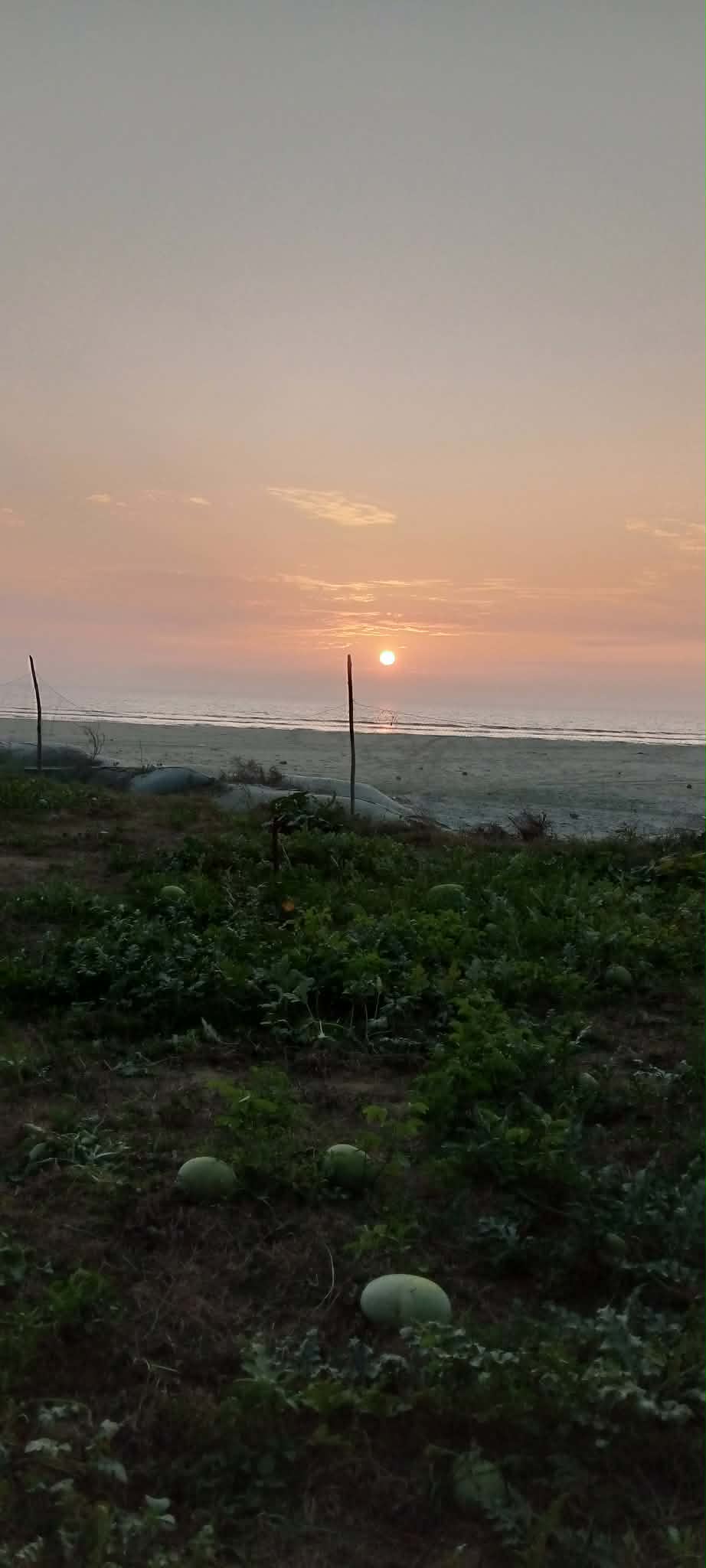
Photo: Sunrise over a watermelon field near Cox's Bazar, Milli Tami / Wikimedia Commons (CC BY 4.0)


Comments
(0)