
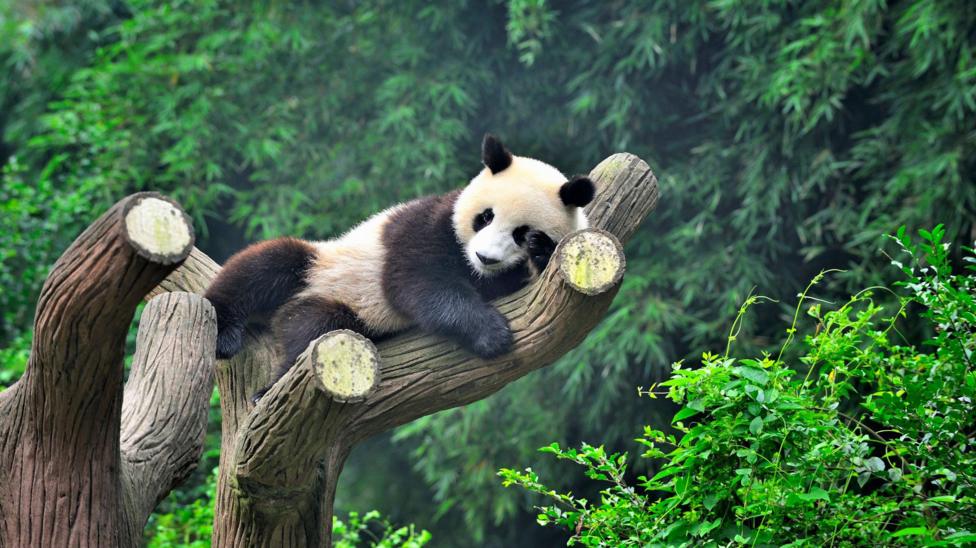
The giant panda, brought back from the edge of extinction, still breeds and lives naturally only in China. In China the black and white member of the bear family is not merely an animal but a symbol of good fortune, peace and the balance of nature.
Its build sets it apart. An adult panda is about one and a half metres long and stands roughly 90 centimetres at the shoulder, weighing up to 150 kilograms, with males slightly larger and heavier than females. Black fur covers the area around the eyes, the ears, part of the nose, the legs and the shoulders, while the thick, woolly coat over the rest of the body keeps the animal warm in cold mountain country.
Its size at birth is extraordinary. A newborn panda cub is about the size of an ear of maize — no other mammal produces young so small in relation to the mother.
The most striking thing about the panda is its diet. Although its digestive system resembles that of a carnivore, evolution has made it almost entirely herbivorous and specifically dependent on bamboo. A giant panda must eat between 12 and 38 kilograms of bamboo every day. About one percent of its diet consists of other plants and, occasionally, small animals.
Its body is equipped for the job. Broad, strong teeth and a special bone in the wrist that works like a thumb allow the panda to grip and eat bamboo with great efficiency.
That dependence is also its greatest weakness. Because the animal relies so heavily on a single plant, the destruction of its habitat — the bamboo forest — puts its existence directly at risk. When a species stands on one plant, the loss of that plant's ground is the road to extinction.
Bringing the panda back has taken more than science. Affection, commitment and a long struggle have gone into it. Children in China grow up looking at pictures of pandas, conservation workers devote their lives to protecting them, and at state level the animal is treated as national heritage.
Source: BBC Bangla

Comments
(0)