
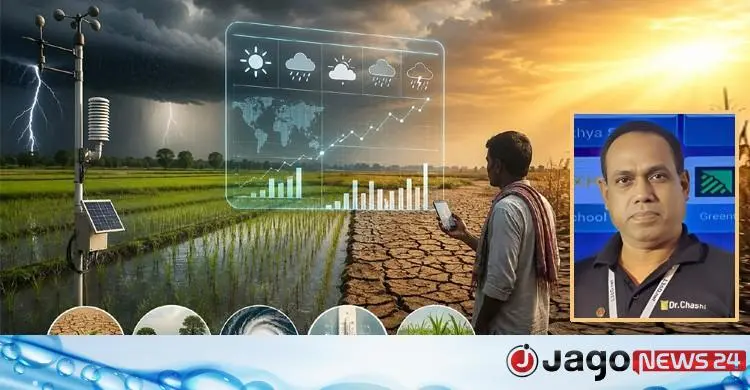
Bangladesh's agriculture faces a new reality. Climate change is disrupting the seasons with untimely rain, long droughts, heavy downpours, cyclones, hailstorms and heatwaves that can wipe out a year's work in moments. Weather forecasting technology has become an essential tool of modern farming, supporting decisions, reducing risk, raising output and helping farmers adapt.
Every step, from sowing and transplanting to irrigation, fertiliser application, spraying and harvesting, depends on accurate weather information. Forecasting is no longer limited to TV bulletins: Artificial Intelligence (AI), satellites, remote sensing, big data analytics, Doppler radar and the Internet of Things (IoT) now make more accurate, location-based forecasts possible, and farmers can check the outlook for the coming hours, days or weeks on a mobile phone.
How forecasts help farmers
- **Early warning:** alerts for heavy rain, floods, cyclones, lightning, hail or heatwaves let farmers harvest rice before rain or move vegetables, fish enclosures, livestock and machinery to safety.
- **Irrigation:** if rain is likely, unnecessary irrigation can be avoided, saving water, electricity, fuel and money.
- **Fertiliser and spraying:** knowing when rain is due prevents fertiliser being washed away and pesticides losing effect, reducing pollution.
- **Pests and diseases:** weather analysis and AI can give advance warning of likely outbreaks, supporting integrated pest management and less pesticide use.
- **Adaptation:** forecasts help farmers choose varieties, change sowing dates, adopt alternative crops or improve irrigation.
Reaching every farmer
Digital initiatives, mobile apps and SMS services already deliver weather information, but it needs to be more accurate, easier to understand and more local. Many farmers are not skilled with technology, so field training, stronger extension staff and digital literacy are essential.
The Bangladesh Meteorological Department has built an API that provides location-based, real-time forecasts for the whole country, available on its website. But most marginal farmers still cannot benefit. The writer argues the state should open this API effectively to public and private technology companies so that forecasts and early warnings can reach every farmer by app, SMS, voice service and other platforms.
What is needed
More automatic weather stations, accurate forecasting models, farmer-friendly apps, warnings in local languages, fast information exchange, and more research on agricultural meteorology, climate science and digital agriculture in universities and research institutes, through coordinated work by government, the private sector, researchers, development partners and tech entrepreneurs.
Conclusion
Weather forecasting is not just an information service but one of the most effective scientific tools for managing farm risk. If timely, accurate forecasts reach farmers, losses will fall, production will rise, food security will strengthen and a smart, climate-resilient farming system will take shape. The writer calls for agricultural weather services to be treated as a national priority.
Source: Jagonews24. First published in Bengali on The Agro News.

Comments
(0)