
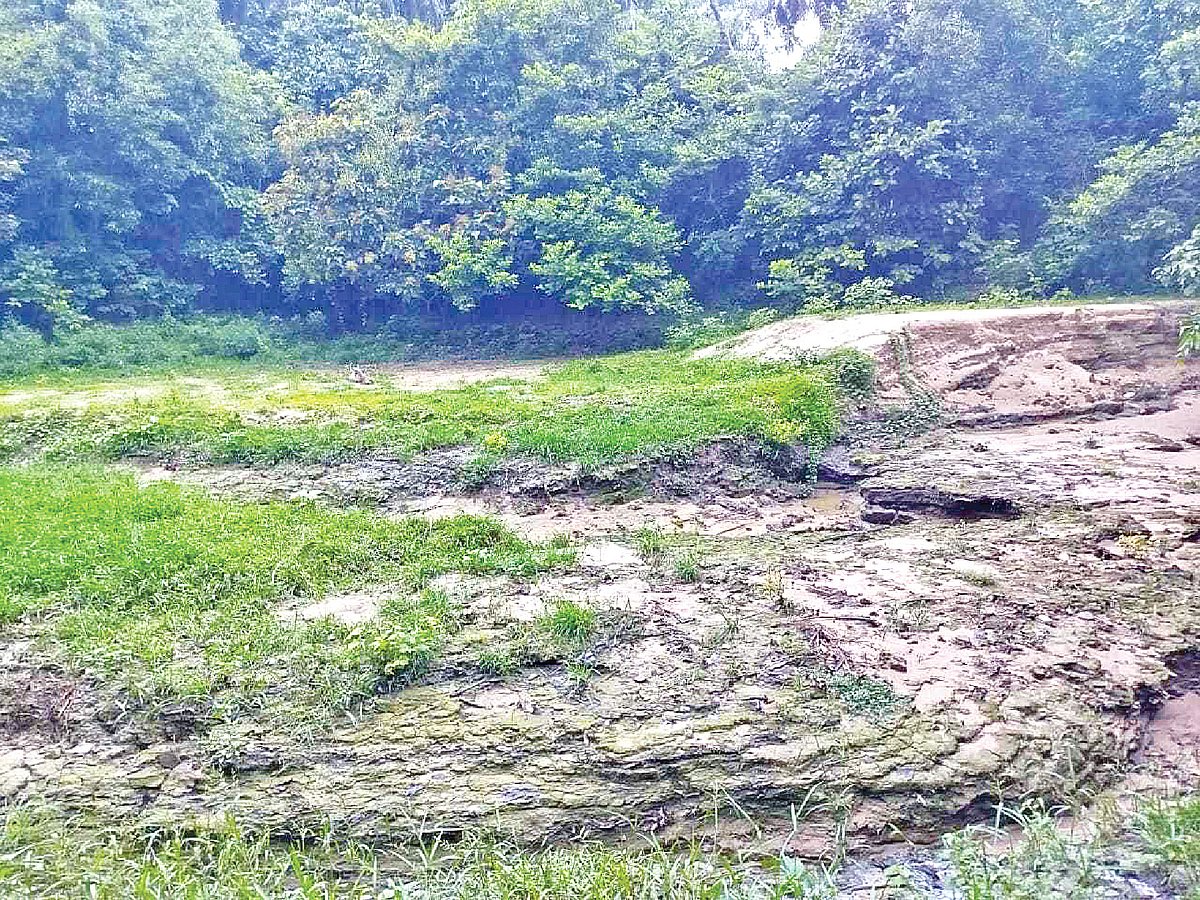
Satchari National Park in Chunarughat upazila of Habiganj took its name from seven hill streams. Four of them no longer exist, and the three that remain visible carry almost no flow. The ponds inside the forest have filled with sand and silt. Local residents, Forest Department officials and experts now fear that the park's animals will face a water shortage in the coming dry season.
The park covers 243 hectares, about 600 acres, of mixed evergreen and deciduous forest in the Raghunandan hills and was declared a national park in 2005. Forest Department records list more than 200 tree species, among them sal, teak, agar, garjan, chapalish, bamboo and cane, and about 197 animal species: some 24 mammals, 18 reptiles, six amphibians and more than 150 birds. The forest is home to the hoolock gibbon, Phayre's langur, slow loris, barking deer and fishing cat, and to birds including hornbills, junglefowl and the red-headed trogon.
On a visit on 14 September, a 10-decimal pond about 500 metres north of the Satchari forest office and a pond of about 12 decimals some 300 metres north-east of the park entrance were both found filled in. A third pond of 15 decimals deep in the forest west of the watchtower still held water, but its depth had plainly shrunk. The streams beside the BGB camp in Satchari tea estate and beside the tower are disappearing under hill sand, and the forest's main stream, which runs from in front of Tipra Palli through the Surma and Noapara tea estates to the Sutang river, has almost dried up. Deer and other wild animals once came to these ponds to drink.
Chitta Ranjan Barma, head of Satchari Tipra Palli and president of the Sylhet divisional committee of the Bangladesh Tipra Kalyan Sangha, said water appears in the streams for an hour or two after rain and then vanishes. Tofazzal Sohel, vice-president of the Habiganj district unit of Bangladesh Poribesh Andolon (BAPA), said the forest's waterbodies do more than quench animals' thirst: they underpin the breeding of frogs and insects, the food supply and the whole ecosystem, which is why re-excavating the ponds and restoring them to their former state is so important.
Mirza Mehedi Sarwar, the Moulvibazar wildlife and biodiversity conservation officer responsible for the park, sent a report to the Forest Department in July noting that several waterbodies had been damaged, that a water crisis for wildlife was likely, and that their holding capacity needed restoring and alternative sources set up. Satchari range officer Mobarak Hossain said the park needs more ponds and that the state of the waterbodies had been reported to senior officials.
Reza Khan, a specialist in wildlife, zoos and safari parks who recently toured the forests of Sylhet division, said Satchari now has the fewest streams of any of them and that the main stream beside the rest house has become a dead channel. The ponds, he said, have been filled by erosion caused by uncontrolled sand and stone extraction around the forest. He recommends renovating the existing ponds, digging several more without harming the forest, grading their banks gently so that animals can reach the water, and ensuring they hold water all year.
Residents have a further worry. Monir Mia of Chaklapunji said animals stay in the forest when there is water there and may move towards the villages when there is not, endangering the animals and frightening people; residents fear endangered species that stray out could also fall to poachers. Forest officials say re-excavating the waterbodies is not only a matter of drinking water for wildlife: trees, soil, water, birds, insects, amphibians and mammals depend on one another, and if the forest loses its water, the people around it will suffer too.
Source: Prothom Alo


Comments
(0)