
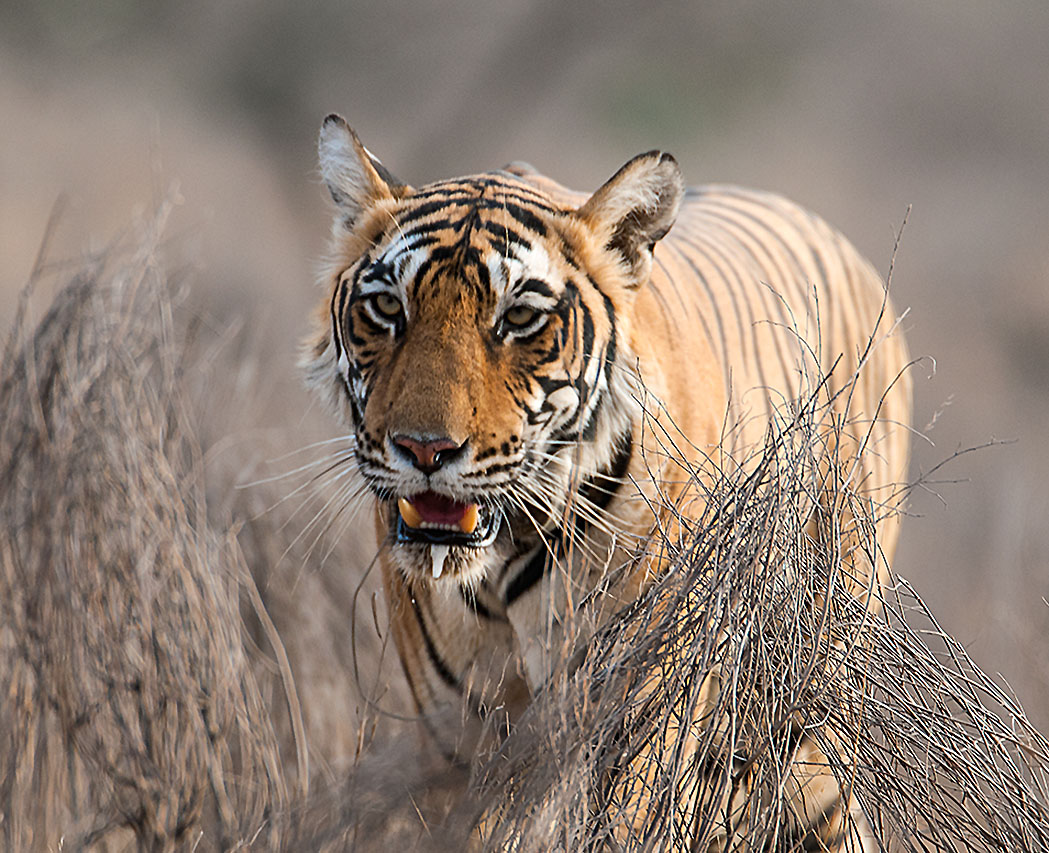
The first tigress of the project to bring tigers back to the Buxa Tiger Reserve in India's West Bengal has set off towards neighbouring Assam. Flown in from Bihar's Valmiki Tiger Reserve about 20 days ago, the three-year-old (BTR TF1) has moved steadily east from Buxa's Pachish Mile tower in the three weeks since she was released from her enclosure, covering about 390 square kilometres.
Past Jayanti and Chunia, she has reached the bank of the Sankosh river on the Bengal-Assam border. Just across the river lies the 422 square kilometre Raimona Tiger Reserve, adjoining the western core and buffer of the Manas Tiger Reserve. Raimona had one tiger when it was declared a tiger reserve in 2021 and now has at least six.
Assam's forest department said it learned on Friday night that the tigress was near the Sankosh and could cross into Raimona at any time. Mustafa Ali Ahmed, divisional forest officer of the Kachugaon division in Kokrajhar, said they had reports of her moving towards Raimona but no photographic proof yet of her presence there. West Bengal's forest department did not address the crossing directly, saying in a statement that she is healthy and roaming Buxa and the adjoining forests.
When the project began, officials of India's central forest ministry said a tigress was brought first in the hope that one of the transient tigers that pass through Buxa each winter would stay on. A male from Valmiki is provisionally due in the first week of November and another tigress after that, for the two-to-one ratio of females to male the foresters want.
She wears a radio collar with high-frequency ground tracking and satellite tracking, and a virtual triangle of her movements was drawn from GPS fixes by 60 trained forest staff working with experts from the National Tiger Conservation Authority and the Wildlife Institute of India. Ground tracking gives a near real-time position within 1-2 km, but collar data takes several hours to reach the portal by satellite, by which time a tiger may have moved. Some wildlife experts are asking why a male and female were not released together from the start.
Two years ago the tigress Zeenat, moved from Tadoba in Maharashtra to Similipal in Odisha, also wandered through Jharkhand into West Bengal; after a month she was tranquillised and sent back, and her four cubs now roam Similipal. For tiger conservation in the region, including Bangladesh's Sundarbans, such journeys show how much forest corridors and cooperation across state and national borders matter.
The report was written for Ei Samay by Shiladitya Saha and Saheli Biswas.
Photo: A radio-collared tigress at Ranthambore (representative), Koshy Koshy / Wikimedia Commons (CC BY 2.0)
Source: Ei Samay




Comments
(0)