
Chattogram, a port city of about eight million people, still has no planned sewerage. Household sewage collects in septic tanks, and about 288 million litres of wastewater a day flow through drains and canals into the rivers. To change that, the first zone of a roughly Tk 5,500 crore modern sewerage project will open next June; 78 percent of the work is done.
WASA officials expect wastewater to reach 515 million litres a day by 2030. About 539 cubic metres of faecal sludge a day collect in septic tanks, rising to some 715 cubic metres by 2030. Toilet wastewater runs through drains into the rivers and even seeps into WASA water pipes that pass through the drains.
Dhaka got a sewerage project in 1923, but Chattogram WASA, founded in 1963, has not built one in 63 years. The city has now been divided into six zones, with six sewage and two faecal sludge treatment plants planned; work on catchment 1 began in 2022.
Project director and WASA superintending engineer Ariful Islam said the first phase connects 28,000 homes in 21 wards, including Kotwali, Batali Hill, Lalkhan Bazar, Agrabad, Pathantuli, Chowmuhani, Eidgah and Halishahar, serving about two million people. More than 200 km of pipeline is being laid 5 to 15 metres underground, 135 km of it already in place.
Two treatment plants are going up on 163 acres at Chouchala in Halishahar. One will treat 90 million litres a day of piped wastewater and discharge it to the sea to environmental standards; the other will treat 300 tonnes a day of waste collected from homes by special vehicles. Engineers said the monsoon made deep pipe-laying difficult, but full work has resumed and they expect to finish by June.
Stopping raw sewage from flowing through canals and drains into the rivers will cut pollution in the city's water and rivers, to the benefit of river fish and the people who depend on river water.
The report was written for Dainik Azadi by Hasan Akbar.
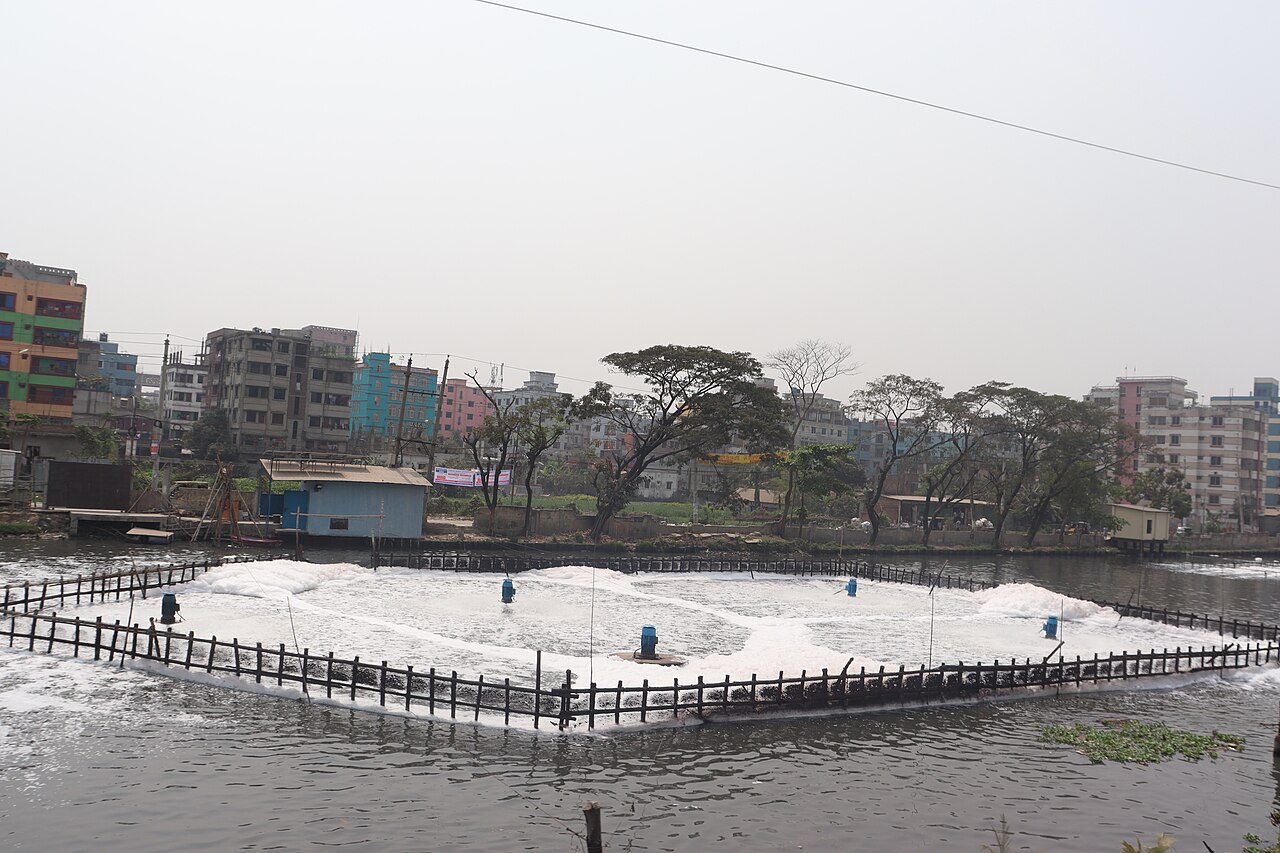
Photo: A water treatment plant on the Shitalakshya river (representative), Wasiul Bahar / Wikimedia Commons (CC BY-SA 4.0)
Source: Dainik Azadi

Comments
(0)