
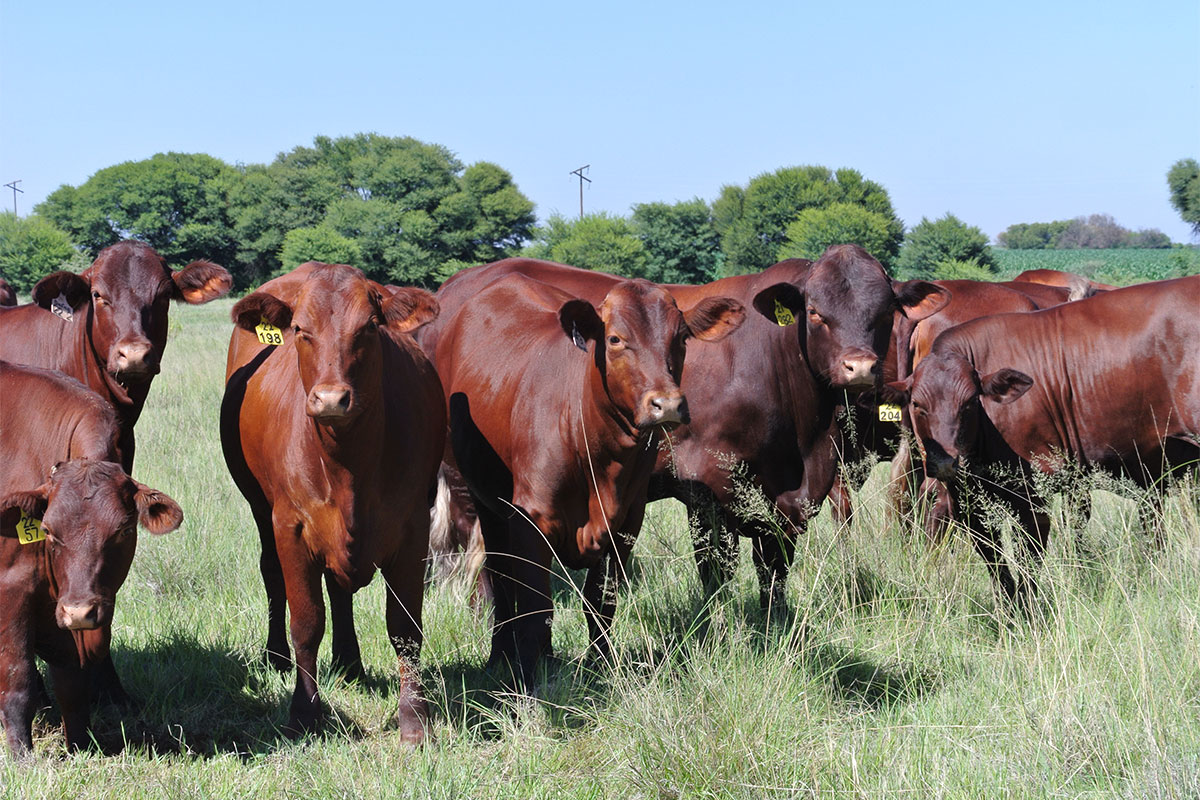
Abri Lock started Red Rock Santas in 2016 without borrowing an established stud identity, even though his family had bred Santa Gertrudis cattle in South Africa since his grandparents Apie and Annie Lock began in 1973. "I wanted the challenge of starting from scratch and building a stud under my own name," he told Farmers Weekly. Red Rock now runs alongside his father Koos Lock's Locklore Santa Gertrudis and his cousin Jozeph du Plessis's JADUP Santas on Locklore farm near Schweizer-Reneke in North West, where about 600 breeding cows are managed extensively on natural sweetveld.
The three studs keep separate registrations and cow families but share management, veld and bulls, giving each breeder a larger genetic pool without erasing its identity. "If Locklore or JADUP breeds an exceptional bull that can improve Red Rock, I want to use him, and the same applies the other way around," Lock said. Koos Lock and Du Plessis have farmed in partnership across the business since 1997.
Fertility carries the most weight in selection: growth, conformation and genetic merit cannot compensate for a female that does not reproduce efficiently. Replacement heifers must show femininity, sound feet and legs, capacity and depth, and the ability to hold condition on the veld; two structural traits are non-negotiable, enough length from hip to pin bones and adequate pelvic capacity, because a short or narrow pelvis raises the risk of calving difficulty. Bulls are judged on feet, legs, mobility, muscling, testicular development and sheath structure, and must offer growth without becoming excessively large.
Lock argues that today's Santa Gertrudis should not be judged by the large-framed type of earlier decades. Red Rock aims for medium to moderately large-framed cattle suited to extensive production, since a moderate cow costs less to maintain when grazing is under pressure from variable rainfall and long dry spells. A show title counts for little unless the champion also conceives, calves and raises a good calf every year.
The cow herd is the proof. JC 15 32, bought as a pregnant heifer from the late Johann de Wet in 2017, has produced nine calves at an average intercalving period of 361 days, five of them sold at the family's production auctions with weaning weights of 234–318 kg; LL 17 133 has eight calves at 356 days. Among sires, the nine-year-old LL 17 231 has shaped all three herds, and the bought-in bull Santarific Camo has sons and daughters entered for the family's production sale on 15 October 2026.
Bulls stay with genetically matched cow groups all year and are rotated every three months, so cows conceive when their condition and the season allow rather than in a forced short breeding season. In 2023 the combined herd recorded an average intercalving period of 411 days and a weaning rate of about 85 per cent. Continuous mating relies on disciplined records: dam, birth date and probable sire from bull movements, DNA parentage testing when needed, and BGP2 genomic testing across all three studs. Cows that repeatedly fail to conceive, run long intercalving periods, lose a calf or develop structural faults are culled.
Lock regards adaptability as the Santa cow's most valuable trait under South African conditions and sees the breed as a maternal line for commercial herds; local Bonsmara breeders who tried Santa bulls have come back for more and added pure heifers. Estimated breeding values, performance records and DNA sharpen mating decisions, he said, but do not replace visual appraisal or knowledge of the cow families: "The numbers must support what we see in the animal, and the animal must support what we see in the numbers."
Reported by Hanlie du Plessis for Farmers Weekly.
Source: Farmers Weekly South Africa
Comments
(0)