
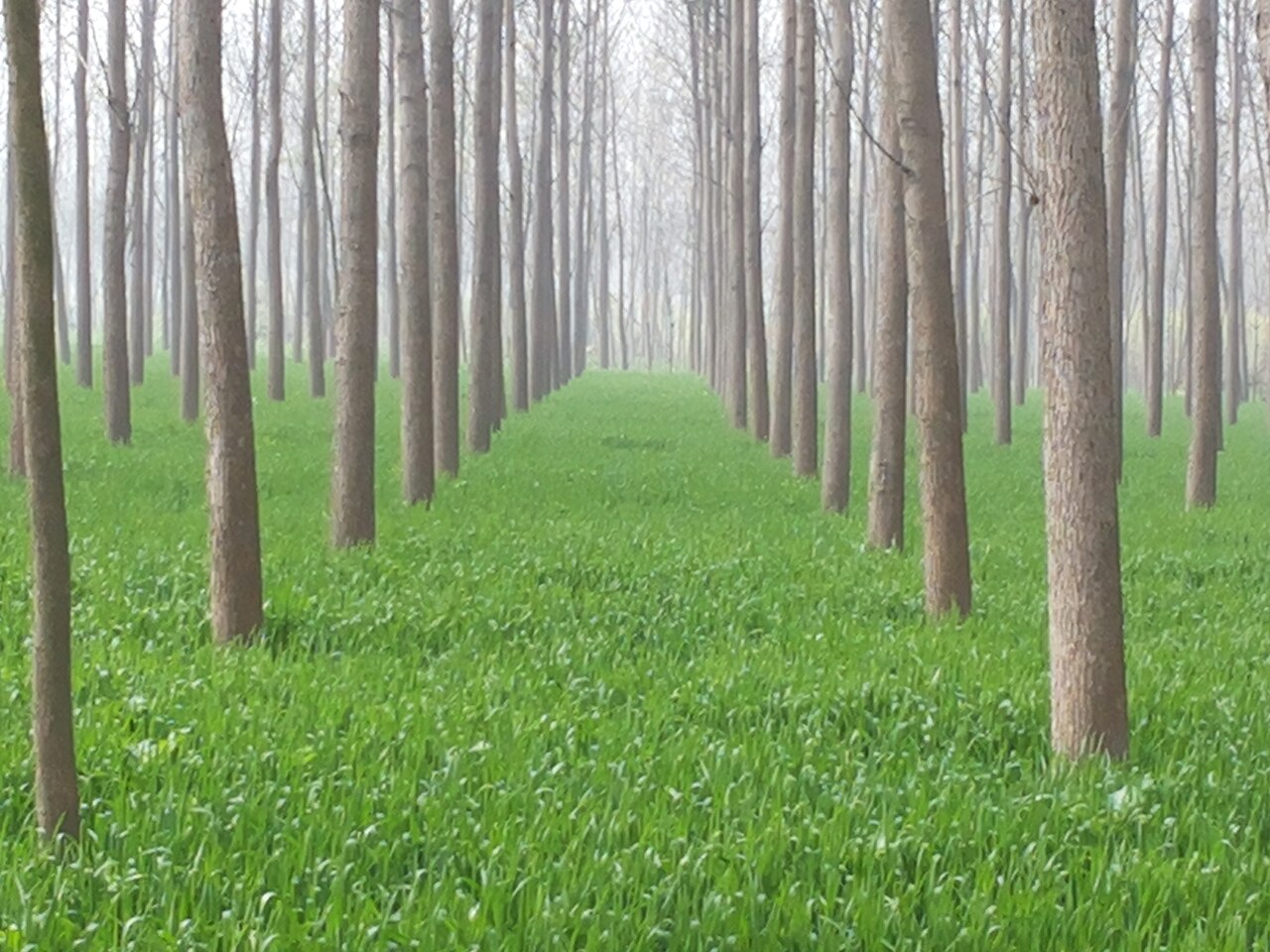
Trees straighten a bent stem by growing a pulling kind of wood first on one side and then on the other, much as animals use opposing muscles to hold their posture, researchers working with France's National Research Institute for Agriculture, Food and Environment (INRAE) have found. The study appears in the journal New Phytologist and was released on 31 October.
In 2012 INRAE researchers showed that plants, like animals, sense their own shape, an ability called proprioception. What remained unknown was how that sense is turned into movement. Plants also respond to gravity and to the direction of light, so the team built a device to take those two signals away: young trees were set on a horizontal platform turning around its own axis, inside a sphere lit equally from every direction.
The experiment began with young poplars laid on their side. As they grew, their stems curved upward, driven by tension wood, a special wood that pulls as it forms and that grew along the upper side of the stem. After about ten days, once a clear curve had formed, the trees went into the device. Over the following weeks the curved stems slowly straightened until they were nearly straight again.
When the researchers examined the wood, they found that the first band of tension wood had stopped forming once the device was switched on, and that the same kind of wood had begun to form on the opposite side, pulling the other way. Until now tension wood was thought to form only on the upper side of a stem. The results suggest that the tree's sense of its own shape decides where tension wood is laid down.
The authors say the finding matters for forests facing storms and landslides, which bend and displace trees. Plants with an especially good sense of their own shape could be selected for straighter growth and better timber. In farming, the same knowledge could help breed cereals less likely to fall over before harvest, the problem known as lodging, which can cause large yield losses late in the season.
"What we have uncovered is a genuine sensorimotor loop operating in the woody parts of trees," said Bruno Moulia, an INRAE research director. Poorly coordinated tension wood, he said, leaves excessive internal tension that can harm wood quality. The paper is by Alexandre Caulus, Félix P. Hartmann, Éric Badel, Stéphane Ploquin, Nicole Brunel-Michac, Julien Ruelle, Mélanie Decourteix and Bruno Moulia.
Photo: Bahar Ahmad Khan / Wikimedia Commons (CC BY-SA 4.0)
Source: ScienceDaily (Agriculture & Food), from material provided by INRAE




Comments
(0)