
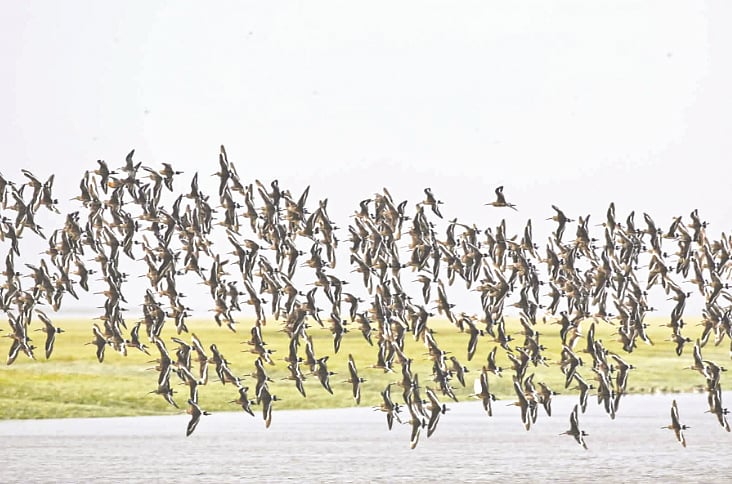
The chars rising in the Meghna estuary where the river meets the Bay of Bengal have become an important refuge for migratory waterbirds. A recent survey of Jahaijjar Char, Dobachar, Bhasanchar, Thengar Char, Ganguirar Char, Islam Char and Caring Char in Noakhali recorded 52 species of waterbird, 46 of them migratory and 14 globally threatened. The Forest Department and Nature Conservation Management (NACOM), with World Bank funding, surveyed the chars in five rounds between November 2025 and April 2026.
The survey found the critically endangered spoon-billed sandpiper — a single bird on Ganguirar Char in December 2025. Only 280 to 620 survive worldwide; 48 were found in the same area in 2015-16 under the Spoon-billed Sandpiper Conservation Project, but sightings on the Bangladesh coast have since fallen. Other endangered or vulnerable migrants recorded include the Indian skimmer, great knot, lesser sand plover, curlew sandpiper, broad-billed sandpiper, Eurasian curlew, black-tailed and bar-tailed godwits, Asian dowitcher, dunlin, black-headed ibis, painted stork and red knot.
More than 32,000 birds were counted across the seven chars in January 2026. Ganguirar Char held the most birds and Jahaijjar Char the most species, while Dobachar emerged as a newly identified site with more than 12,000 birds. A flock of 1,338 Indian skimmers — of a global population of just 2,450 to 2,900 — was seen regularly, and 9,000 black-tailed godwits and 1,507 Eurasian curlews were notable finds.
Abdur Rob Mollah, former professor of zoology at Dhaka University and chairman of NACOM, said the six-month study through winter and early summer shows the chars of the Ganges delta to be globally important for the survival of migratory birds.
NACOM wildlife researcher Shoeb Ali explained that the Ganges-Brahmaputra-Meghna delta fills the coastal mudflats with invertebrates — worms, crabs, snails and shellfish — and abundant fish, making them ideal feeding grounds for migratory waterbirds.
The threats are clear. Fellow researcher Naim Khandaker said the unrestricted movement of the many people who farm and graze cattle on the chars must be controlled, since some of them hunt birds when they can, and the countless 'charpata' fishing traps on the mudflats are shrinking the birds' range. A ten-year conservation action plan has been prepared under the project to address these problems.
Source: Prothom Alo
Comments
(0)