
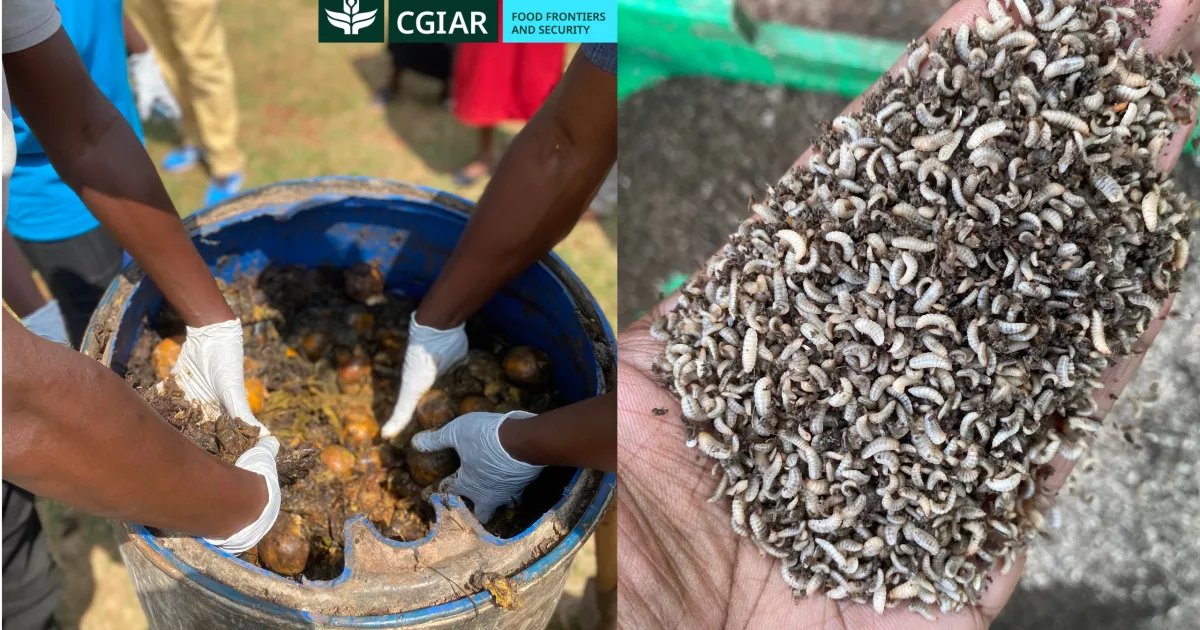
Three schools in Nairobi and a farmers' hub on the city's edge have harvested their first crop of black soldier fly larvae from organic waste, in a pilot that turns a disposal problem into animal feed and fertiliser. The World Vegetable Center (WorldVeg) and the International Institute of Tropical Agriculture (IITA), with partners Zehunger Solutions and icipe, are running the trial under the CGIAR Food Frontiers and Security Science Program.
Nairobi generates around two and a half tonnes of organic waste a day from kitchens, schools, farms and informal markets, most of it ending up in dumpsites. Across Africa, up to 40% of food is lost or wasted along informal urban supply chains, which cuts farmers' incomes, pushes up prices and deepens nutritional insecurity among low-income urban households.
The process is simple. Organic waste is separated at source, fed to larvae of the black soldier fly (Hermetia illucens), the larvae are harvested as a protein-rich feed for livestock, and the residue, known as frass, goes back to the soil as fertiliser. The pilot runs at Tassia School, Umoja 1 Primary School, Clanne Academy and the Kogongo Area Farmers Hub in Ruaka.
The schools first received collection bins and training for pupils, teachers and 4K Club patrons on separating organic from inorganic waste. They were then given biopods and taught feeding, substrate preparation, hygiene, monitoring and harvesting. In May and June 2026, five-day-old larvae were introduced, three kilograms to each biopod, with kitchen waste collected by the pupils as the main feedstock. At Kogongo, farmers use waste from nearby markets and from their own livestock.
The first production cycle yielded 19 kilograms of larvae at Tassia, 16 kilograms at Umoja and 15 kilograms at Clanne Academy, which went to feed poultry. The schools have since raised larvae output by 30% to 60% and are preparing a third cycle with improved feeding, biopod maintenance and record keeping. Demonstration plots compare spinach grown with crude, granulated and pelletised frass against spinach grown without it, so that farmers can see which formulation works.
At Kogongo, farmers are testing different waste streams and watching how their animals respond. "My pigs love the larvae so much they fight over them," said Purity, one of the participating farmers. Poultry keepers reported the same eager acceptance of live larvae by chickens, pointing to a locally produced feed at a time when bought feed is a heavy cost for small producers.
"Scaling innovation is not simply about replicating a technology; it is about adapting solutions to the people, resources and conditions of each place," said Dr. Cecilia Limera, Programs Lead for Africa and Country Representative at the World Vegetable Center. The partners say the next step is to document what works and refine a model that schools, farmers and youth groups in other fast-growing African cities can adopt.
Source: CGIAR
Comments
(0)