
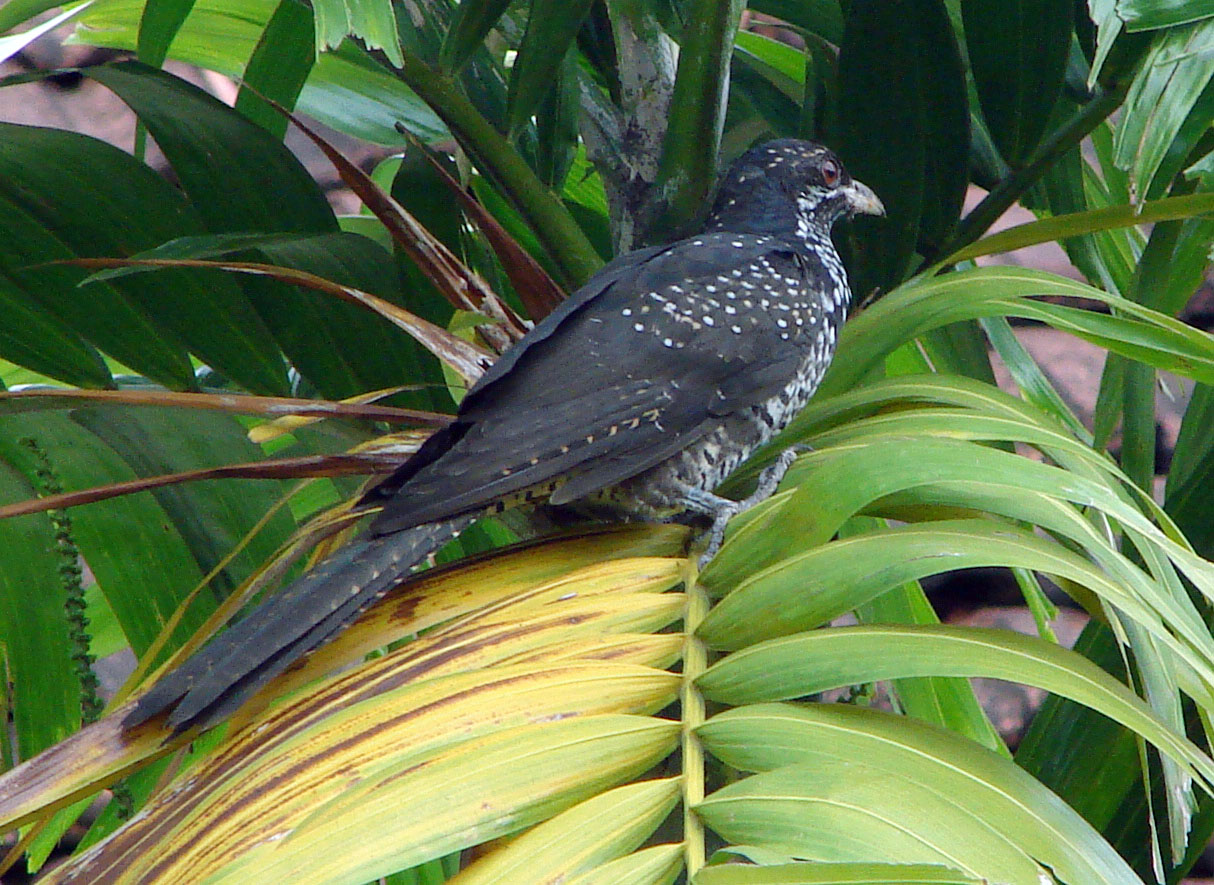
One mid-October morning Dr A N M Aminur Rahman, a specialist in bird and wildlife breeding and medicine, took his camera around the Gazipur Agricultural University campus looking for birds. In a piece for Desh Rupantor he describes a jet-black bird with blood-red eyes sitting quietly on a dead branch in the amla (Indian gooseberry) garden of the forestry and environment faculty, joined within half a minute by a brown bird spotted with white. The black one was the male, the speckled one the female.
The feathers around both birds' beaks were ruffled, wet and stained red. The reason soon became clear: below the amla garden grow dragon fruit plants, planted for research, heavy with fruit, some of it ripe and bright red. The female came down, ate an entire ripe dragon fruit at leisure and hopped across to the next one while he photographed and filmed her.
The birds were Asian koels (Eudynamys scolopacea), a familiar resident bird in Bangladesh. The writer recalls that in 2016, while teaching veterinary students to identify wildlife at Chittagong Veterinary and Animal Sciences University's coastal biodiversity centre at Dariyanagar in Cox's Bazar, he learned that local people call the bird kaksayer. An old man explained: "They are black like crows and sing beautifully."
An adult koel is 40 to 43 centimetres long and weighs 190 to 327 grams. The male is black with a green sheen and a shiny green bill; the female is brown with countless white spots and streaks and a pale grey bill. Both have bright red eyes and black legs. Koels live across the Indian subcontinent, South and Southeast Asia and Australia.
Koels are mostly solitary, love ripe fruit of all sizes and keep to the shade of leaves. The male sings its rising ku-kuu call while the female stays silent. They breed from March to August without building nests: the female lays two or three bluish eggs in the nests of crows, treepies or common mynas. The eggs hatch in 12 to 13 days, the chicks fly in 18 to 20 days, and a koel can live more than four years.
Photo: Hafiz Issadeen / Wikimedia Commons (CC BY 2.0)
Source: Desh Rupantor

Comments
(0)