
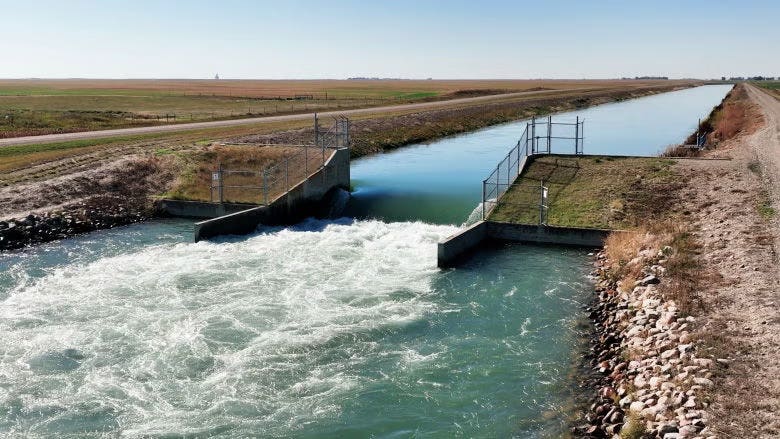
Standing at the edge of a newly lined canal in Shymkent, the farmer Atabek Kozhabekov totted up his harvest. "This year we planted cotton. Seedling counts rose. Compared to last year, productivity is 50 percent higher." He is now taking 6,500 kilograms of cotton from a hectare.
His field is one of hundreds of thousands across southern Kazakhstan reshaped by the Second Irrigation and Drainage Improvement Project, IDIP-2, through which the government has rehabilitated and modernised irrigation and drainage infrastructure with World Bank support.
The scale is not modest. Across the Kyzylorda, Zhambyl, Turkistan and Almaty regions, the project relined 812.6 kilometres of canals, rebuilt 2,325 kilometres of earthen secondary canals and repaired more than 28,800 hydraulic structures. Irrigation and drainage services improved on over 100,000 hectares of farmland.
Some of the change is in the instruments rather than the concrete. At a site in Kyzylkum, Pavel Grasmik of AKELIC Group pulled out a tablet and demonstrated remote pump controls that would have been unimaginable a decade ago. Water-level and pressure sensors feed a central server continuously.
Across 147 kilometres of canals at that site alone, real-time monitoring has replaced reactive manual management. The system can anticipate a problem before it arrives, operators are freed for other work, and water losses that once went unnoticed are caught as they happen.
Not every answer was high technology. Where canals run close to houses and heavy machinery cannot reach, engineers laid a bitumen geomembrane lining that can be installed in hours and lasts for years — a reminder that the cheapest fix is sometimes the one that fits the site.
The project also created work. As water arrived more reliably, jobs followed in building and maintaining the canals and in the agribusinesses nearby. "We hired specialists from this village and young workers from outside," said Nurkenbay, whose company built drainage infrastructure and pumping stations. "They worked well, delivered results, and gained valuable experience."
The results feed into Kazakhstan's wider water agenda, aligning with its new Water Code, the Concept for the Development and Management of Water Resources 2024–2030 and its Green Economy Transition — which is why the government treats IDIP-2 as a model to repeat rather than a one-off repair.
Source: World Bank

Comments
(0)