
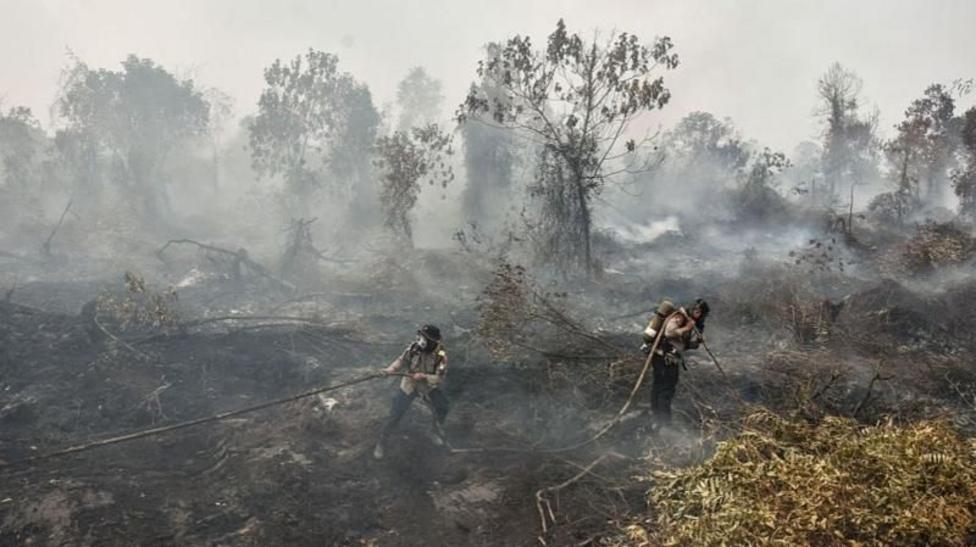
Indonesia has spent the week fighting severe wildfires, and the toxic smoke they produce has spread into parts of Malaysia and the Philippines. Hundreds of thousands of people on Sumatra and in Kalimantan, the Indonesian part of Borneo, have already been affected.
The fires start with a standard method of preparing farmland. Through Indonesia's dry season, from July to October, growers frequently use fire to clear land for palm oil cultivation and for pulp and paper production. It is a cheap way to ready a field, but in dry weather the fires often spread out of control, including into protected forest in Kalimantan and Sumatra.
Clearing land by burning is illegal in Indonesia, yet the practice continues. The Indonesian government has acknowledged that the fires are largely lit deliberately by individuals or corporations. President Prabowo Subianto said recently that he would take firm action against those responsible.
The health toll is already heavy. More than 50,000 people have been admitted to hospital in Indonesia with respiratory infections. The dense haze is also hampering the response, making cloud-seeding and aerial firefighting operations difficult. Authorities have deployed several thousand officials to prevent new fires and to protect wildlife.
Neighbouring countries have issued warnings. In Sarawak, the Malaysian part of Borneo, the air pollution index has reached "unhealthy" levels in several areas. Authorities in Kuching, Samarahan, Serian, Sri Aman and Betong have suspended in-person classes. Muhammad Fazli bin Daud, a Sarawak resident, said he was worried because the haze was "getting more intense day by day".
The weather has made matters worse. These fires turn especially fierce during an El Nino dry season, and a super El Nino this year is thought to have deepened the disaster.
Singapore has also said it is watching air pollution. Many are recalling the fires of 2013 and 2015, when the city was covered in haze for weeks, schools were closed and N95 masks ran short. Singapore had avoided the smoke in recent years because Indonesia had brought its annual fires somewhat under control.
Source: BBC Bangla

Comments
(0)