
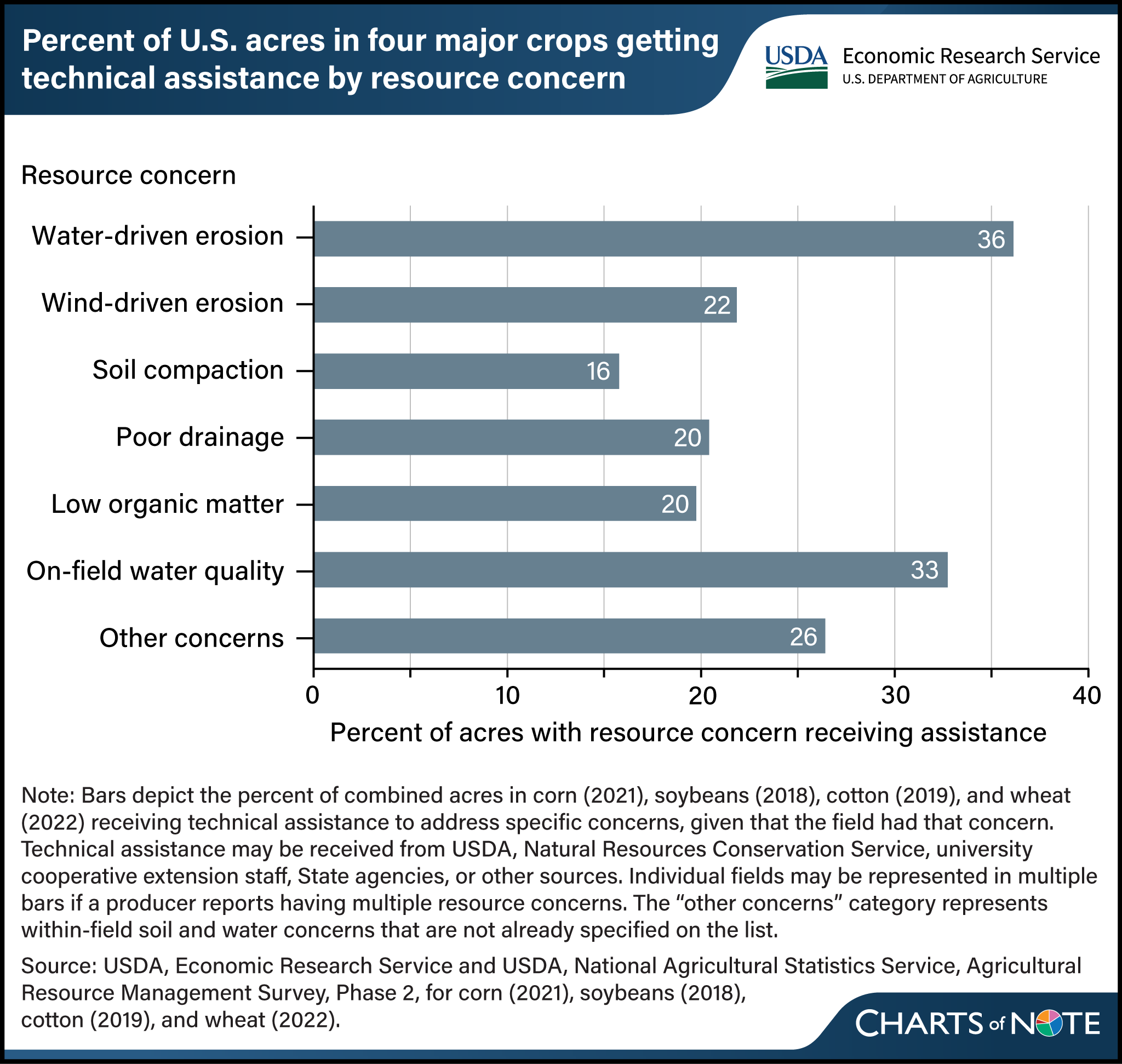
When American farmers seek help with a damaged natural resource, they are far more likely to receive it for erosion and water quality than for anything else, USDA's Economic Research Service has found.
The agency starts from what it calls a resource concern: a point at which management practices have degraded something a farm depends on — soil above all — badly enough to impair the land's sustained productive use. Where that happens, a producer can seek targeted technical assistance, meaning personalized guidance on how to farm the problem back out.
Examining survey data from producers who sought that assistance, ERS researchers Andrew B. Rosenberg and Kate Binzen Fuller found that water-driven erosion drew the most. Thirty-six percent of corn, soybean, cotton and wheat acres affected by it received technical assistance.
On-field water quality came next at 33 percent of affected acres, and wind-driven erosion at 22 percent.
Most of that advice comes from one place. USDA's Natural Resources Conservation Service is the most common provider for on-field resource concerns, either directly or through third-party technical service providers it reimburses. University cooperative extension staff, state agencies and other sources make up the rest.
The unevenness is the finding. Two problems attract roughly a third of the available help while others attract far less, which tells whoever designs a conservation programme where the guidance is reaching the field and where it is not.
Resource concerns are one of five trends examined in the ERS report Status and Trends of USDA Conservation Programs, 2002–2025, published in March 2026.
Source: USDA Economic Research Service

Comments
(0)