
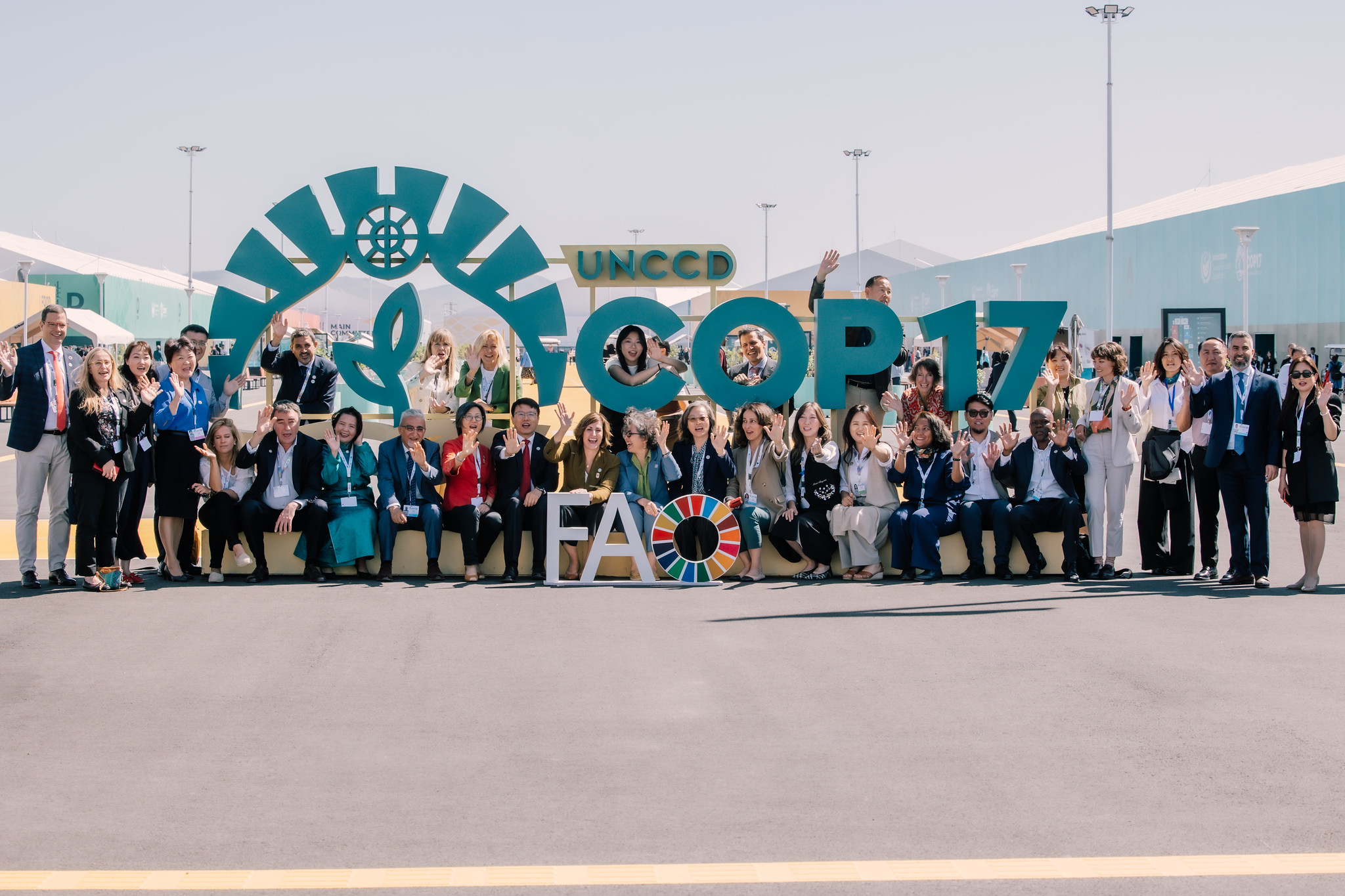
Of the 1.66 billion hectares of land worldwide affected by human-induced degradation, more than 60 percent — over a billion hectares — is agricultural land. That figure framed the Food and Agriculture Organization of the United Nations (FAO)'s work at the 17th Conference of the Parties to the UN Convention to Combat Desertification (UNCCD COP17), held in Ulaanbaatar under the theme "Restoring Land. Restoring Hope".
Without restoring agricultural land, FAO argued, global goals on land degradation neutrality, biodiversity, climate change and Zero Hunger cannot be met — and preventing further degradation matters as much as restoring what has already been lost.
The conference fell during the UN International Year of Rangelands and Pastoralists 2026, and rangelands took a central place. Through the launch of the Rangelands Flagship Initiative, FAO contributed to mobilising $1.2 billion in pledges across 45 projects, five of them designed and led by the Organization.
"Restoration cannot simply mean making degraded land green again. What grows matters," said Deputy Director-General Beth Bechdol. "The diversity and quality of grasses, forage and other vegetation matter — for livestock, biodiversity and the long-term productivity and health of these ecosystems." On finance she added that how capital is deployed counts as much as how much: "We must use available resources more effectively, combining public and concessional finance, mobilizing private capital where it makes sense, and using each investment to leverage more."
FAO supported a global consultation that produced three declarations carrying pastoralist voices into the high-level forum: the Global Pastoralist and Indigenous Pastoralists' Call for Action, the Global Declaration of Young Pastoralists and a Pastoralist Women Declaration.
On soils, FAO and UNCCD jointly launched Living Soils, Productive Lands, Resilient Landscapes — guidance on avoiding, reducing and reversing agricultural land and soil degradation — alongside the Status of the World's Soil Resources 2026 report, which prompted Parties to call for greater attention to soils. Lifeng Li, Director of FAO's Land and Water Division, told the conference that agriculture can be part of the answer to sand and dust storms, which affect over 150 countries and cost billions a year by damaging crops, trees and livestock.
Parties decided that drought will remain a stand-alone agenda item at COP18 and every ordinary session thereafter. The Riyadh Global Drought Resilience Partnership advanced a proposed pooled fund of up to $400 million for around 70 vulnerable countries, with FAO a registered partner helping countries access it, and FAO positioned itself as a potential co-lead for the GEF-9 Integrated Program on Dryland and Drought Management, with a proposed allocation of $126 million.
COP17 also deepened FAO's work with the host country. Around 80 percent of Mongolia's land is rangeland and nearly 77 percent is affected by degradation; FAO held high-level talks with the government on rangeland management, pastoral livelihoods and emerging agricultural sectors. A roundtable for Landlocked Developing Countries launched an Asian LLDC ministerial network covering Afghanistan, Bhutan, the Lao People's Democratic Republic, Mongolia and Nepal.
Source: FAO Newsroom

Comments
(0)