
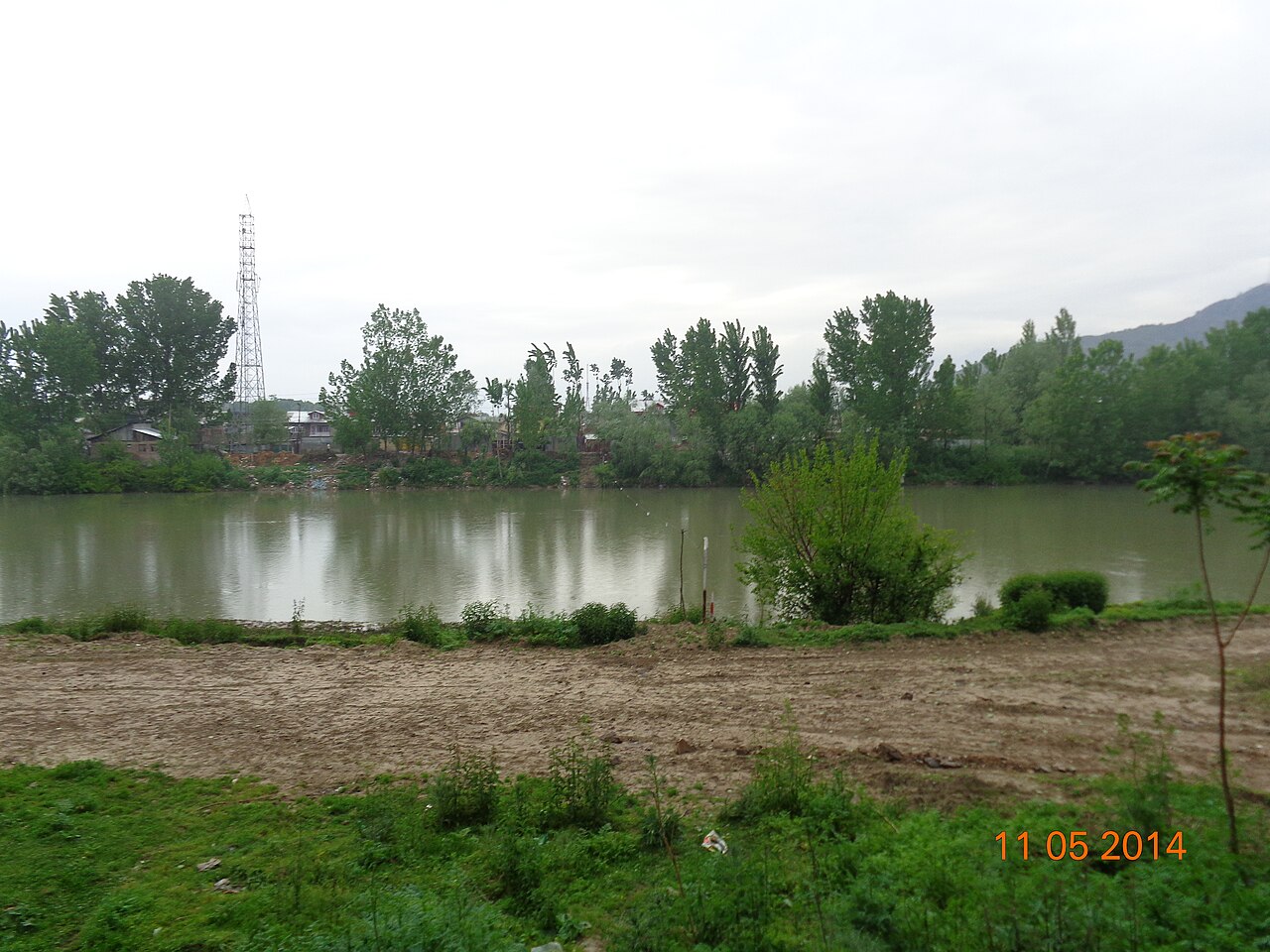
Households in uptown Srinagar are going days without piped water as Doodh Ganga, the river that supplies much of the area, comes under pressure from climate change and construction, Insha Shirazi reports in Down To Earth.
Residents of Bagh-e-Mehtab and Pir Bagh describe erratic supply that worsens in summer, with taps dry for up to four consecutive days. Families have installed storage tanks and hand pumps to reach groundwater, at growing cost; one resident said the water that does arrive is sometimes not clean.
Doodh Ganga, also called Chazz Kul, is a tributary of the Jhelum. It rises in the Pir Panjal glaciers near Tattakoti peak at about 4,500 metres and runs about 45 kilometres through Budgam and Pulwama before reaching Srinagar. A 2024 study in the International Journal of Hydrology Science and Technology found that 122 Pir Panjal glaciers shrank from 25.7 square kilometres in 1980 to 15.9 square kilometres in 2020, with south-facing glaciers between 3,800 and 4,000 metres retreating fastest.
Shakil Romshoo, earth scientist and vice chancellor of the Islamic University of Science and Technology, called the signs of climate change "very loud and clear". Snowfall in the upper reaches has declined over four or five decades, winters are warmer, and snow that once melted gradually from April to July now often melts in February and March, he said, while high-intensity rain brings flash floods.
Construction has added to the strain. In Srinagar the river once split into two channels; over three decades the Batamaloo channel was buried under buildings, parks and bus stops, and in the September 2014 floods the water followed that same low-lying route. Raja Muzaffar Bhat of the J&K Climate Action Group warned that cloudbursts and heavy rain could raise flooding and contamination, and Anbreena Anjum, a superintending engineer with Jal Shakti, said reduced flow has already affected supply in dry periods.
Photo: Dvellakat / Wikimedia Commons (CC BY-SA 4.0)
Source: Down To Earth

Comments
(0)