
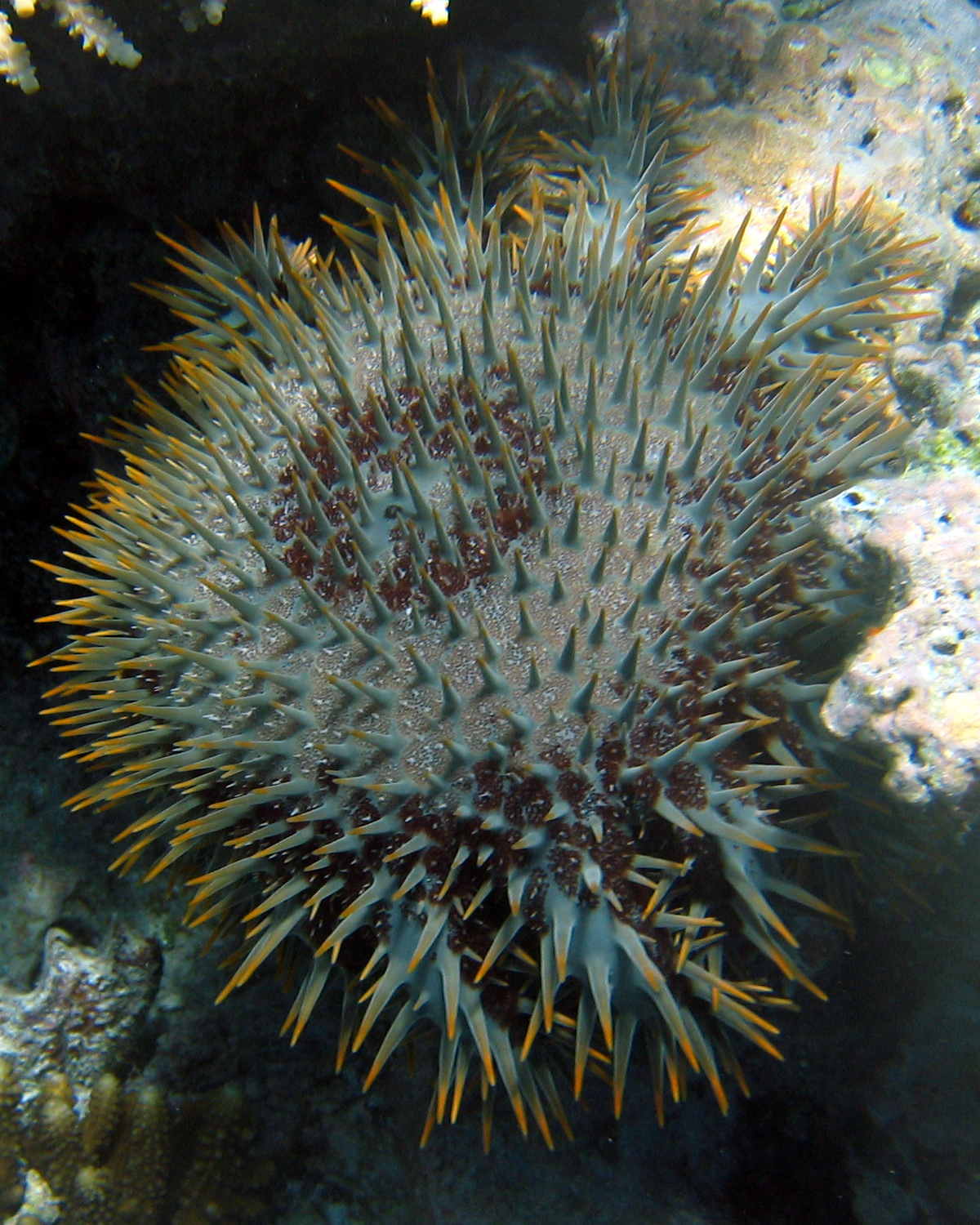
The crown-of-thorns starfish, long blamed for stripping Australia's Great Barrier Reef of coral, may do the reef some good when its numbers are low, according to a study by researchers at the University of Sydney published in the journal Ecology and Evolution.
The team, led by Dr Shawna Foo, a University of Sydney Horizon Fellow in the School of Life and Environmental Sciences, watched the starfish feed around the university's One Tree Island Research Station. The sites lie in protected parts of the reef where fish populations are healthy and starfish are relatively few.
In nearly 75 per cent of the feeding events they observed, living coral tissue survived. The starfish seemed to eat a fairly fixed amount at each sitting and then move on, rather than killing whole colonies.
Their favourite food was fast-growing Acropora corals. By grazing on these, starfish at low density appear to open up space for slower-growing corals. The researchers found that damaged fragments of the fast-growing Acroporidae did not grow back over the eaten areas, while regrowth came mostly in slower-growing Montipora and Porites corals.
Professor Maria Byrne, a co-author, said the results fit the intermediate disturbance hypothesis, the idea that a moderate level of disturbance stops any one species from taking over and so keeps a community diverse.
The researchers stressed that outbreaks remain a serious threat. The Great Barrier Reef has suffered four major crown-of-thorns outbreaks since the 1960s, roughly one every 15 years, and the loss of the starfish's natural predators, such as triton snails and some reef fish, has left it more exposed.
Their conclusion is that once an outbreak has been brought under control, the aim need not be to wipe the starfish out altogether. Culling, they said, should go hand in hand with strong marine management that protects the animals that prey on the starfish.
The other authors of the paper are Matthew Clements, Adi Zweifler, Georgie Eggleton and Hayden Millican.
Photo: Matt Wright / Wikimedia Commons (CC BY 2.5)
Source: ScienceDaily Agriculture & Food


Comments
(0)