
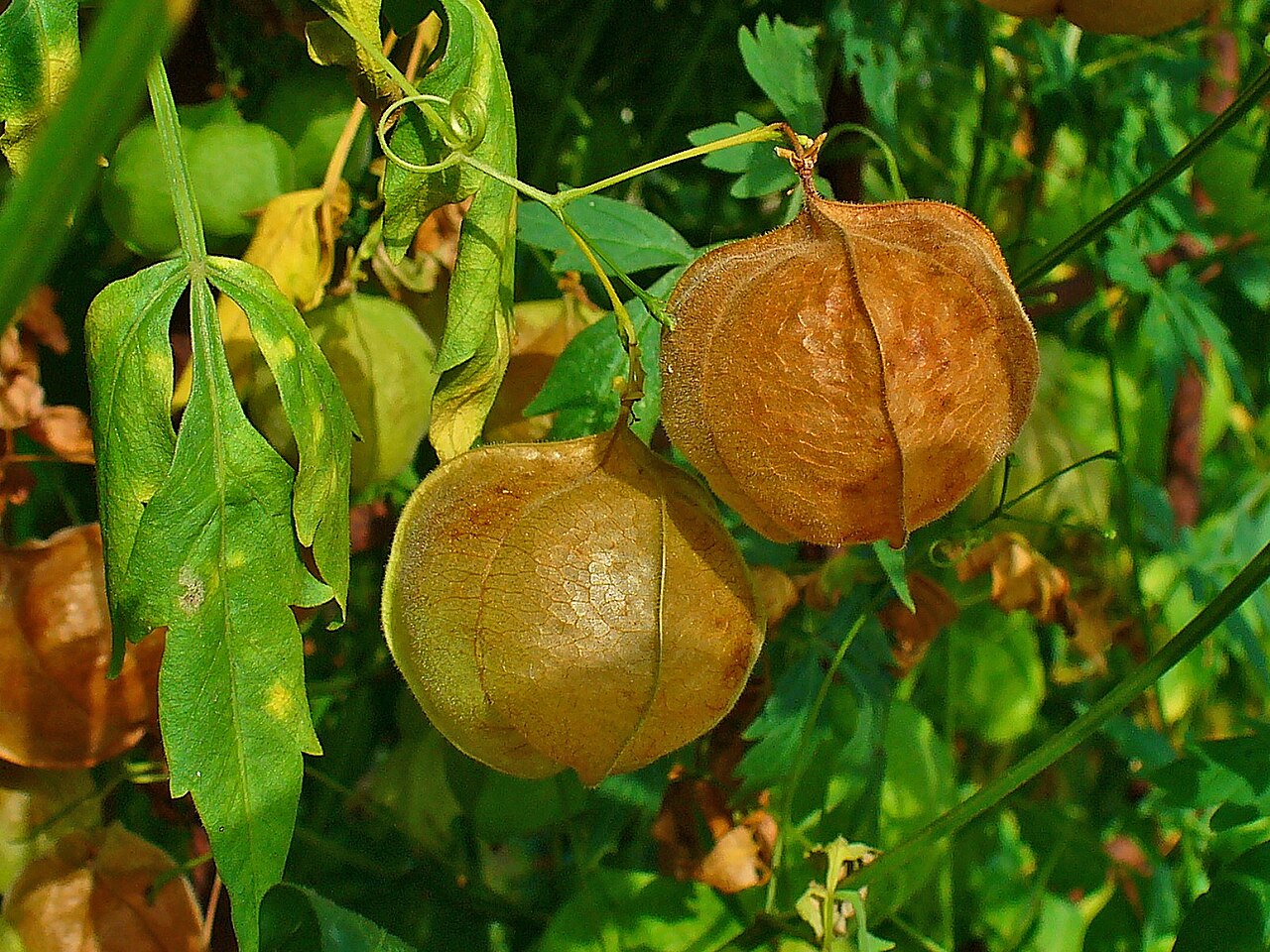
The haors change with the seasons, and their variety of plants changes with them. Mokarram Hossain, who writes on nature and the environment, often goes to Tanguar Haor in Sunamganj in search of it. In an article for Desh Rupantor he described finding latafutki there.
After about an hour and a half by engine boat from Solemanpur bazar, he stopped at a hijal forest and found a wild rose bush beside hurhuri and ghagra plants. Then came a walk along the embankment next to the Golabari camp. This side of the haor is quiet, with long rows of hijal, koroch and barun trees and a dense tangle of vines on the slope beside them. There he found the flowers and fruit of a rare wild strawberry, and next to it a trailing vine with fruit that looked like phatka.
Phatka is a herb, the writer notes, but this plant was a climber; he had seen something very similar at the Brooklyn Botanic Garden in New York. Back in Dhaka, botanical books identified it as latafutki (Cardiospermum halicacabum), known locally as phutka, kopalphutki, noaphutki and kanphutki. It springs up naturally every year once the haor water dries.
Latafutki is an annual or perennial vine. Its leaves are divided into three, on stalks 2-4 cm long. The tiny flowers are 2 to 3.5 mm, with four green sepals marked with red and eight stamens. The fruit is a three-lobed, rounded capsule 1.5 to 4 cm across, green with a reddish base and hairy, holding small, black, smooth seeds. It flowers and fruits from November to June.
The writer says its young shoots are eaten as a vegetable, and that folk medicine has various uses for its roots, seed oil and leaves. Those uses are not tested treatments, and it should not be used for any illness without a doctor's advice.
Vines and wild plants that come up on their own in the haor's dry season are part of Tanguar's wetland ecosystem, and deserve the same protection as its hijal and koroch forests.
Photo: Balloon vine fruit, H. Zell / Wikimedia Commons (CC BY-SA 3.0)
Source: Desh Rupantor


Comments
(0)