
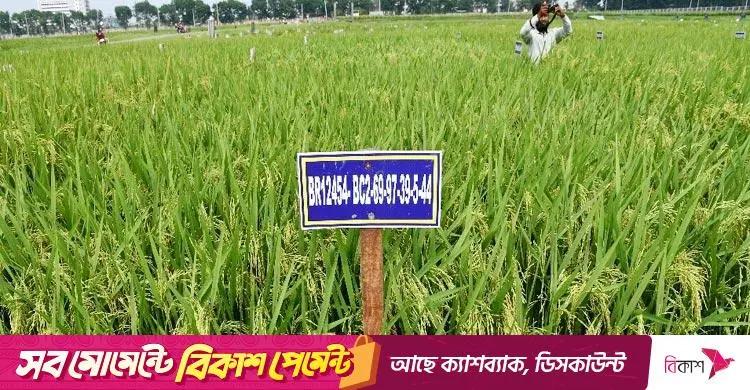
The National Seed Board (NSB) has approved three more rice varieties developed by the Bangladesh Rice Research Institute (BRRI): one salt-tolerant, one high-yielding Boro variety and one resistant to blast disease. The meeting on Wednesday (18 June) was chaired by Agriculture Secretary Dr Mohammad Emdad Ullah Mian and attended by BRRI Director General Dr Mohammad Khalequzzaman. BRRI has now developed 121 varieties, eight of them hybrids.
BRRI dhan112: salt-tolerant Aman
BRRI dhan112 is a salt-tolerant, medium-duration transplanted Aman variety with a more erect flag leaf than the widely grown BRRI dhan73. Depending on salinity, it yields 4.14 to 6.12 tonnes per hectare, one to one and a half tonnes more than its parent BRRI dhan73. It matures in 120 to 125 days and grows 103 to 105 cm tall, with sturdy, lodging-resistant stems. Each panicle carries about 210 filled grains, 80 to 90 more than BRRI dhan73, because of the Gn1a gene. The rice is medium slender and white, and cooks fluffy.
It tolerates salinity of 12 dS/m at the seedling stage for up to three weeks and 8 dS/m at all salt-sensitive stages from vegetative growth to reproduction. Grains do not shatter easily. Its shorter duration will allow sunflower and salt-tolerant mustard to follow on medium-high to high land in coastal saline areas.
BRRI dhan113: a BRRI dhan29 alternative
BRRI dhan113 is a high-yielding, medium-slender Boro variety released as an alternative to the popular BRRI dhan29. Its flag leaf is erect, broad and long and stays green at maturity. Plants are 102 to 105 cm tall and resist lodging, and it matures in 143 days on average. A thousand grains weigh 19.4 grams; the white rice looks similar to Nizershail, with 28 per cent amylose and 8.4 per cent protein. In trials it outyielded BRRI dhan88 by 11.5 per cent, averaging 8.15 tonnes per hectare and up to 10.1 tonnes under good management.
BRRI dhan114: blast-resistant Boro
BRRI dhan114 is a long-duration Boro variety resistant to blast. It has an erect, broad, long flag leaf, dark green leaves and sturdy stems. It yields 7.76 tonnes per hectare on average and up to 10.23 tonnes with good care. The grain is medium bold and golden, and its 149-day life cycle matches the popular BRRI dhan89. A thousand grains weigh 17.4 grams, with 27 per cent amylose and 7.7 per cent protein. It carries the dominant blast-resistance gene Pi9 and showed a high level of resistance (score 0) under artificial inoculation.
Source: Jagonews24. First published in Bengali on The Agro News.
Comments
(0)