
Highly pathogenic avian influenza has been confirmed in commercial poultry at farms in North Lincolnshire, England, and the Scottish Borders within two days, according to the Department for Environment, Food and Rural Affairs (Defra) and the Animal and Plant Health Agency (APHA). The cases are near Brigg and Biggar.
Authorities have declared a 3 km protection zone and a 10 km surveillance zone around each farm, and all poultry on both are being humanely culled. Industry estimates put the Lincolnshire farm, a commercial duck operation, at around 64,000 birds, though the official notification gives no count.
The UK season formally began on 1 October and now stands at three H5N1 cases and one H5N5. England has two H5N1 cases, Scotland one of each strain, and Wales and Northern Ireland none. The first was in Scotland in early October, followed by an H5N1 case near Belford in North Northumberland on 19 October.
Because of the recurring detections, the UK is no longer classed as free of highly pathogenic avian influenza under World Organisation for Animal Health reporting rules. Defra and APHA rate the risk in wild birds across Great Britain as medium. They rate the risk to poultry as low where biosecurity is suboptimal and very low where stringent measures are applied consistently.
Neither England nor Scotland has a nationwide order to house birds indoors, on the latest guidance, though keepers in and around the zones face movement and biosecurity restrictions. The UK Health Security Agency says the risk to public health is very low, and the Food Standards Agency says properly cooked poultry and eggs remain safe to eat.
Autumn and winter wild bird migration typically raises the risk of the virus reaching commercial flocks. Authorities are urging all keepers, down to small backyard flocks, to control access to bird housing, clean and disinfect footwear and equipment, and keep contact with wild birds to a minimum.
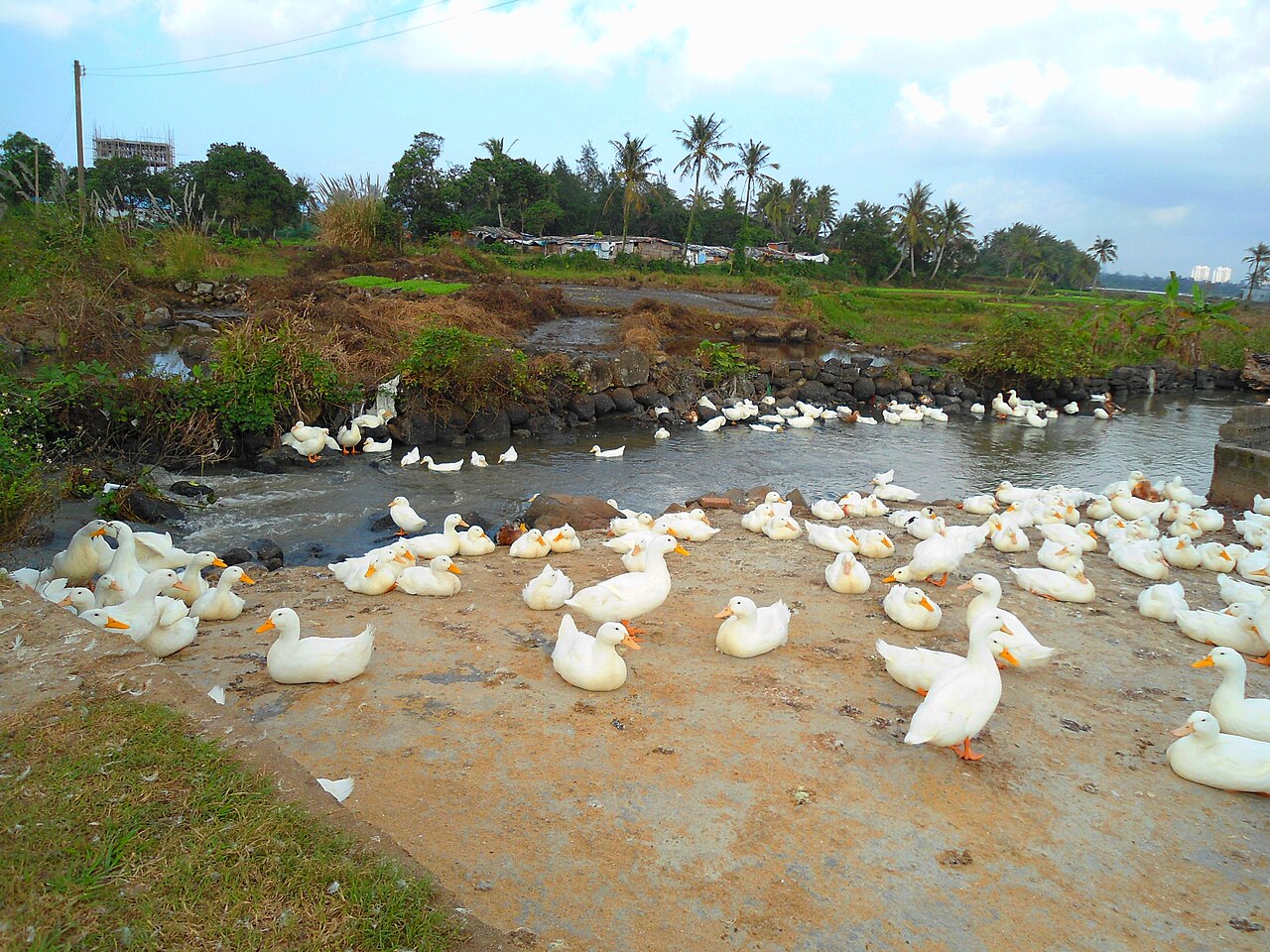
Photo: Anna Frodesiak / Wikimedia Commons (CC0), a duck farm, not the farm in this report
Source: Global Agriculture

Comments
(0)