
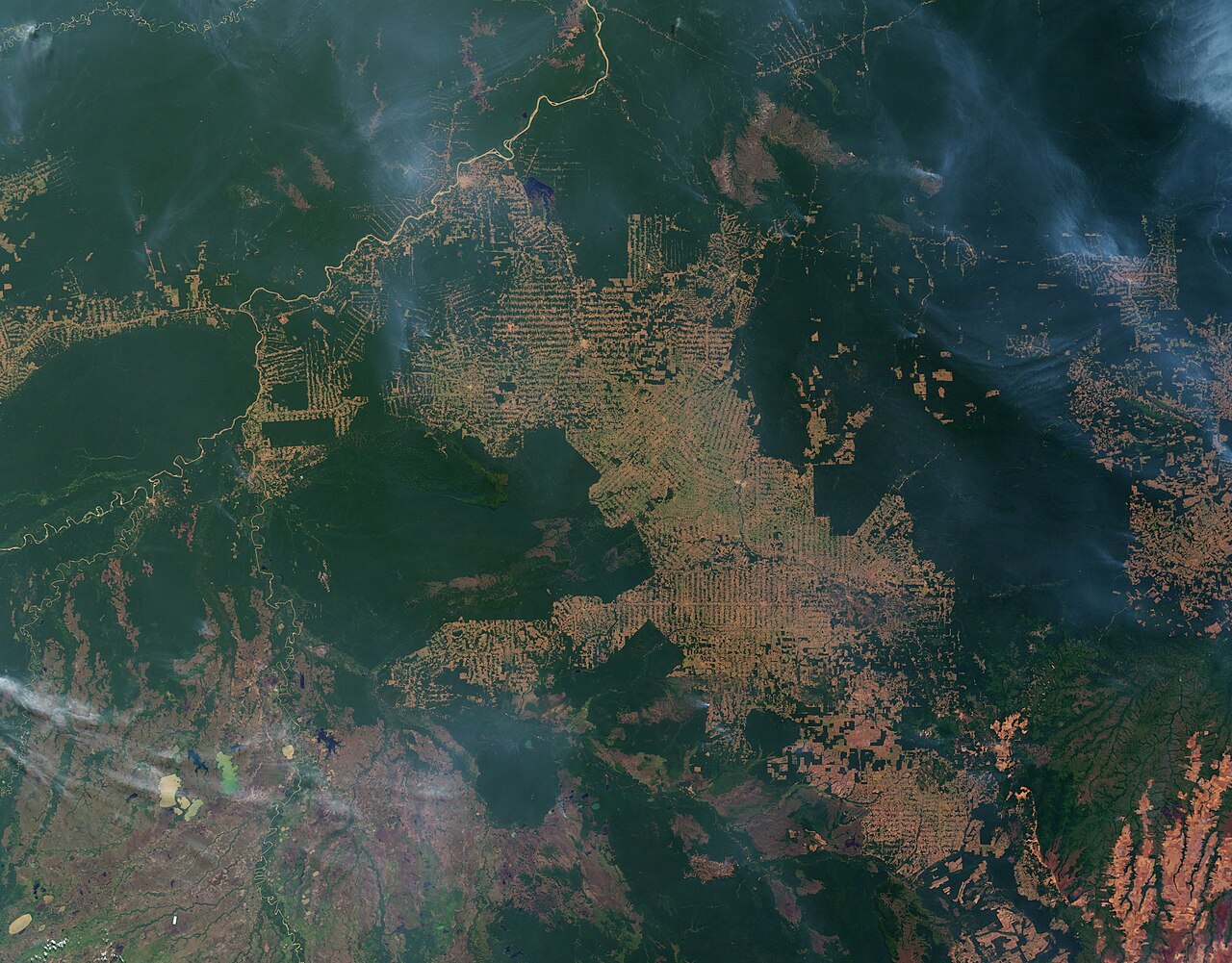
Deforestation in Brazil's Amazon has fallen to its lowest level in nearly four decades. Official figures released on Friday, 16 October, show 3,335 square kilometres of Amazon forest cleared between August 2025 and July 2026, about 42 percent less than the year before and the lowest since records began in 1988, Naya Diganta reports.
The official rate is measured by PRODES, a satellite-based system run by Brazil's National Institute for Space Research. Deforestation has fallen every year since 2022, by 71.2 percent in total over four years, which officials put down to tighter monitoring and stiffer penalties for illegal logging. From 2019 to 2022 some 11,600 square kilometres were cleared, about 60 percent more than in the previous four years, as land was cleared for cattle ranching and illegal mining.
"This is an incredibly big fall," Environment Minister Joao Paulo Capobianco told a news conference in Brasilia. President Luiz Inacio Lula da Silva repeated his goal of ending illegal deforestation completely by 2030.
There was good news too from the Cerrado savanna south of the Amazon, where 5,517 square kilometres of native vegetation were destroyed over the same period, about 24 percent less than a year earlier and the lowest since records began there in 2001.
About 60 percent of the world's largest tropical rainforest lies in Brazil, and it plays a major role in absorbing greenhouse gases. Marcio Astrini, executive secretary of the Climate Observatory, a network of more than a hundred civil society groups, called the figures a "historic victory" and said they show that with political will both chainsaws and emissions can be cut.
Photo: Jesse Allen and Robert Simmon (NASA) / Wikimedia Commons (public domain)
Source: Naya Diganta


Comments
(0)