
After the Aman rice harvest, vast areas of land in southern Bangladesh lie fallow because salt in the soil and water makes other crops hard to grow. Now sunflower grown without tillage using the dibbling method has succeeded on such land. The Bangladesh Institute of Nuclear Agriculture (BINA) sub-station in Satkhira is working to spread this new technology among farmers across the south-west.
Field evaluation
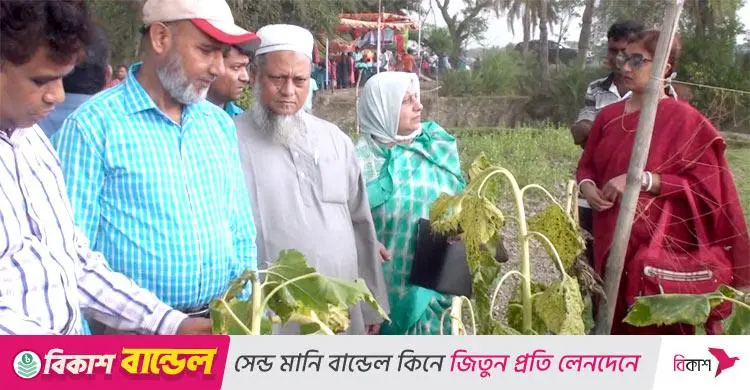
As part of BINA's research, a field evaluation and promotion meeting on zero-tillage sunflower after transplanted Aman in saline areas was held on the afternoon of 17 April in Shahosh union, Dumuria upazila, Khulna. It was chaired by Dr. Md. Harunur Rashid, chief scientific officer of the Bangladesh Agricultural Research Council (BARC), with BARC executive chairman Dr. Nazmun Nahar Karim as chief guest.
Special guests included BINA director (administration and support services) Dr. Md. Azizul Haque, DAE additional director Md. Rafiqul Islam, PCU-BARC programme director Dr. Md. Ashraful Alam, scientific officer Dr. Md. Jamal Uddin, Khulna DAE deputy director Md. Nazrul Islam, BINA Satkhira sub-station in-charge Dr. Shilpi Das and Dumuria upazila agriculture officer Md. Insad Ibne Amin.
How it was done
Officials explained that after the Aman harvest in mid-November, sunflower seed was sown in the moist soil by dibbling. The base of the seedlings was then earthed up and fertiliser applied. Three varieties were used in the research, a local variety, BARI Sunflower-2 and Hysun-33, and all of them bore heads, with Hysun-33 giving the best yield.
"Sunflower is a salt-tolerant crop, so there is huge potential for it on saline land in Khulna, Satkhira and other areas," said Dr. Nazmun Nahar Karim. "We are supporting the agriculture department through research to encourage farmers to grow sunflower."
Source: Jagonews24. First published in Bengali on The Agro News.



Comments
(0)