
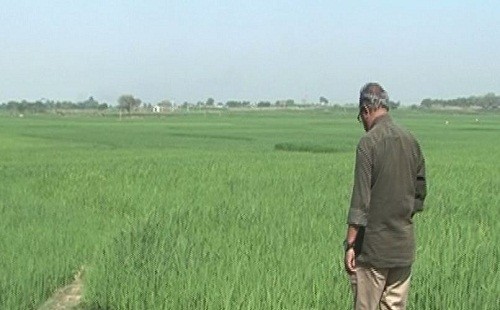
Drought is increasing in the north and the groundwater table is falling. To cope, farmers in Rajshahi's Barind region have begun growing rice without tillage. They say the method halves the cost of growing rice, and scientists urge spreading it along with drought-tolerant rice varieties.
"They called me mad"
The method is entirely new. Young farmer Shafiqul Islam Kalu of Bijoynagar, Godagari upazila, said that when he first planted rice this way, everyone called him mad. His mother came and asked why he had not planted rice; he said he already had, without ploughing, but the seedlings were too small to see.
Half the cost, same yield
Another Bijoynagar farmer, Abul Khair, said tilled land costs 6,500 taka a bigha, while zero-tillage land costs 3,500 taka. Kalu said costs are lower and yields are the same.
How it is done
Kalu first sprayed herbicide to kill the grass, then released water from a deep tube well. A day later, when the soil softened, labourers transplanted seedlings in lines marked with rope, with no ploughing or even levelling. Farmers recommend the drought-tolerant BRRI dhan56 or BRRI dhan57; Kalu has grown BRRI dhan57 for two years.
Less water
Dr Elias Hossain, chief scientific officer at the Regional Agricultural Research Institute, Rajshahi, said their research shows land needs 6,000 litres of water before transplanting under tillage, but only 2,000 litres without it; the field is simply soaked a day before planting. Scientists say spreading this resource-saving method to drought-prone areas is a need of the time, and it could make rice profitable for farmers elsewhere too.
Source: Shykh Seraj, Hridoye Mati O Manush. First published in Bengali on The Agro News.
Comments
(0)