
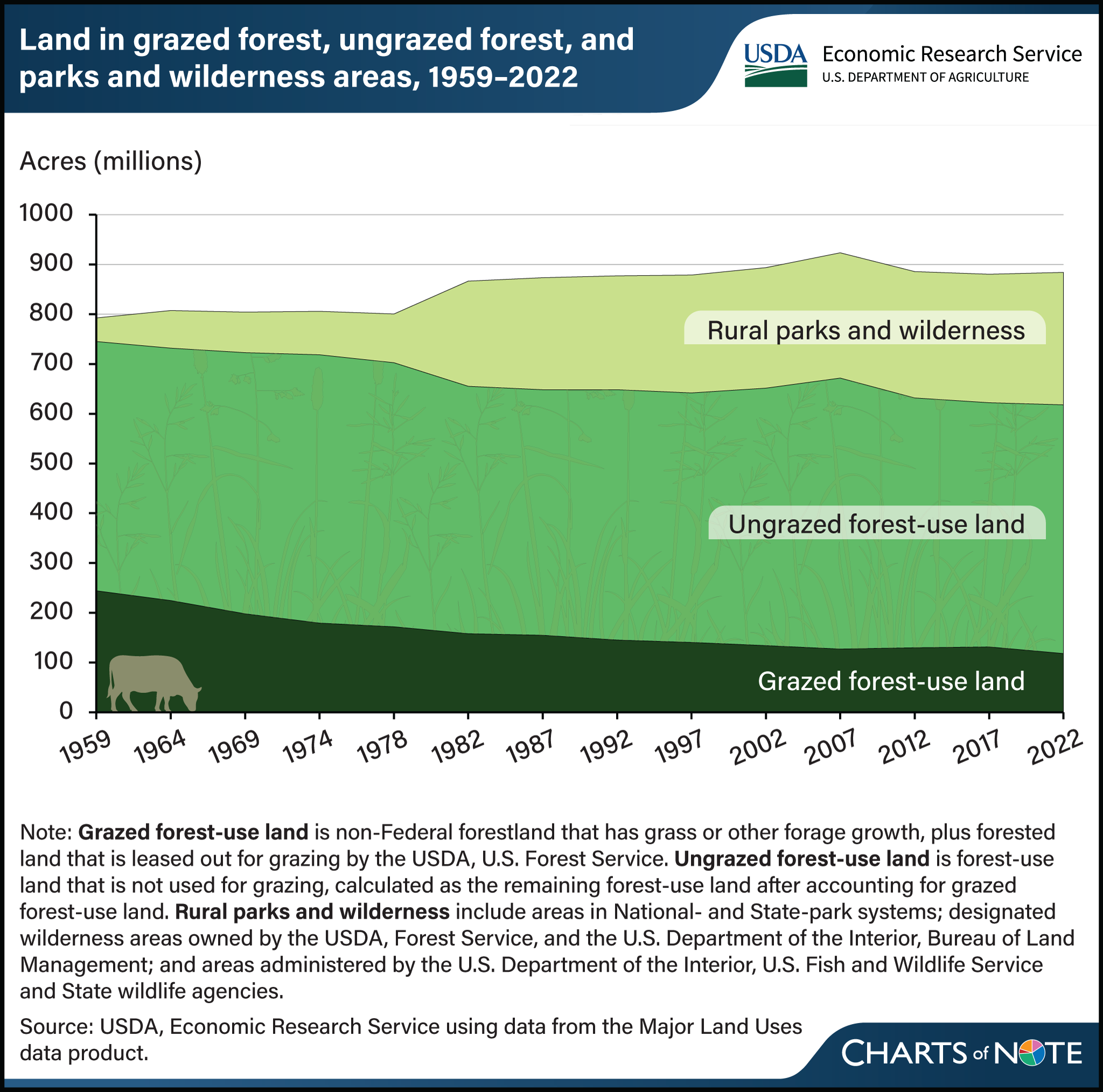
Forest land in the United States used for grazing livestock has fallen by roughly half in six decades, while land set aside in rural parks, wildlife reserves and wilderness areas has kept growing, according to a chart published by the US Department of Agriculture's Economic Research Service (ERS).
Grazed forest-use land, which ERS defines as non-federal forest with forage or forest leased for grazing, stood at 245 million acres in the late 1950s. By 2022 it was down to 118 million acres. Over the same period, the acreage in rural parks, wildlife reserves and wilderness grew steadily, reflecting additions to federal and state protected systems and other conservation designations.
Forest land that is not grazed stayed broadly stable, with modest swings that ERS attributes to changes in how timberland is classified rather than to wide changes in land cover. Taken together, forest land of all three kinds has increased over the last 60 years.
ERS reads the trends as a shift in purpose: more forested acres are now managed mainly for recreation, habitat and preservation, and fewer for livestock grazing.
Grassland pasture and range remained the largest single land-use category in the country in 2022. Protected lands made up a growing share of what ERS calls "special uses" land, a category that also covers rural roads and airports, farmsteads, and national defence and industrial areas.
The chart is drawn from the ERS Major Land Uses series, updated in August 2026.
Source: USDA Economic Research Service
Comments
(0)