
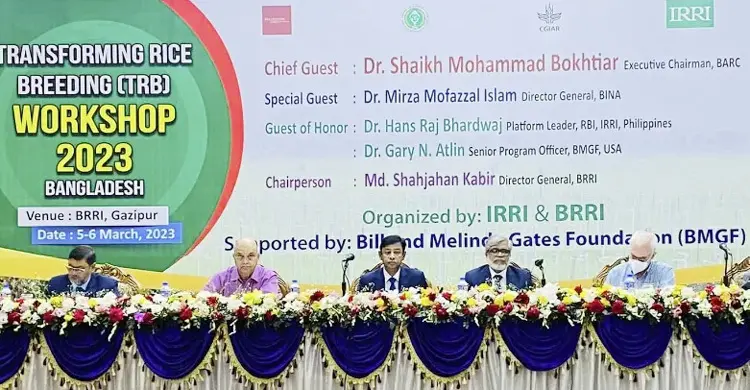
The time needed to develop a new rice variety is being cut by five to seven years using the latest technology. What used to take 10 to 15 years can now be done in 8 to 10 years, scientists said at a two-day workshop on Transforming Rice Breeding (TRB) at the Bangladesh Rice Research Institute (BRRI).
The workshop, organised jointly by IRRI and BRRI, was held on Sunday, 5 March, at BRRI's central auditorium in Gazipur. It was chaired by BRRI director general Md. Shahjahan Kabir, with Dr. Sheikh Mohammad Bakhtiar, executive chairman of the Bangladesh Agricultural Research Council, as chief guest. Special guests were BINA director general Dr. Mirza Mofazzal Islam, IRRI platform leader Dr. Hans Raj Bhardwaj and Dr. Gary Atlin, senior programme officer at the Bill & Melinda Gates Foundation (BMGF).
How the project works
Funded by BMGF with technical support from IRRI, the TRB project uses the latest technology to shorten variety development. Modernising research will greatly increase genetic gain in future varieties, and BRRI's capacity to develop varieties tailored to location, market and farmer demand has grown, the director general said. Alongside TRB, BRRI is using speed breeding to shorten development time further.
Results so far
BRRI director (research) Dr. Mohammad Khalequzzaman, who presented the keynote, said TRB will allow the maximum yield ceiling to be surpassed, and third-level high-yielding, high-quality varieties are being developed.
- 277,938 fixed lines have been developed according to location, market and farmer demand, from which new varieties can be continually released.
- Using a backcross strategy, a genetic line producing 850 filled grains per panicle has been developed and is now in its eighth generation, which could lead to even more productive varieties.
Dr. Khondoker Md. Iftekharuddaula, chief scientific officer and head of BRRI's Plant Breeding Division, presented TRB's progress, and Dr. Md. Hasanuzzaman Rony presented on behalf of BINA. IRRI Bangladesh senior plant breeder Dr. Rafiqul Islam gave the welcome address. More than a hundred scientists from BRRI, BINA, IRRI and agricultural universities, public and private seed producers and journalists took part.
Source: Jagonews24. First published in Bengali on The Agro News.
Comments
(0)