
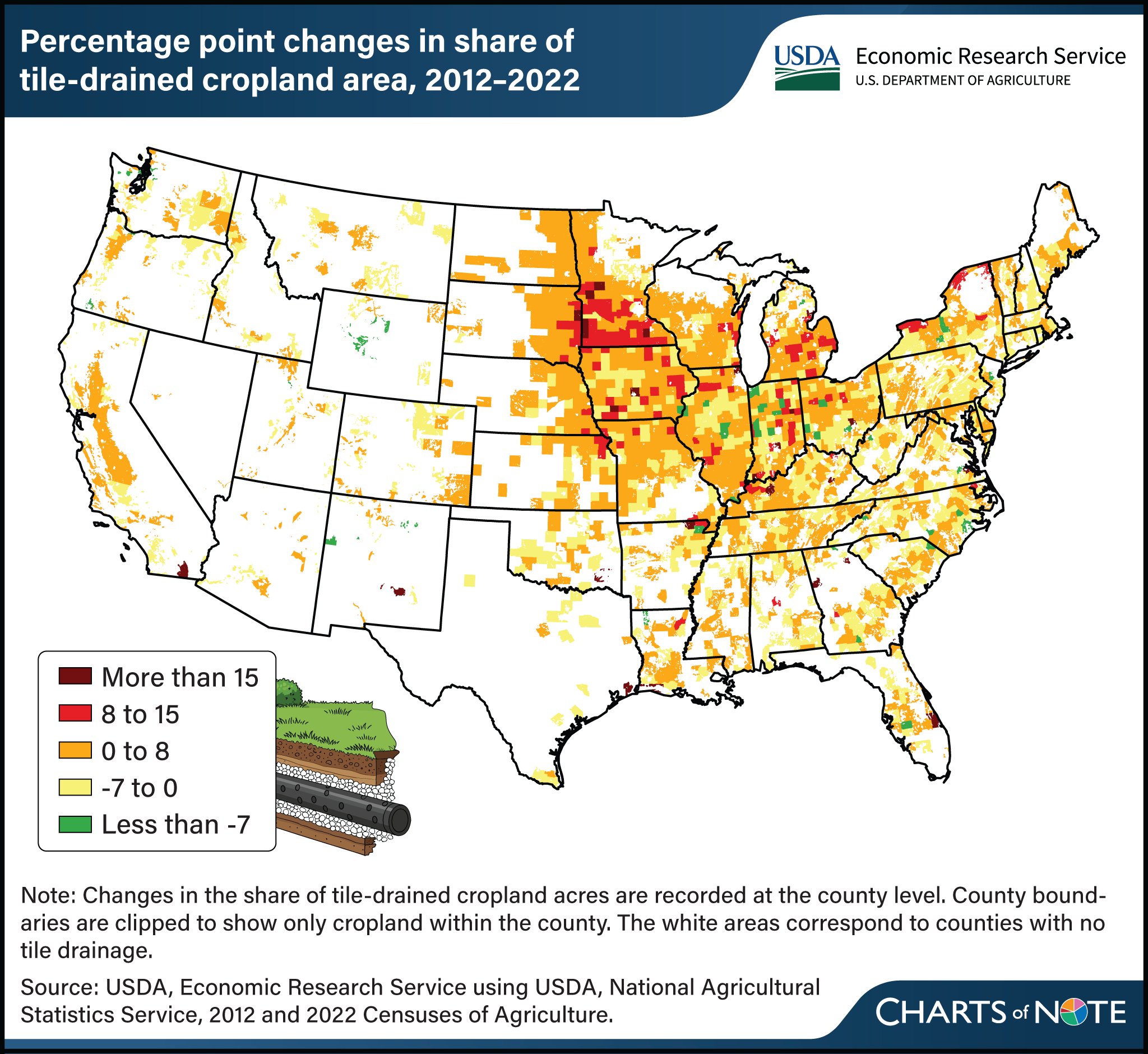
The share of American cropland drained by subsurface tile is rising, and the sharpest growth is in the northern latitudes of the Midwest and the Northeast, according to a Chart of Note from USDA's Economic Research Service (ERS) built on the 2022 Census of Agriculture.
Respondents to the census reported how much of their farm acreage was drained by tile. Tile drainage, also called subsurface drainage, is a land-use practice that lowers the water table and removes excess water from cropland so that planting can happen on time and crops are spared the stress of waterlogged soil. In heavily irrigated regions it is also used to flush salts out of the soil subsurface.
Between 2012 and 2022, hundreds of counties across the continental United States recorded an increase in the proportion of their cropland that is tile-drained, ERS found. The most substantial increases were concentrated in counties at northern latitudes.
Counties across the plains of eastern South Dakota, southern and western Minnesota, eastern Wisconsin, eastern and central Michigan and northern New York saw their shares of tile-drained cropland rise by 8 percentage points or more over the decade.
The growth was not limited to newcomers to the practice. Counties across Iowa, Illinois and Indiana, states that already had prominent drainage infrastructure in 2012, also posted significant increases, the agency said.
For growers in wet regions with cold, late springs, drainage is often what turns a marginal field into one that can be planted on schedule. The census pattern suggests that farms in the northern Corn Belt and the Northeast are putting money into the practice to protect their planting windows. The chart, prepared by ERS's Daniel Szmurlo, is taken from the ERS report Tile Drainage Systems Management and Conservation, published in September 2026.
Source: USDA Economic Research Service

Comments
(0)