
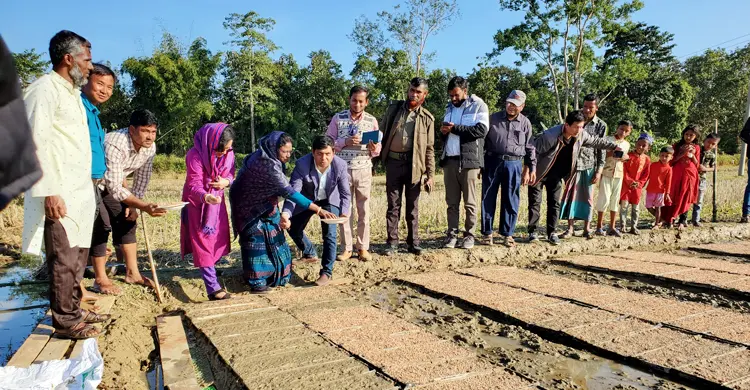
Synchronised ("somoloy") cultivation could change the idea of rice farming in the hills and open a new horizon for hill agriculture, officials believe. Part of the push for sustainable mechanisation to make farming modern and profitable, the method lets farmers plant the same variety across a field at the same time using machines. Agricultural scientists developed it as an effective way to grow rice.
Matiranga Upazila Nirbahi Officer Daisy Chakraborty gave the information at a meeting with beneficiary farmers after inaugurating a tray seedbed programme at Singhapara, Tabalchhari, near the border in Matiranga.
How it works
A rice transplanter can plant one acre an hour, work that takes 10 to 12 labourers a whole day. The government will provide a subsidy of half to 70 percent of the machine's price, and the cost of planting and harvesting is expected to fall by half.
Under an incentive programme, Boro seed has been sown in 4,500 trays at Singhapara. Seventy-three farmers will grow Altaf BL 70 hybrid Boro on 50 acres by the synchronised method. The seedlings will be planted by transplanter within 25 days, and the rice harvested five months after planting.
Farmers and officials
Farmer Md. Haider Ali said it is the first time he has made a seedbed by this method, no chemical fertiliser is being used, and with the agriculture office's support seed is being sown and seedlings raised in trays. Farmer Md. Amir Hossain said the method will reduce labour costs and production costs, and if yields are good this year, more farmers will adopt it.
Sub-assistant agriculture officer Nur Mohammad said tray seedlings do not have to be pulled up, so roots are not torn, take up nutrients quickly and grow fast; trays waste less land, and transplanters plant seedlings evenly at the same depth, so farmers can harvest together. Upazila agriculture officer Md. Sabuj Ali said the government will bear all costs for the 50 acres, from tray seedbeds, fertiliser, seed and pesticide to harvesting, with farmers contributing only their land.
Source: Jagonews24. First published in Bengali on The Agro News.


Comments
(0)