
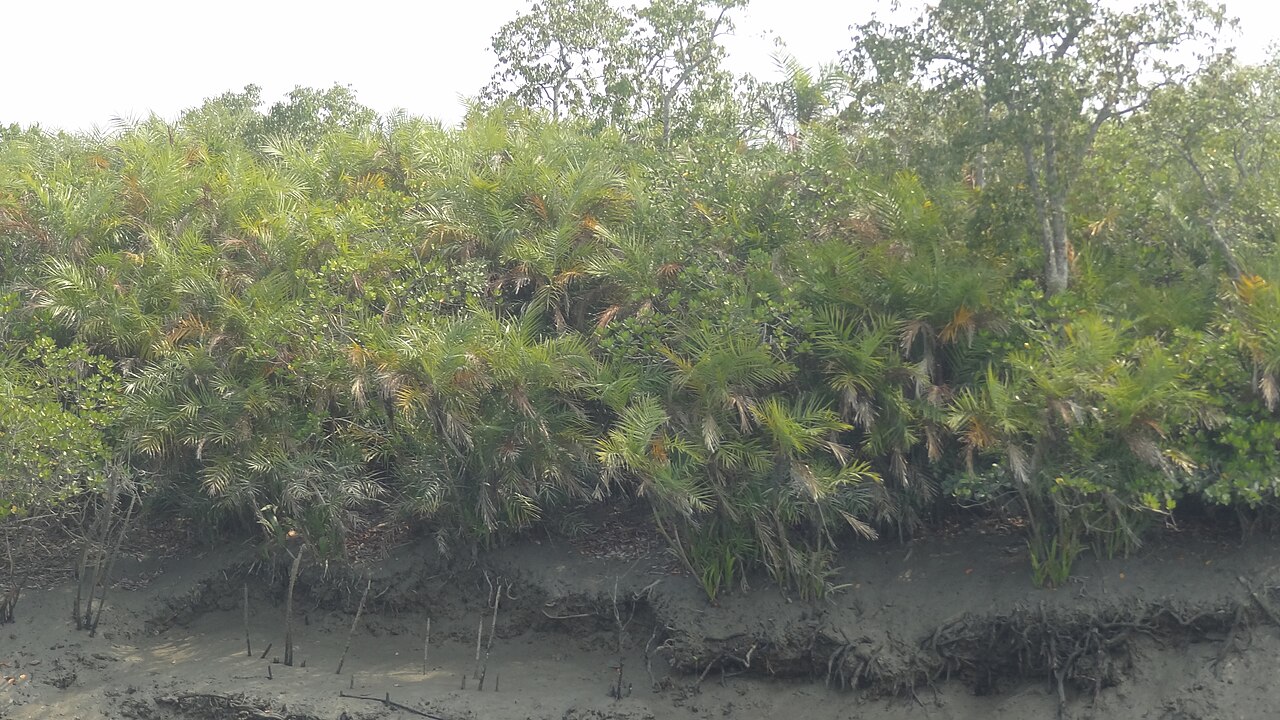
The Sundarbans, the largest contiguous mangrove forest on Earth, shared by India and Bangladesh, is at a crossroads between conservation and the survival of the millions who live on it, Aditi Tandon, an adjunct professor at the National Institute of Advanced Studies in Bengaluru, writes in a commentary for Mongabay India. The views are the writer's own.
She describes a delta built by the Ganga (Padma in Bangladesh), the Brahmaputra and the Meghna, where the slowing of sea-level rise between about 5,000 and 2,000 years ago let sediment build mudflats on which mangroves such as the sundari (Heritiera fomes) took hold. Its mixing of fresh and salt water makes it a nursery for roughly 90 percent of the region's aquatic species, including the Ganges river dolphin and the Irrawaddy dolphin.
That balance is now breaking, she argues. Citing NASA Landsat-based data, she writes that sea levels in the Sundarbans have risen about 3 cm a year over the past two decades, well above the global average, and that the region has lost nearly 12 percent of its shoreline to erosion in 40 years. She names four drivers: faster sea-level rise, land subsidence, less sediment because of upstream dams, and less fresh water from the Ganges-Padma system because of structures such as the Farakka Barrage.
Saltwater intrusion has contaminated farmland and freshwater, she writes, crippling the farming and fishing that local families depend on; salinity drops in the monsoon and soars in summer. The region is home to about 7 to 7.5 million people, roughly 4.4 to 4.5 million in India and 2.5 to 2.7 million in Bangladesh. Islands have already been submerged, yet environmental migration has no standing in international treaty law, and India's disaster policies cover relief after extreme weather, not displacement from slow environmental change.
Drawing on Amitav Ghosh's novel The Hungry Tide, she sees a lasting tension between protecting the forest and letting people earn a living from it. As a way forward she points to Amphibious Living Opportunities, explored by researchers and communities on both sides of the border: resilient housing, disaster-resilient farming and fisheries, and cooperative ventures backed by capital, technology and institutions. Its success, she writes, will depend on sustained investment and on the communities most at risk taking part.
Photo: Amartyabag (mangroves in the Sundarbans) / Wikimedia Commons (CC BY-SA 3.0)
Source: Mongabay India


Comments
(0)