
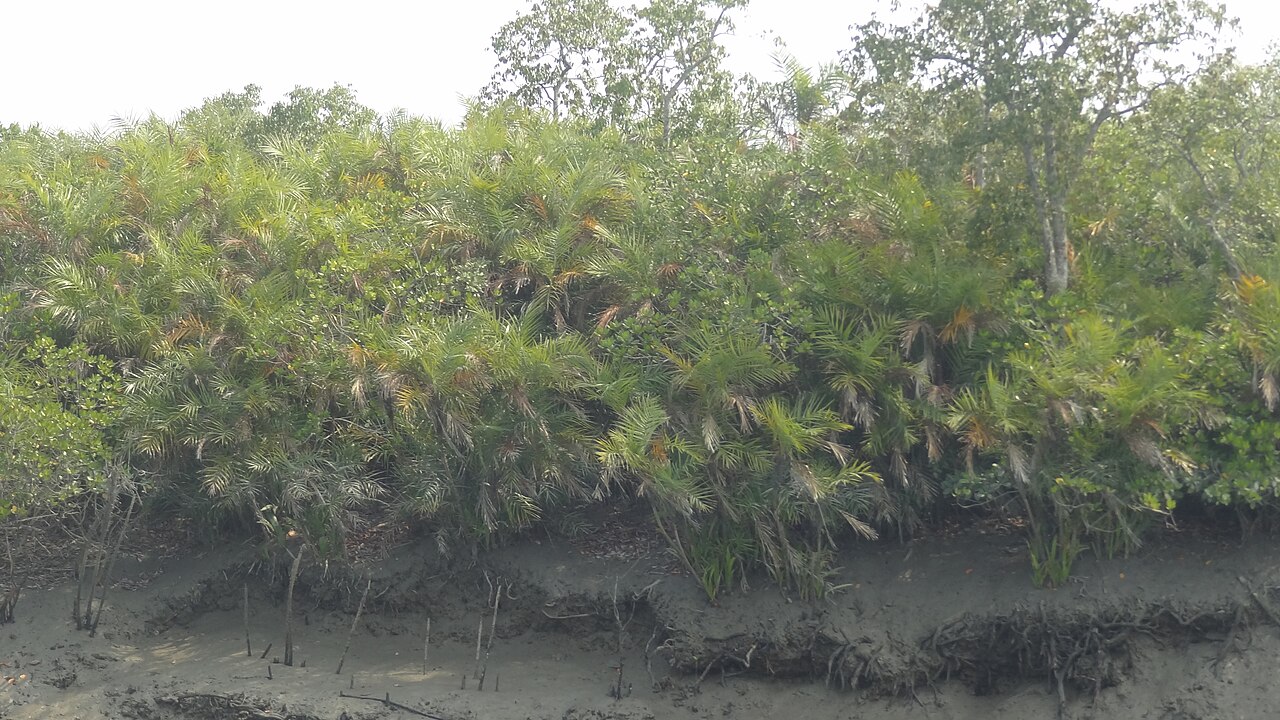
Forests are thought of as stores of clean air, but parts of the Sundarbans, the world's largest mangrove forest, carry fine particles (PM2.5) and coarser particles (PM10) above permitted levels. The finding comes from a study in the Khulna, Satkhira, Sarankhola and Chandpai ranges during January and February of 2024 and 2025.
The work was done by the Center for Environmental and Geographic Information Services (CEGIS), a trust under the water resources ministry, and the Arannayk Foundation. Titled "Ecological Monitoring of Sundarbans", it is the first baseline survey of the forest's animals, air, soil, water and trees.
In the Sarankhola range the air held 102 micrograms of PM2.5 and 114 micrograms of PM10 per cubic metre. The Chandpai range came second, with 89.3 and 98.1 micrograms. Under Bangladesh's Air Pollution Control Rules 2022, PM2.5 above 35 micrograms and PM10 above 45 micrograms per cubic metre are unhealthy; the World Health Organization's 2021 guideline for PM2.5 is 5 micrograms. Sulphur dioxide, nitrogen oxides and carbon monoxide were within tolerable levels.
Mutasim Billah, an environment specialist at CEGIS who worked on the study, said dust raised when ships unload cement clinker and coal for the Rampal power plant in the Pasur channel and at Chandpai is the likely source of the fine particles. Dry-season storms and pollution drifting in from across the border also play a part, he said, but continuous monitoring is needed to show how pollution changes over time.
Professor M A Aziz of the zoology department at Jahangirnagar University said the Sundarbans is not only tigers and deer: bees and butterflies will be the first to suffer. Fine dust settling on leaves and flowers disrupts both honey gathering and pollination. In his view the study confirms long-voiced fears about Mongla's factories and Rampal's coal.
The survey warns that even moderate air pollution can deepen the stress on an ecosystem already under pressure from salinity and other changes, and can alter how nutrients reach the soil and tidal water. It recommends long-term monitoring with priority on PM2.5 and sulphur dioxide.
Professor Ahmad Kamruzzaman Majumder, founder of the Centre for Atmospheric Pollution Studies at Stamford University, said the two dry-season sources of pollution in the Sundarbans are fires and fly ash from unloading clinker and coal, and that the navy and the forest department can act when unloading pollutes the air. Reported for Prothom Alo by Mostafa Yusuf.
Photo: Amartyabag / Wikimedia Commons (CC BY-SA 3.0)
Source: Prothom Alo


Comments
(0)