
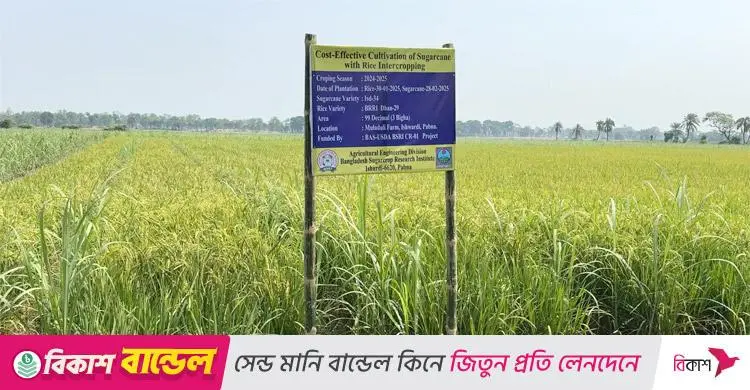
Rice is being grown experimentally as a companion crop in sugarcane fields in Pabna. The method allows rice to be grown with sugarcane using little water, and the cost of the sugarcane crop can cover two-thirds of the cost of the rice, cutting farmers' costs by a third. It could also raise rice production and ease the shortage of cane for sugar mills.
A new method
Scientists at the Bangladesh Sugarcrop Research Institute (BSRI) developed the method. They say irrigation and fuel costs for rice grown this way are a quarter of the conventional method. In the cane zones of the country's 15 state-owned sugar mills, it could produce an extra 260,000 tonnes of rice a year on 100,000 hectares.
Why cane needs help
Sugarcane takes at least a year to grow. Because the long, costly crop was making losses, cane production has fallen alarmingly in Pabna and nearby districts over the past decade, and the state sugar mills of the north struggle to meet targets for lack of raw material.
To make cane profitable, BSRI scientists planned rice as a companion crop. After three years of trials at the Muladuli farm in Ishwardi, run by the Bangladesh Sugar and Food Industries Corporation, and other sites, detailed testing is now under way, and the researchers hope to take the method to farmers soon.
How it saves water
BSRI chief scientific officer Dr Shams Tabriz said producing one kilogram of Boro rice in the north needs about 2,500 litres of water, but sugarcane is drought-tolerant. Because the two crops have opposite traits, growing them together saves water and cuts irrigation and fuel costs, and fertiliser applied to the rice also benefits the cane.
Dr Anisur Rahman, chief scientific officer at the Bangladesh Academy of Sciences and lead researcher of the project, said farmers' costs will fall by a third. The crops can be grown together on beds or by direct planting, with surface water conserved so that groundwater is not needed, cutting fuel and electricity costs. Final trials are under way before extension to farmers.
Ishwardi upazila agriculture officer Mita Sarkar said the joint crop offers big economic potential, but correct planting time and care are vital. BSRI Director General Dr Kabir Uddin Ahmed said that as rice is the country's main crop, rice in cane fields should quickly become popular, giving farmers an extra crop for the same cost.
Source: Jagonews24 (reported by Alamgir Hossain Nabil). First published in Bengali on The Agro News.
Comments
(0)