
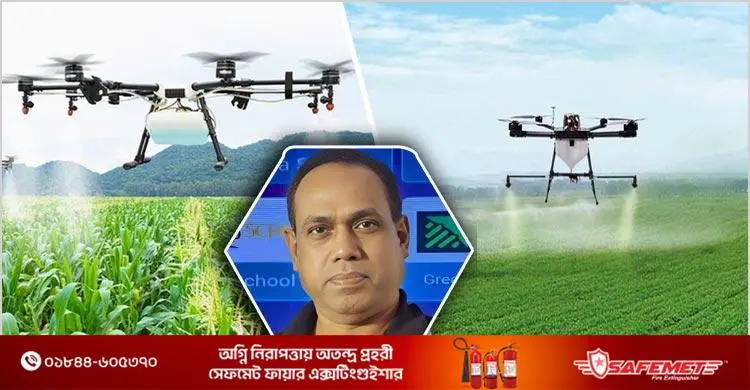
Spray drones are being seen as a breakthrough technology in modern agriculture. Manual or mechanical spraying takes time, labour and money, and it is hard to apply pesticide or fertiliser evenly. A drone can spray at a set height and speed, ensuring precise, uniform application, cutting pesticide waste and crop damage and saving farmers' labour. Drones are particularly effective on remote or waterlogged land and can also analyse soil moisture, crop health and nutrient status as part of smart farming.
A fast-growing market
The global crop-spraying drone market was worth $2.47 billion in 2024 and is put at $3.41 billion in 2025, rising to $10.86 billion by 2029, about 34 percent growth in a year and more than threefold in the following four years. Drivers include advanced drone technology, farm automation, labour shortages and demand for environmental efficiency. One report valued the global agricultural drone market at $2.71 billion in 2024, growing at a CAGR of 27.97 percent from 2025 to 2033, and IMARC Group put the 2024 market at $2.706 billion with a potential of $31.882 billion over 2025–33. The Asia-Pacific region, with large farmland and fast technology adoption, shows strong demand, and drone spraying is spreading quickly on small and medium farms. The writer notes that estimates vary between sources, so expectations should be measured.
Potential in Bangladesh
Many Bangladeshi farmers still rely on traditional methods that make spraying slow and labour-intensive, so crops are not always protected in time. A spray drone can cover a large field evenly within minutes, strengthening disease protection and raising yields. It also reduces pollution by spraying precise amounts, works despite labour shortages or poor weather, and has proved effective for rice, wheat, maize and vegetables.
Who is working on it
- The Bangladesh Agricultural Research Institute and various technology firms have begun research and training.
- ACI Motors and the Syngenta Foundation have pointed towards implementing spray drone technology.
- Iconic Engineering is working on drone solutions for agriculture.
- Sky Beez Limited is focusing on production and plans to make agricultural spray drones.
- Genius Farms Limited and Flymech are working jointly, respectively on field piloting of spray drones and on drone production and marketing.
If government and the private sector expand the technology together, the writer says, production will rise, costs will fall and food security will strengthen. Drone data can also help farmers decide quickly about disease, pest attacks and nutrient deficiencies, making spray drones an important tool for smart, efficient and sustainable farming.
Source: Jagonews24. First published in Bengali on The Agro News.

Comments
(0)