
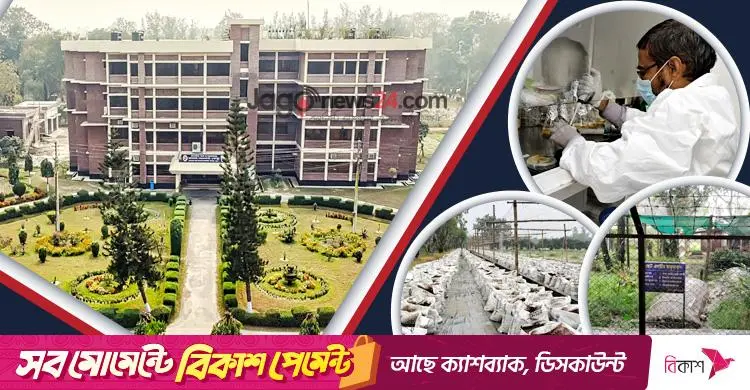
Unused yards, rooftops and corners of homes are turning into "gold mines" as young entrepreneurs across the country start growing ginger in sacks, a method that is simple and profitable. The Spices Research Centre in Bogura has played a major role.
Ruhul Amin, a young man from Anahoto village in Dupchanchia upazila, Bogura, first grew ginger in 22 sacks after watching YouTube and was amazed by the yield; he now wants to grow it commercially and has sought advice from the centre. Others, such as Imran Hossain of Shajahanpur, housewife Salma Akter of Nandigram and Touhid of Shibganj, are growing ginger, turmeric and cardamom in sacks.
The centre and its output
The country's only full-fledged spice research centre was set up in 1996 on 70 acres at Raynagar in Shibganj upazila, near Mahasthangarh, under the Bangladesh Agricultural Research Institute (BARI). It oversees regional centres in Magura, Cumilla and Gazipur and sub-regional centres in Lalmonirhat, Faridpur, Sylhet and Khagrachhari. It has developed 58 improved varieties and 156 technologies for onion, chilli, garlic, ginger, turmeric, coriander, black cumin, fennel, radhuni, cinnamon, black pepper, betel leaf, cumin and other spices. Thirteen scientists work there, and officials, NGO workers, trainees and farmers are trained regularly.
Bangladesh grows about 30 kinds of spices but imports about 4.5 million tonnes against annual demand of 5.85 million tonnes, spending an average of Tk 8,000 crore to Tk 9,000 crore a year. The centre says domestic production could double in five to seven years with the right technology and training.
Innovations
- **Cumin:** once thought to grow only in deserts and the Mediterranean, cumin can now be produced in Bangladesh through adaptation and variety development. This season 80 farmers in 17 districts are growing it, with potential profits up to four times those of rice, said senior scientific officer Dr. Mahmudul Hasan Suja. Farmer Saiful Islam of Krishnapur, Deuli union, is trying it on 8 decimals.
- **Onion powder:** the centre has developed processing technology for onion, ginger and garlic powder, entirely with local technology. About 2.5 million tonnes of onions are produced a year, but 25 to 30 percent (600,000 to 700,000 tonnes) rot for lack of storage against demand of over 3.5 million tonnes. Food processing researcher Dr. Masud Alam said entrepreneurs can make onion powder at home or small-industry scale, stabilising prices and easing storage.
- **BARI Piaz-5:** a year-round onion variety to fill the August–November shortage, now grown in various districts and trialled on city rooftops with DAE. Senior scientific officer Dr. Nur Alam Chowdhury said producing summer onion seedlings was very challenging but has succeeded.
- **Other technologies:** mound and sack planting of ginger, zinc and boron for summer onion seed yield and quality, intercropping of summer chilli and onion and of turmeric and chilli, integrated nutrient and irrigation management for garlic, turmeric from seedlings, and integrated disease control in stored onions.
The centre is also researching less common spices such as bay leaf, chui jhal, curry leaf, clove, pistachio, nutmeg, rosemary, lemongrass, vanilla and mango ginger, and plans high-yielding, stress-tolerant varieties, especially of cumin, cardamom and cinnamon. Chief scientific officer Dr. Md. Zulfikar Haider Prodhan said the centre works closely with DAE to put technologies in farmers' hands, and although bad weather and a shortage of skilled staff remain challenges, spreading local technology could quickly reduce import dependence.
Source: Jagonews24. First published in Bengali on The Agro News.

Comments
(0)