
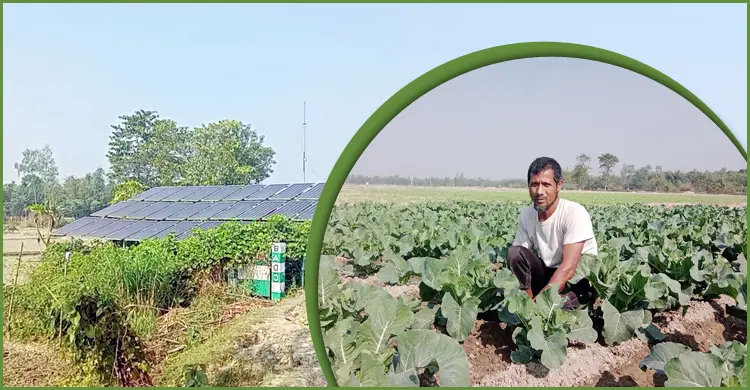
Most people in Nilphamari district live by farming, and because riverbank char land produced only one crop a year, farmers depended on a single harvest. Government initiatives have now made the sandy char land fertile, and solar-powered farm technology is changing farmers' prospects. Even in remote villages, farmers are turning from traditional methods to solar irrigation.
The project
In 2020-21 the Bangladesh Agricultural Development Corporation (BADC) launched the project "Expanding irrigation in the district through optimum use of surface water" in greater Nilphamari, benefiting more than 500 farmers. Ten solar-powered pumps have been installed in Nilphamari Sadar, Domar, Dimla, Saidpur and other areas. The landowner given each pump looks after it and collects payments from farmers, so the authorities bear no extra cost.
The pumps lift river water as well as groundwater, which is then delivered to farmland using solar power. Farmers in areas with little water in the dry season benefit greatly, and the system has become popular.
Farmers' experience
- Jahangir Alam said about 5 bighas of his land used to lie fallow in the dry season for lack of irrigation; now he has enough water for cabbage, cauliflower, beans, bottle gourd, chilli, ash gourd, pumpkin, aubergine, tomato and potato.
- Ishwar Chandra Roy said the sandy char had no water supply, but with the government's solar pump he grows mustard and gets water whenever needed at low cost.
- Ataul Islam grows potatoes and leafy greens on 2 bighas that used to be uncultivated; the solar-powered deep tube well needs no electricity or diesel.
- Golam Mostafa said rising electricity and diesel prices had pushed up irrigation costs for his one bigha of cauliflower, but now he can irrigate cheaply.
Official view
Mosfiqur Rahman, assistant engineer of BADC Nilphamari, said 10 solar pumps have been installed in six upazilas, bringing 250 hectares under irrigation and benefiting about 500 farmers, which will make northern agriculture more prosperous and farmers more profitable.
Source: Jagonews24. First published in Bengali on The Agro News.
Comments
(0)