
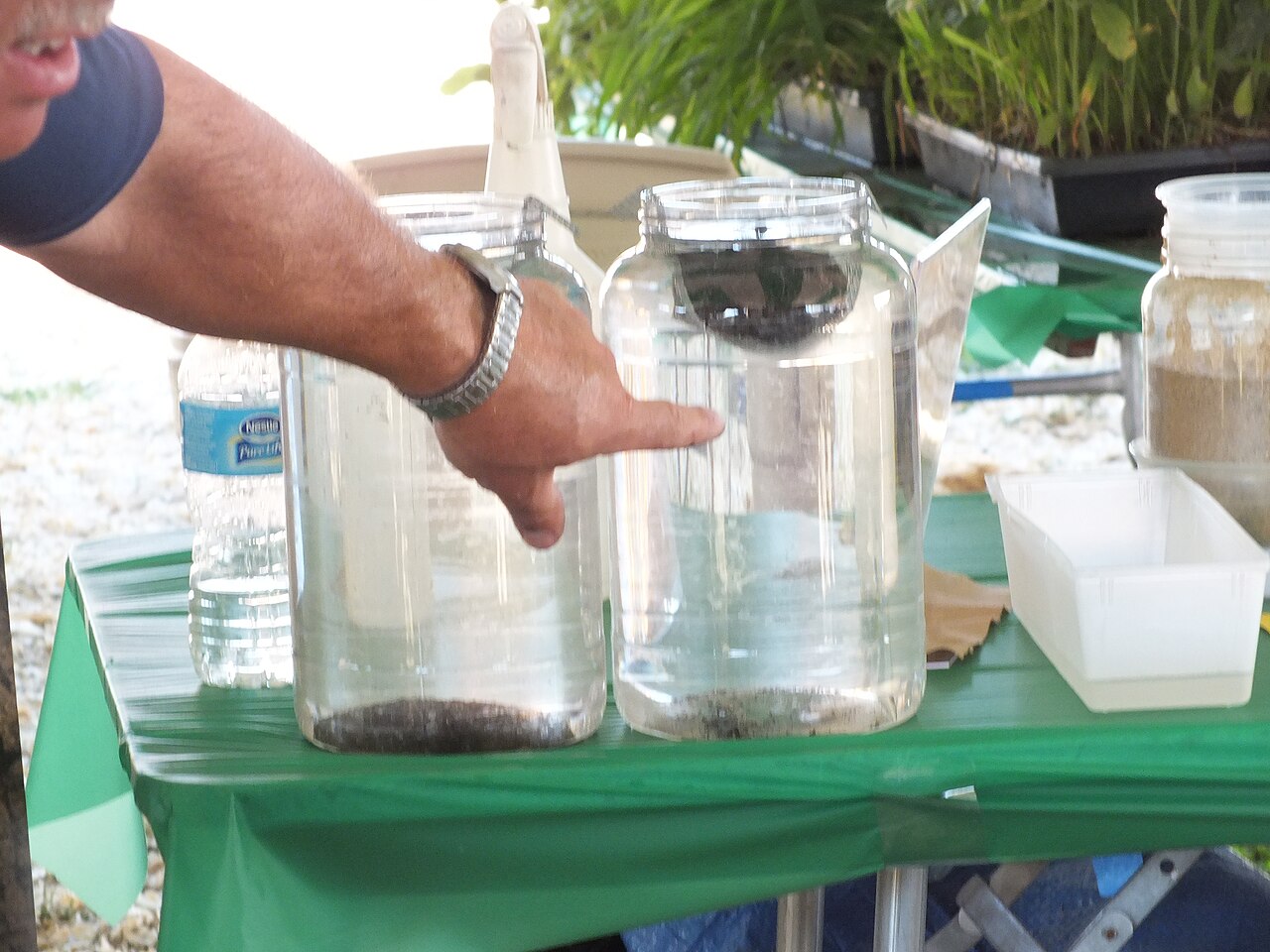
A clump of soil, a pail of water and a screen are enough for a farmer to see how well a field's soil holds together, Megan Westphal, soil health specialist with Manitoba Agriculture, told growers at Crop Diagnostic School in Carman, Manitoba, this past summer, the Manitoba Co-operator's Greg Berg reports.
There is a long list of factors that experts cite to call a soil healthy, but Westphal pointed growers to a few. Drawing on work in the United States by the Soil Health Institute, which has been standardising soil health testing, she named soil organic carbon, carbon mineralisation potential and aggregate stability as the key ones to assess.
How and when the sample is taken matters too. Biological activity can be lower when the soil is very cold, very dry or recently disturbed, and that can skew results. "After a major soil disturbing event like a heavy rainfall, seeding operations or a tillage pass, we want to wait roughly two to four weeks," Westphal said. That was the situation earlier this summer, when heavy rainfall hit southern Manitoba.
Such events can destroy the aggregates at the soil surface. Heavy rain breaks soil into individual particles that are more easily carried off by wind and water. Saturated soil and standing water can form a crust that leads to poor emergence, and particles settling back into place can clog pores in the soil profile and cause water infiltration problems later. Building organic matter and aggregate stability, Westphal said, can reduce or prevent that damage.
The slake test is one simple way to check. The farmer takes a clump of soil from the field and gently places it on a screen held under water in a pail. If the clump breaks into fine particles that settle at the bottom, aggregate stability is weak. If it stays largely intact with little settling, it is strong.
Healthier soils generally carry more organic matter and greater aggregate stability. "Having that aggregate stability is important because it keeps that soil in place and on the field," Westphal said.
The Co-operator lists five main practices for building soil health: reduce tillage and other soil disturbance, keep plant diversity with a good crop rotation, keep a living root in the soil for as much of the season as possible, keep the soil covered with growing plants or crop residue, and integrate livestock into the farm.
Photo: USDA NRCS South Dakota / Wikimedia Commons (public domain)
Source: Manitoba Co-operator


Comments
(0)