
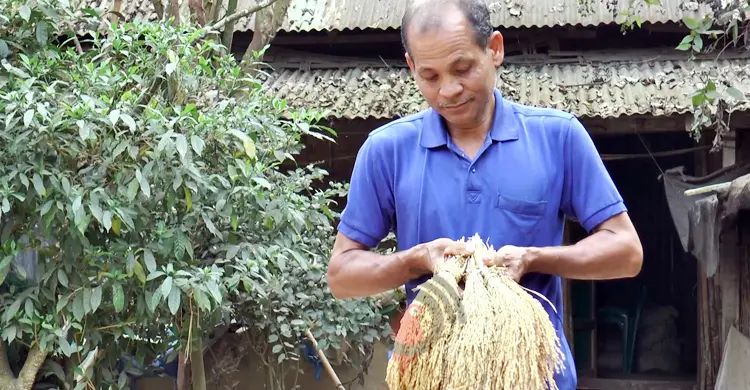
Sentu Hajong, a farmer from a remote village in Sherpur, has developed 23 new rice varieties. Several hundred local farmers have already succeeded with them, and demand for these varieties is growing in the district's markets.
Seventeen years of breeding
Sentu Chandra Hajong, 48, of Chatkia village in Nayabil union, Nalitabari upazila, develops new local rice varieties by hand through cross-breeding, earning him a reputation locally as a farmer-scientist. He left school after the SSC because of poverty and has researched rice in his dilapidated house for 17 years.
He began in 2005 after training from the NGO Caritas and, after seven years, developed a variety named "Sentu Shail", now in wide demand. It took him about seven years to develop his first variety. He runs trials all year in 370 plots on his own land. This year he marketed Sentu-23, a slender, fine local aromatic (atap) variety.
Saving local rices
To save nearly extinct Aman varieties such as Bogi, Haloi, Golapi, Malonchi, Moynagiri, Malsira, Anamia, Parijat, Apchi, Kaishabinni, Marakkabinni, Shongbinni, Dudhbinni, Biroi, Chapal and Khasiabinni, he plants them every year on an acre of his land. On six acres he grows local rice organically with dung and his own vermicompost, researching Sentu Shail, Chinishail, Tulshimala, Paijam, Dhepa, Chapal, Purabinni and Nedrabinni.
He said local varieties suffer fewer pests, organic fertiliser keeps costs down and plants stay sturdy, and he sprays boiled neem, golancha and basak leaves if pests appear. Good local varieties yield 40 to 50 maunds an acre, and their rice, cakes and puffed rice have a distinctive taste.
Farmers' results
His varieties yield almost twice as much as ordinary rice at lower cost. Farmer Aminul Islam Sujon grew Sentu-Shail on five acres and 15 decimals and got 50 to 55 maunds an acre at a cost of about 15,000 taka an acre; it sells at 1,800 to 1,900 taka a maund. Ariful Islam got 40 to 45 maunds an acre from Sentu-Paijam, which sells at 1,400 to 1,500 taka. Trader Md Helal Uddin said Sentu-Paijam is in higher demand.
Recognition sought
Despite growing demand, Sentu has received no government support or recognition, though officials at Khamarbari have promised to coordinate with the rice research institute. Nalitabari upazila agriculture officer Alamgir Kabir said Sentu has caused a stir with his local varieties, and his name will be sent to the Ministry of Agriculture so he can be honoured as an innovator.
Source: Jagonews24. First published in Bengali on The Agro News.


Comments
(0)