LiveMarket prices
Wheat flour (packaged)58+0.0%Ginger (imported)167+0.0%Ginger (local)154+0.0%Aman rice (medium)56+0.0%Aman rice (coarse)48+0.0%Aman rice (fine)72+0.0%Iodised salt (packaged)32+0.0%Green chilli218+0.0%Broiler chicken162+0.0%Mutton900+0.0%Sugar (local)132+0.0%Chickpeas (whole)85+0.0%Farm eggs (red)47+0.0%Onion (local)60+0.0%Boro rice (medium)55+0.0%Boro rice (coarse)47+0.0%Boro rice (fine)66+0.0%Beef729+0.0%Mung dal122+0.0%Garlic (imported)192+0.0%Garlic (local)173+0.0%Soybean oil163+0.0%
Updated 4 October 2026
Dhaka32°Clear skyHumidity 59%Wind 3 km/h

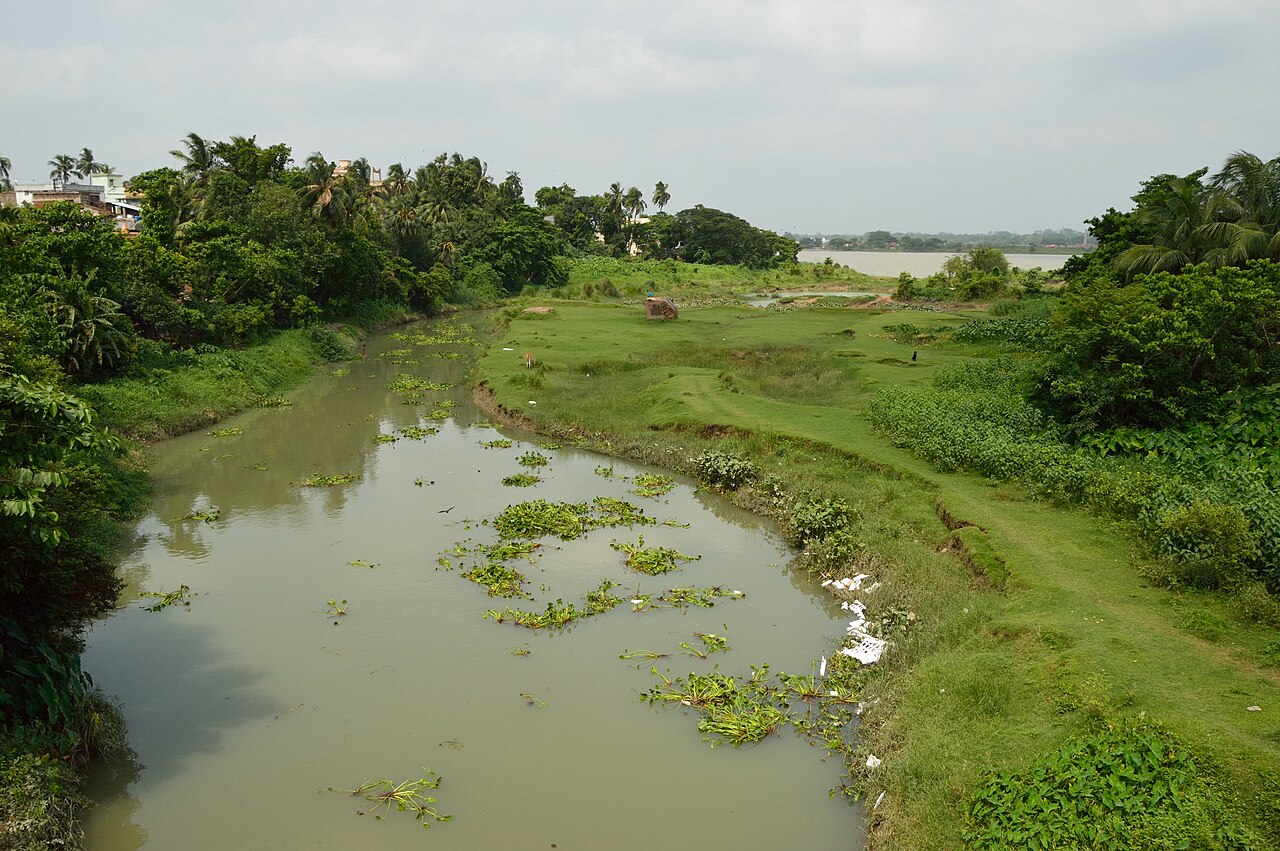
Howrah's Saraswati, shrunk to a drain, bubbles and stinks as pollution worsens

Under the Bhandardah bridge in Domjur, the water of the Saraswati bubbled as if boiling for more than an hour; residents blame factory effluent and gas from rotting sludge.

Howrah's Saraswati, shrunk to a drain, bubbles and stinks as pollution worsens
Environment

On Saturday morning the Saraswati river under the Bhandardah bridge at Domjur in Howrah, West Bengal, suddenly began to bubble as if boiling, giving off a foul smell. Word spread and crowds gathered on the banks. After more than an hour the bubbling slowly eased and stopped.

Puja Pal, who lives by the river, said it was the first time she had seen the water bubble like this, and blamed dirt, rubbish and acidic factory water draining into the river. Another resident, Barun Naskar, said heavy pollution was producing gas that bubbled up and spread the smell.

Bapi Thakur, secretary of the Save Saraswati River Committee, said the river has not been dredged or restored for a long time and pollution keeps rising. Rotting sludge often produces gases such as nitrogen and hydrogen, he said, and he believes that gas caused the bubbling.

Of the Saraswati's 77 km from Sankrail to Tribeni, he said, most has silted up into a drain, in places a narrow ditch. Years of neglect by the administration, the irrigation department and riverside residents have brought it to this state; no fish breed in it now and its water is no longer used for farming.

Older than the Bhagirathi, the Saraswati has yielded many traces of ancient architecture; the old port of Saptagram stood on its banks. Silted and polluted by urban growth, the river is now all but passing into history.

The report is by Kousik Sinha of Sangbad Pratidin.

Photo: Biswarup Ganguly / Wikimedia Commons (CC BY 3.0)

Source: Sangbad Pratidin

Sangbad PratidinSource

Environment

Related stories

Bangladesh

AEZ-4 Karatoya-Bangali Floodplain: Where Rivers, Fertile Sediments and Farmers Shape Northern Bangladesh's Agriculture

The Karatoya-Bangali Floodplain, Bangladesh's fourth agro-ecological zone, covers about 257,000 hectares of Sirajganj and eastern Bogura. Old river sediments left a mix of higher ridges and wetter basins, acidic soils short of several nutrients, and farms that grow rice, jute, potato, mustard and more. Recent trials on farmers' fields in Gabtali show what diversified cropping can earn, and satellite data and artificial intelligence could help match each field to the right crop, provided every prediction is tested in real fields.

Tania Chowdhary5 October 202610 min read

Comments

(0)