
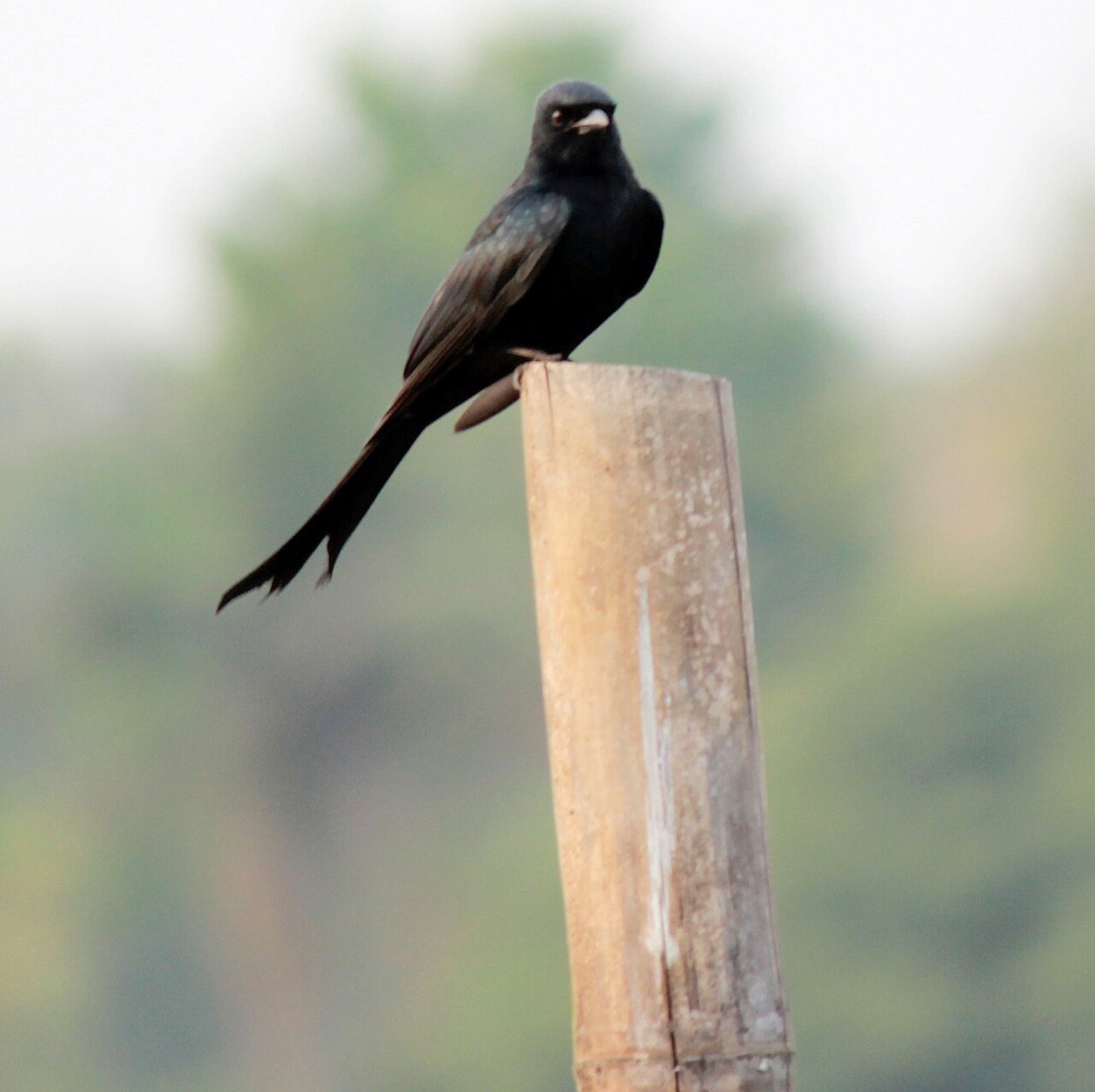
A crow-billed drongo, a passage migrant recorded fewer than ten times in Bangladesh, has been photographed in the casuarina forest at Kuakata. A N M Aminur Rahman, a specialist in birds and wildlife breeding and medicine at Gazipur Agricultural University, had been looking for it for two decades, and described the search in Prothom Alo.
The bird had earlier been recorded at Dulahazara and Inani in Cox's Bazar, Kaptai, Hazarikhil, Lawachara, Karamjal and Kuakata. Reading recent records, BirdingBD Tours announced a search for passage migrants at Kuakata. A team of eight set out on the night of 15 October; on the first day five hours of searching in the Lembur forest found nothing.
The next day, while photographing a flock of black drongos in the casuarina forest beside the mangroves, the writer noticed one with white spots on its breast and belly and a short, stout bill. He and Iqbal Babu got only three pictures before it flew. It proved to be the crow-billed drongo, known in West Bengal as the kakchanchu finge.
By the writer's description the bird is 27 to 32 cm long and weighs 44 to 68 grams. Its plumage is glossy black, its tail broader and less deeply forked than the black drongo's, and its eyes dark brown; without a careful look it is hard to tell from the common drongo. It lives in evergreen, deciduous and mangrove forest and eats insects, frogs, reptiles and small birds.
In Bangladesh the species is classed as data deficient; many believe it passes through for a few days in October. It breeds from April to June in the hill forests of the Himalayas and north-east India, building a cup-shaped nest in a tree fork and laying three or four eggs. The writer said two crow-billed drongos have also been seen for several days at the National Botanical Garden in Mirpur.
The sighting is a reminder that coastal casuarina and mangrove forests are resting places for rare migrants.
Photo: Sourabh Biswas / Wikimedia Commons (CC BY-SA 4.0)
Source: Prothom Alo

Comments
(0)