
India's 2026 El Niño was forecast accurately and months in advance, but the warning changed what farmers did only where they already had a link to the extension system, argue Vandana Choudhary, a project scientist at the National Institute of Disaster Management, and Milap Punia, vice chancellor of Maharshi Dayanand University, in a commentary for Mongabay India published on 9 November.
The signal was emphatic. The India Meteorological Department (IMD) put the chance of El Niño developing in the monsoon at 92% and forecast rainfall at 90% of the long period average. By the first week of September Rajasthan was 21% short of normal rain, with 21 districts deficient; the country recorded a 13.8% shortfall from June to August, and Maharashtra has declared drought in 265 of its 358 talukas. Kharif sowing lagged by about 16% on 10 July, at 53.12 million hectares against 63.27 million a year earlier.
The forecasting science is not the weak point, the authors write; the last stretch from bulletin to field is. India's Agromet Advisory Services began in 1977 with radio and newspaper bulletins, reached district level in 2008 and block level in 2018 with the Indian Council of Agricultural Research. More than 130 Agromet Field Units and District Agromet Units at Krishi Vigyan Kendras (KVKs) now issue advisories, twice a week for medium-range farm operations, and send them by SMS, KVK WhatsApp groups, the Meghdoot app and the Kisan Portal.
Between May and August the authors spoke with farmers across Rajasthan's zones. Half were in regular contact with a KVK and used digital advisories, and for them the warning worked. Rampal in Sri Ganganagar sowed his rice in portions while he watched the rain; Sheeshpal in Pratapgarh and Rajpal in Baran swapped thirsty crops, including soybean, for bajra and guar; another farmer sowed only 10 of his 25 bighas, as much as his tube well could carry if the rain failed. The other half had no KVK link. "We are relying on god. We have sown the crop and are waiting for the rain, and the crop is being ruined," said Girdhari in Jaisalmer.
The two groups fail in different ways. Farmers inside the system complain about quality: a forecast right for a block can be too coarse for one plot, which they blame on too few automated weather stations, and government, private and speculative messages now arrive looking alike. "We can't tell which warning is genuine and which is false," said Dhanraj in Hanumangarh. Farmers outside it get advisories late or not at all because of patchy networks and low awareness, often in technical or non-local language. Mohanlal in Jodhpur bought more seed on a WhatsApp rumour of a good monsoon and lost heavily when it turned dry.
The authors propose four steps: make one agency answerable for whether advisories reach farmers, instead of splitting the job between IMD, the agriculture ministry, the National Disaster Management Authority and ISRO's remote sensing centres; give farmers outside the KVK network their own channel of local-language audio messages and voice response lines; let farmers speak to an agrometeorologist, as Karnataka's Varuna Mitra service does; and add automated weather stations for plot-level precision. National food security only needs enough farmers to be reached, they note, which is exactly why it matters who is left out.
The views are the authors'. Their findings draw on an ongoing, not yet published study of heat waves and droughts in Rajasthan.
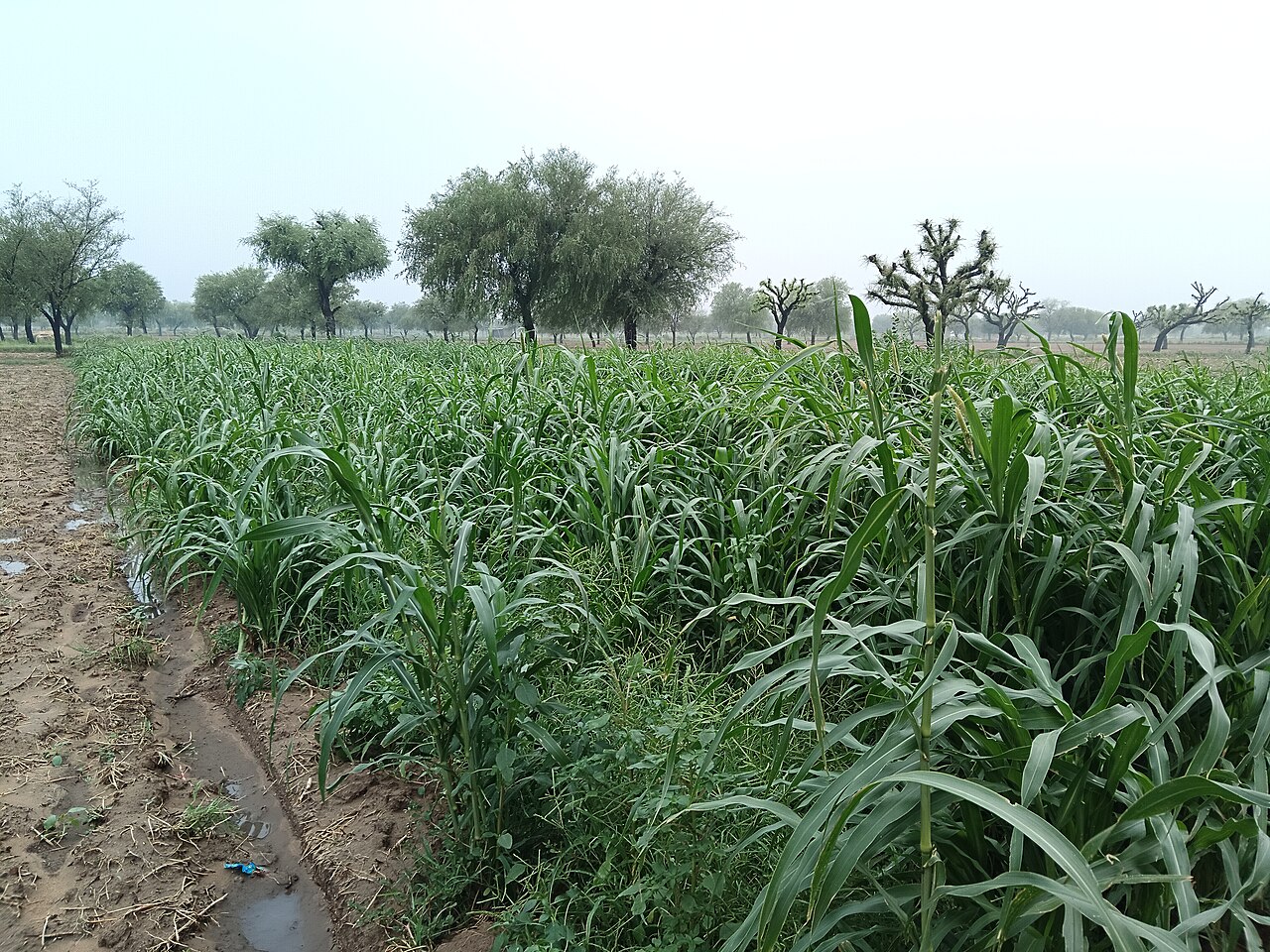
Photo: Herovaclicks / Wikimedia Commons (CC BY 4.0). Pearl millet (bajra), one of the crops some Rajasthan farmers sowed instead of thirstier ones this season.
Source: Mongabay India

Comments
(0)