
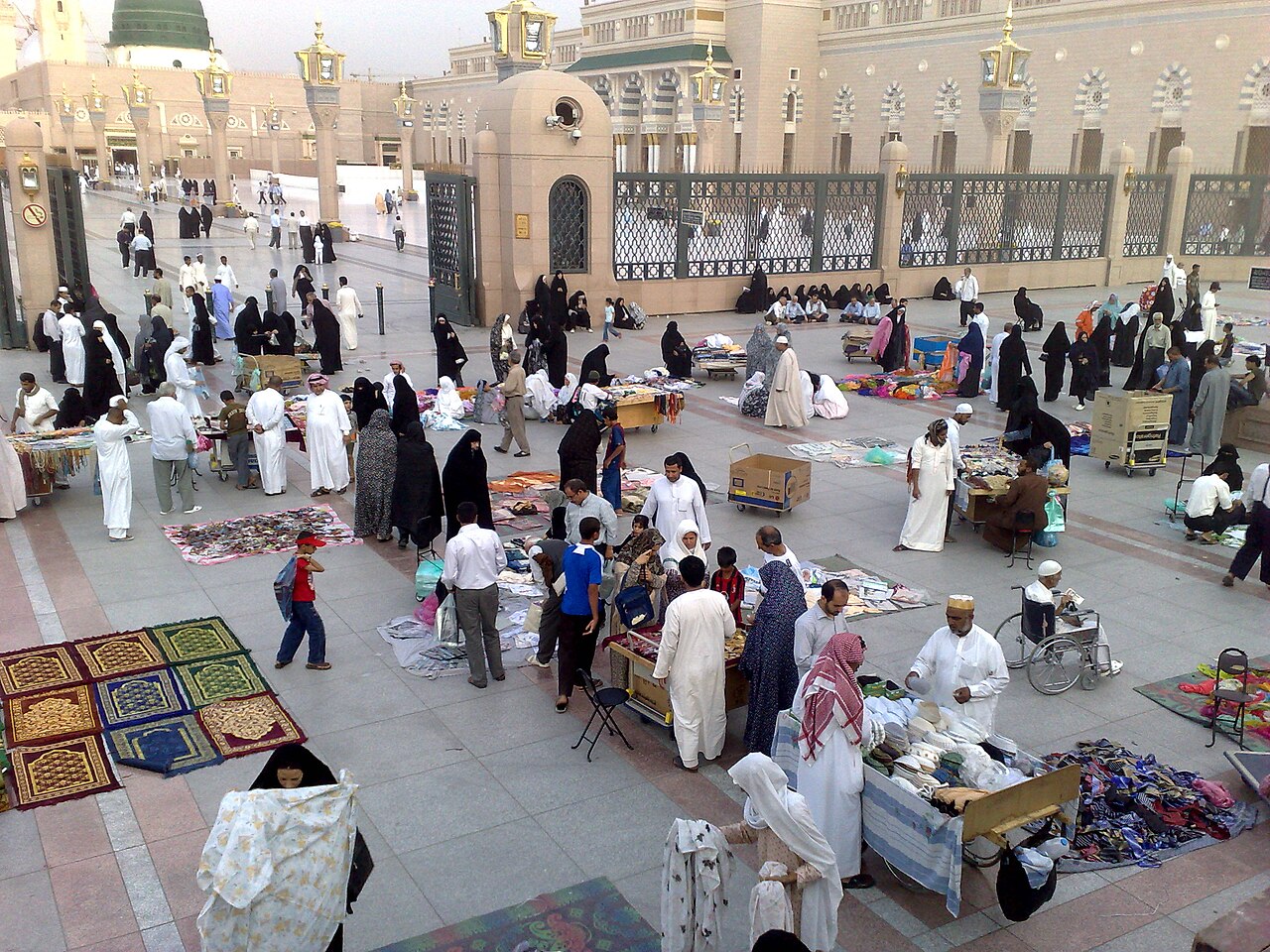
In the ninth year of the Hijra, delegation after delegation from across Arabia arrived in Medina, which is why Islamic history calls it 'Am al-Wufud', the Year of Delegations. Some came to learn about Islam, some to pledge allegiance, some to state their tribe's position. The Prophet (peace be upon him) answered each according to the situation: with argument in one case, warm welcome in another, a clear decision in a third.
The wave followed the conquest of Mecca in the eighth year. Before it, many tribes had waited to see how the conflict between the Prophet and the Quraysh would end. After Mecca and the conversion of the Ta'if delegation, visitors multiplied; the opening verses of Surah An-Nasr speak of people entering God's religion in crowds. Ibn Hisham's biography notes, however, that delegations had come to Medina before the ninth year too.
Members of the Banu Tamim delegation stood outside the Prophet's rooms and called out to him loudly, conduct addressed in Surah Al-Hujurat, verses 4-5. He still met and talked with them. To answer their poets and orators he asked Thabit ibn Qays to reply in speech and Hassan ibn Thabit in verse, after which the Tamim leaders conceded the Muslims' superiority and accepted Islam.
The Abd al-Qays delegation was received with particular warmth. In Sahih al-Bukhari the Prophet welcomes them as a group that came 'neither humiliated nor regretful', and in Sahih Muslim he tells their leader, al-Ashajj, that he has two qualities God loves: forbearance and deliberation.
When Musaylimah, who came with the Banu Hanifa, asked for a share of leadership, the Prophet refused outright, saying in al-Bukhari's report that he would not give him even a small date-palm stalk. Musaylimah later claimed prophethood and was killed at the Battle of Yamama under the caliphate of Abu Bakr.
For the writer, the deeper meaning of the year is direct contact with people from every part of Arabia: delegates heard the Prophet, learned the rulings and carried them home. His lessons are that relationships need a willingness to listen, that respect and acknowledging good qualities build trust, and that offering dialogue does not mean giving up one's principles.
The article was written by Faizullah Riyad, a teacher at Jamia Arabia Darus Sunnah Rajabari in Dhaka, for Prothom Alo; the views are the writer's own.
Photo: Mondephile / Wikimedia Commons (CC BY-SA 3.0)
Source: Prothom Alo

Comments
(0)