
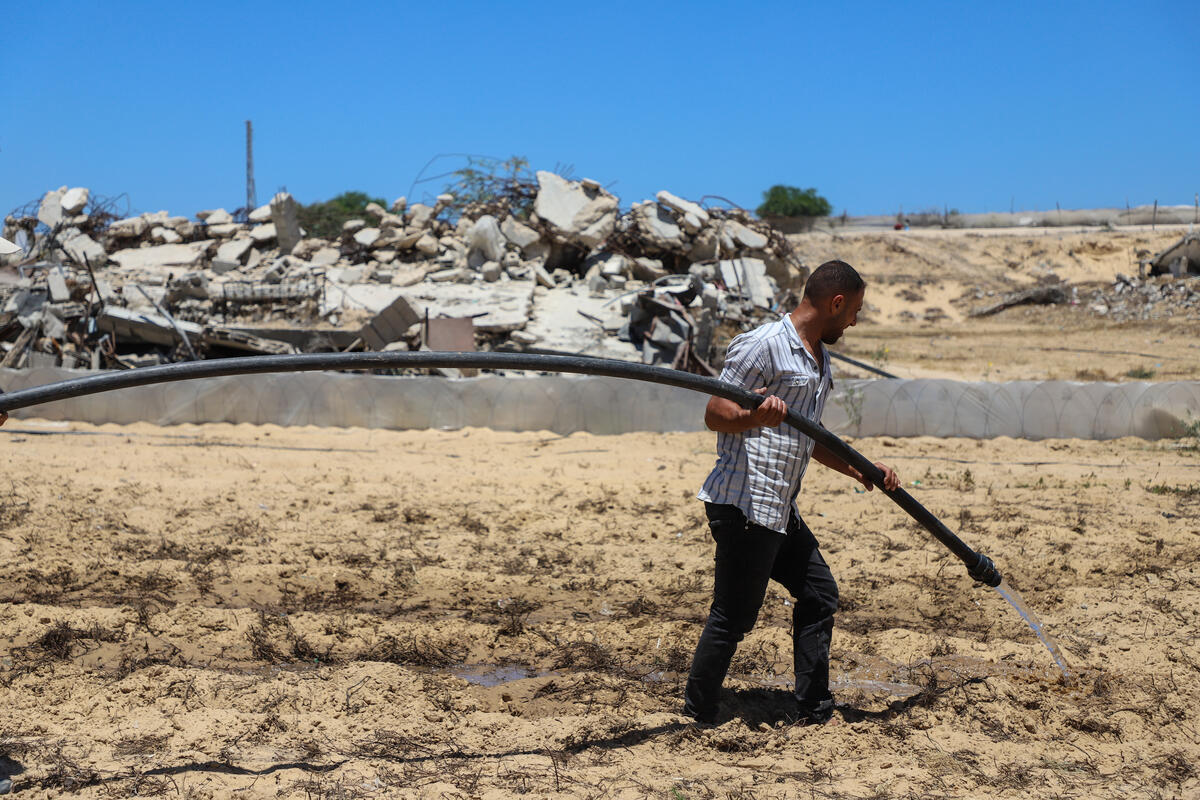
Only 3 percent of the Gaza Strip's cropland remains both accessible and undamaged, according to a geospatial assessment released by the Food and Agriculture Organization of the United Nations (FAO) and the United Nations Satellite Centre (UNOSAT).
As of 24 June 2026, 4,091 hectares — 27 percent of Gaza's cropland — were accessible, but only 448 hectares of that was also undamaged. The remaining 3,643 accessible hectares are damaged and would need rehabilitation before cultivation could resume. Since October 2025, accessible and undamaged cropland has fallen from 601 hectares to 448, a loss of 153 hectares or 25.5 percent, with Deir al-Balah and Khan Younis recording the largest reductions.
The assessment is explicit about the cause: reduced access, not additional physical damage, has been the main driver of the decline since October 2025, associated primarily with the westward expansion of the so-called "Yellow Line" separating the ceasefire zone from the military-controlled area. Rafah has the highest levels of inaccessibility, with 97.2 percent of cropland and 98.4 percent of greenhouse area out of reach, while the heaviest physical damage remains concentrated in North Gaza and Gaza governorates.
Greenhouses show the same pattern. The assessment found 224 hectares, or 16.6 percent of greenhouse area, accessible and undamaged — down from 226 hectares, or 17.3 percent, in October 2025, with Deir al-Balah recording the largest decrease.
"This latest assessment paints a stark picture of the continued deterioration of Gaza's agriculture sector," said Rein Paulsen, Director of FAO's Office of Emergencies and Resilience. "The loss of access to farmland is further shrinking the space available for farmers to produce food, even where agricultural assets remain physically intact. Farmers in Gaza have shown time and again that when land and inputs are available, production is possible."
Even the land that can be reached is hard to farm. Restrictions on importing and distributing essential agricultural inputs mean farmers face critical shortages of seed, fertilizer, irrigation equipment, fuel and other production materials. Livestock keepers struggle to obtain feed, veterinary supplies and animal health services, and FAO's ability to bring in feed and other materials to protect and restock herds remains inconsistent. What inputs are available are often of declining quality and priced beyond the reach of farming households.
Before hostilities escalated in October 2023, agriculture accounted for about 10 percent of Gaza's economy and supported the livelihoods of more than 560,000 people through crop production, livestock rearing and fishing.
FAO is calling for urgent and sustained action to restore agricultural production: safe access for farmers to their land, entry of essential agricultural inputs including commercial imports of non-dual-use items, and rehabilitation of damaged farmland. Without that, it warns, the openings to restore local food production will keep narrowing.
Source: FAO Newsroom

Comments
(0)