
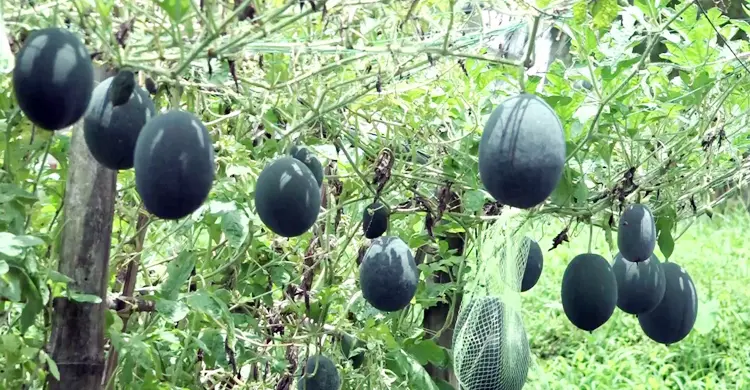
The watermelon season ended long ago, but the Rahmatpur Regional Agricultural Research Station in Barishal has succeeded in growing the fruit off-season on trellises built over floating beds. After two years of research, it has succeeded with BARI Watermelon-1 and BARI Watermelon-2.
Growing on water
Having grown toxin-free watermelon on floating beds on a small scale, the station is encouraging farmers to take it up, and commercial cultivation could benefit them. At the station, trellises have been built on floating beds in ponds and water bodies full of water hyacinth, and striped, juicy watermelons hang in net bags from them.
No fertiliser needed
According to the station, July to September is the right time. Unlike seasonal watermelon, crops grown on floating beds over water hyacinth need no fertiliser, suffer less disease and give more yield for less work.
Chief scientific officer Dr Md Golam Kibria said the trial succeeded, and growing on floating beds rather than land is creating interest among farmers, with various steps being taken to spread it. Scientific officer Dr Md Mahbubur Rahman Talukder said the fruit is ready for sale two and a half to three months after sowing, needs no fertiliser and, being toxin-free, is more nutritious.
Dr Mostafizur Rahman Talukder, chief scientific officer and director of the floating agriculture project, said the station was the first in the south to research off-season BARI watermelons on floating beds. The south has many ditches and canals where farmers could profit from this technology, and meetings and seminars are being held to encourage them.
Source: Jagonews24 (reported by Shawon Khan). First published in Bengali on The Agro News.

Comments
(0)