
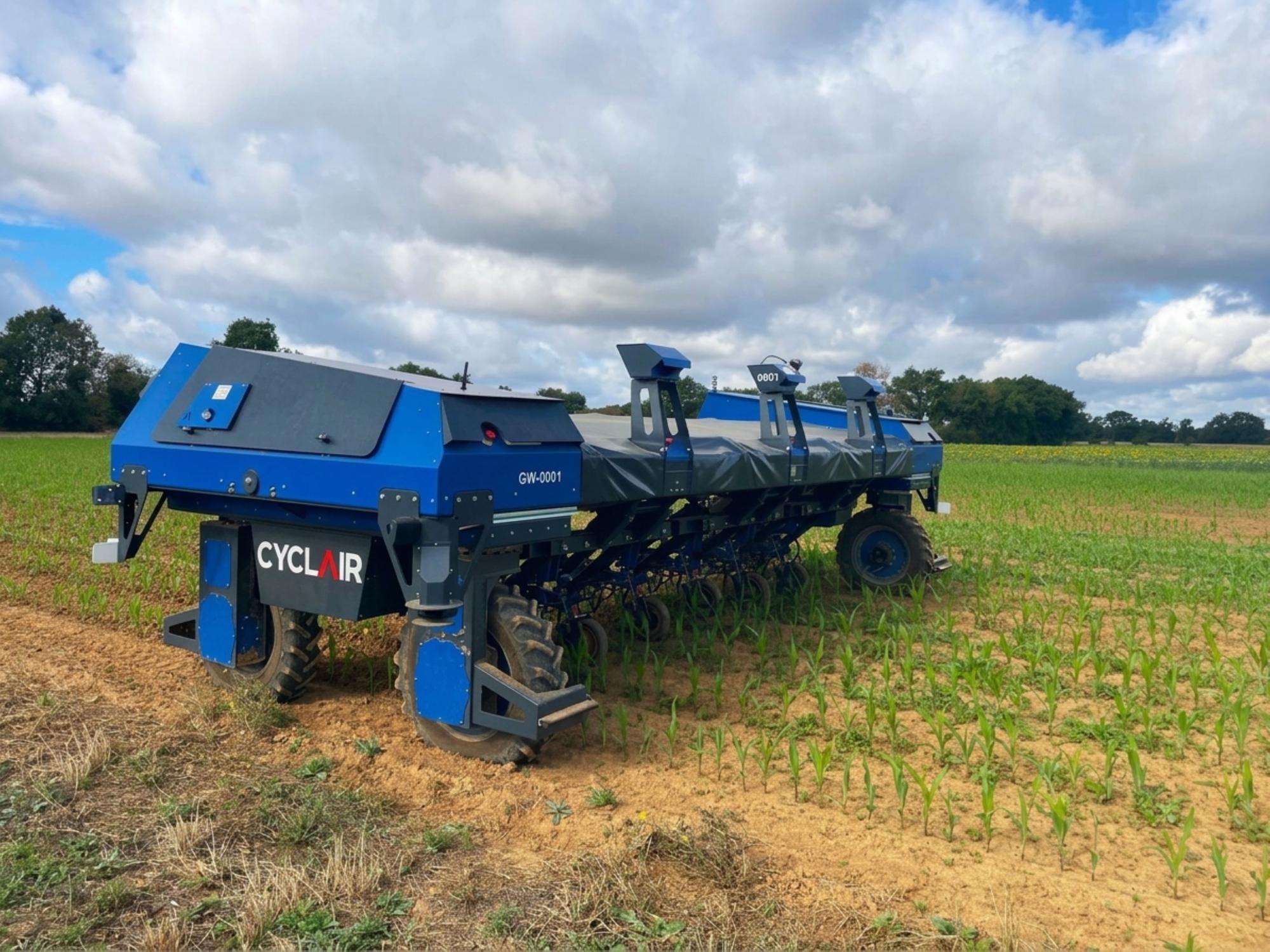
French agricultural cooperative group Océalia has taken a minority stake in Cyclair, a start-up building autonomous weeding robots, as part of its Cap 2030 strategic plan. The investment, announced earlier this year, is meant to give the cooperative's members across Nouvelle-Aquitaine a practical alternative to chemical herbicides.
For Océalia the deal sits within its Sillon Responsable (Responsible Furrow) sustainability framework, which treats technology adoption as a long-term route to farming that is both commercially sound and environmentally responsible. The cooperative wants solutions that cut herbicide use without hurting farm profitability, which makes the economics of mechanical weeding at scale the heart of the matter.
Cyclair was founded in Pressac, in the Vienne department, by three partners from industry, robotics and agriculture. Its GS and GW robots are built for open-field crops with row spacing of 30 to 90 cm and combine mechanical weeding, AI-based vision and an optional spot-spraying module. Rather than relying on GPS, the robot uses cameras and LIDAR to find the crop rows, tell weeds from crop plants and steer around obstacles; it needs only the field boundaries to start work.
The robot currently handles maize, sunflower and rapeseed, with cereals, open-field vegetables and specialty crops planned, and it doubles as a data-collection platform, recording leaf-development metrics for field monitoring through a dedicated application suite. The development roadmap adds an electric weeding module, a crop-health sensor and a soil sensor.
Cost is the test. Conventional chemical weeding runs between €35 and €85 a hectare depending on the pass, according to both partners, and they have set parity with that range as the target so that the system works for ordinary farms, not just early adopters. Cyclair quotes a net weight of 3,400 kg, an adjustable wheel spacing of 6.0 to 6.5 m, up to 20 hectares a day, in-row precision down to 1 cm, and sales direct, through distributors or as robot-as-a-service in Western and Central Europe, North America and Australia. In Australia it indicates a price of AUD 151,000–250,000, running costs of about AUD 10,000 a year and input savings of about AUD 70,000 a year.
Source: Future Farming
Comments
(0)