
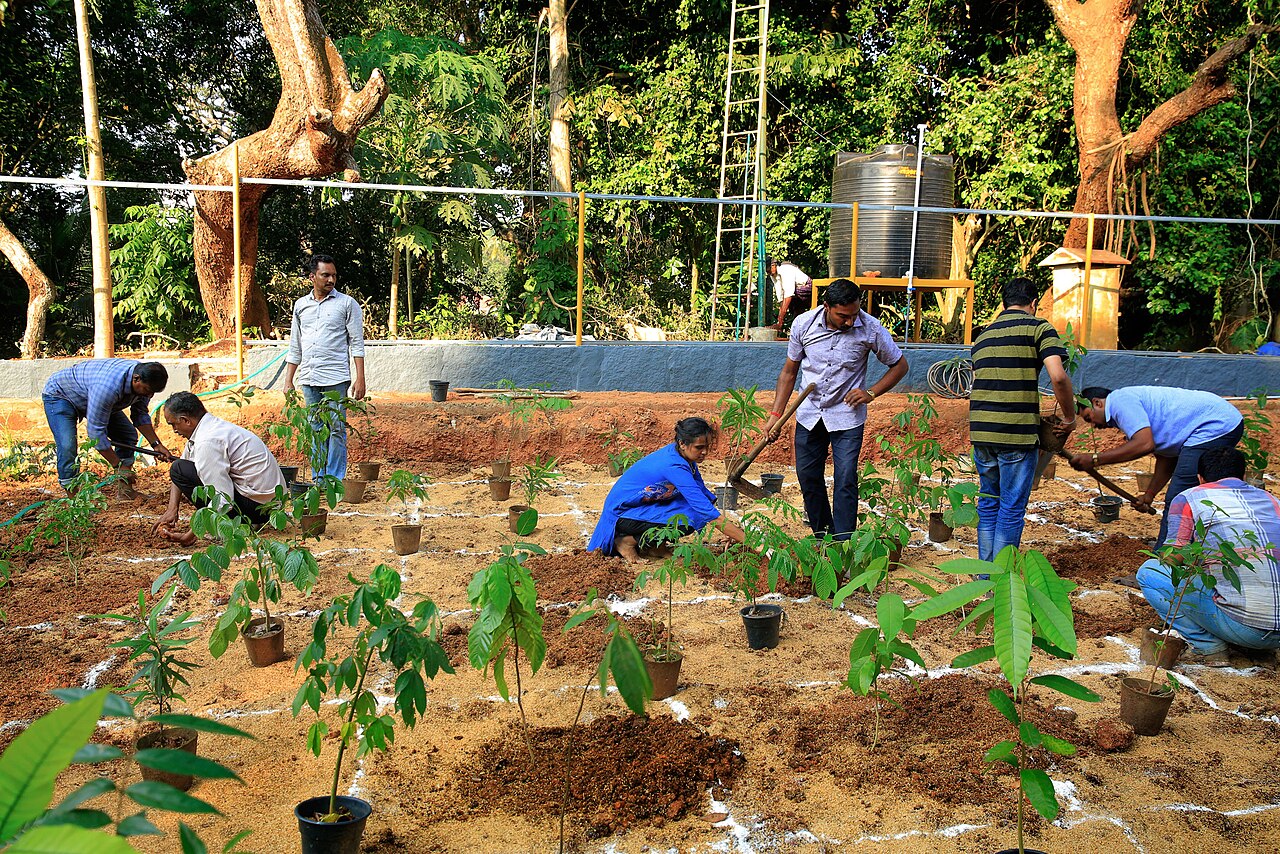
At Godownpara in Sapahar upazila, Naogaon, national youth award-winning agri-entrepreneur Sohel Rana has planted a forest by the Miyawaki method on about 55 decimals of his roughly 150-bigha Barind Agro Park. About 2,700 trees and climbers, native, fruit, timber, medicinal and ornamental, have gone in; among them, he says, are more than 500 species now rare in the region. He claims it is the first Miyawaki forest in the 16 districts of northern Bangladesh.
The Miyawaki method of afforestation was developed by the Japanese botanist and plant ecologist Professor Akira Miyawaki. Native species are planted densely, chosen to match the area's natural plant communities, with the soil improved and organic matter added. The aim is a dense, diverse forest in a small space that shelters and feeds birds and insects.
It was not easy. The land had to be prepared, the soil tested, organic fertiliser applied, saplings sourced, bamboo stakes set and organic mulch laid to keep moisture in. Rana says trees grow faster under this method than in conventional plantations and a small plot can carry a dense forest. Bangladesh's first Miyawaki forest was planted at Mirsarai in Chattogram, he says.
Rana took a master's degree in statistics at Rajshahi University in 2009 and worked as a journalist in Dhaka for about six years before returning to his home district, Naogaon, to become an agri-entrepreneur and build the Barind Agro Park.
Experts see both promise and limits. Professor Monjur Hossain of Rajshahi University's botany department said a Miyawaki forest is somewhat harder to establish in the Barind because rainfall is relatively low, but it can be done with planning. Such forests add trees and absorb carbon, he said, but any effect on rainfall or dryness would depend on their extent, the species, their care and local conditions. Plant and nature researcher Mokarram Hossain said the method could work well for growing dense forests of native and rare trees on open land that once held scrub or native trees.
Some also see income from carbon credits. Farhanul Haque, project manager at the Sustainable Agriculture Foundation (SAF), which works in the 16 northern districts, said carbon-credit projects based on planted forests could open new opportunities for climate action, conservation and alternative income for farmers.
Reported by Bangla Tribune's Rajshahi correspondent.
Photo: Afforestation at Kanakakunnu, Thiruvananthapuram, Kerala (illustrative), BemanHerish / Wikimedia Commons (CC BY-SA 4.0)
Source: Bangla Tribune

Comments
(0)