
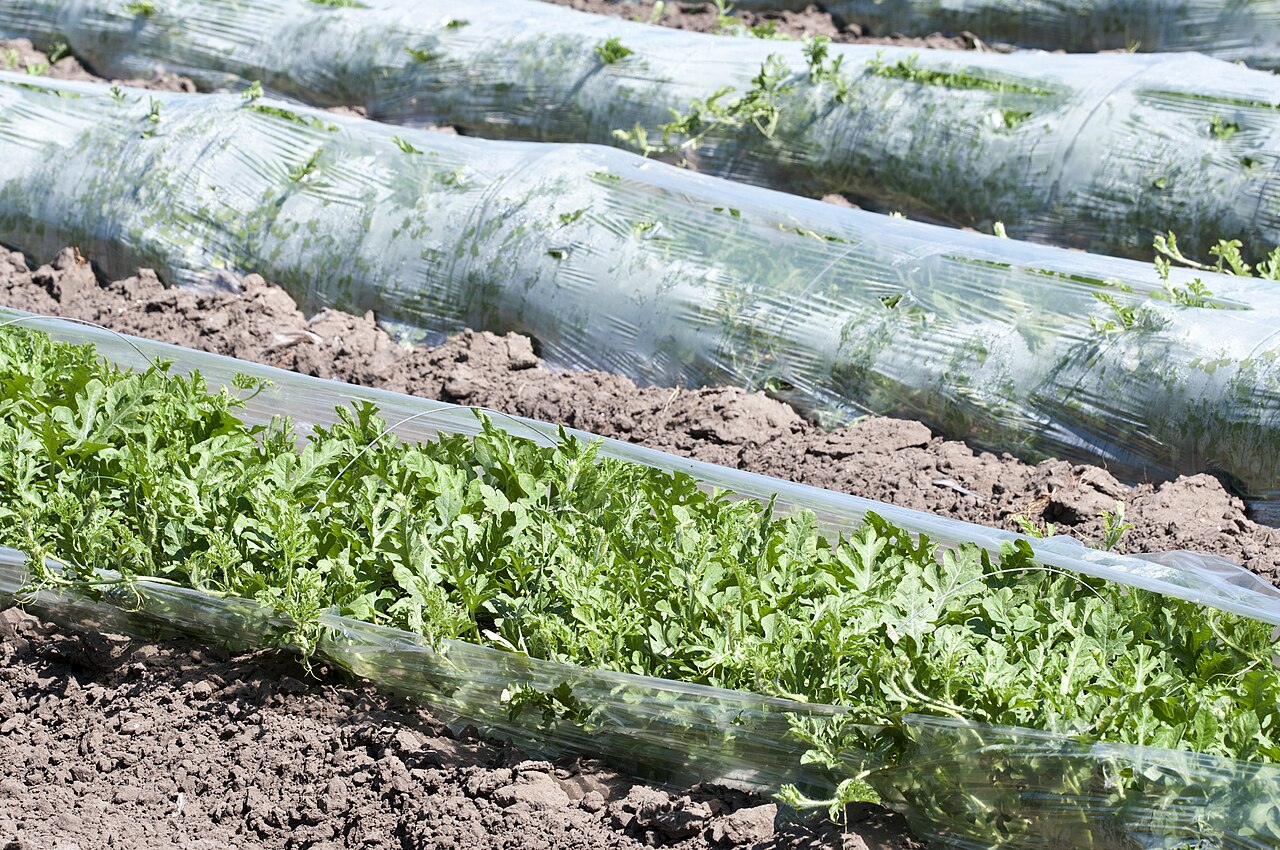
In early November 2025 the agriculture department in Jhenaidah said that growing summer watermelon with mulching had opened a new prospect in the district. Abdur Rahim Badsha, a farmer in the Holidhani block of Jhenaidah Sadar upazila, had grown a trial crop of summer watermelon on 52 decimals of land beside the Jhenaidah-Chuadanga road, using mulching and trellises, and more than 2,000 fruits had set on the vines. Curious people from the area were crowding into the field to see it. On the afternoon of 6 November 2025 a special team from the Ministry of Agriculture visited the field, and both the farmer and the agriculture officials said they were pleased with the yield and the taste of the fruit. Jagonews24 published the report from Jhenaidah on 9 November 2025; the state news agency BSS had reported the same field on 7 November.
A trial crop beside the Jhenaidah-Chuadanga road
According to the district agriculture department, Abdur Rahim Badsha grew the watermelon in a field beside the Jhenaidah-Chuadanga road in the Holidhani block of Jhenaidah Sadar upazila. He collected the seed on his own initiative and planted summer watermelon on 52 decimals of land. The seed was sown in the first week of September 2025.
Two methods were used together. Mulching, in which the soil around the plants is covered, was used to keep moisture at the base of the watermelon plants. Trellises, called macha in Bengali, were built to protect the crop from insect attack, and the fresh watermelons were hanging from them when the field was reported. In the BSS report of 7 November the trellises were described as lofts or sheds built to protect the plants from insect and spider attacks.
"Watermelon has been grown on 11 trellises or sheds on 52 decimals of land," Abdur Rahim Badsha told Jagonews24. "I have done this cultivation with the modern mulching method. In all, more than 2,000 fruits have set in the field. The size, colour, taste and quality of the fruit are very good."
He said each fruit could weigh 3 to 5 kg and that the watermelon is very sweet when it ripens. The plants had set fruit after two months of care, and he expected the harvest to begin a week later. Curious people from the neighbouring villages were coming to the field every day to see the unusual crop.
Costs, sales and the farmer's own figures
By the farmer's account, his total outlay on the crop was 40,000 taka, and he had already sold all the fruit in the field for 125,000 taka (1 lakh 25 thousand taka) before it was harvested. "On average, a profit of 70,000 to 80,000 taka can be made by growing summer watermelon in two and a half months," he said. The BSS report gave the same figures from him: 40,000 taka spent on 52 decimals and the whole crop sold for 1.25 lakh taka.
These cost, sale and profit figures are the farmer's own, from one trial field in one season; neither report gives an official calculation. Returns from the same method can be quite different with another variety, another plot, another season or another market. The reports also do not say which variety was grown, and no fertiliser or pesticide amounts were published for this field. Farmers who want to try summer watermelon are best advised to ask the sub-assistant agriculture officer of their block or the upazila agriculture office, who give advice on varieties, sowing time, fertiliser and pest control for local conditions.
The ministry team's visit
A special team from the Ministry of Agriculture visited the unusual watermelon field, reaching it at 4:30 pm on 6 November 2025, a Thursday. The visit was made to inspect ongoing work under the provisions of the development project proposals (DPP) of two projects: the Department of Agricultural Extension's "Strengthening Nutrition and Food Security through Agricultural Development" project and the Department of Agricultural Marketing's "Strengthening the Department of Agricultural Marketing" project.
Present were Ferdousi Akhter, joint chief of the crops wing of the ministry's agriculture, water resources and rural institutions division; deputy chief Ratna Sharmin Jhora; and senior assistant chief Priyanka Debi Pal. With them were the Department of Agricultural Extension's officials: Md Selim Reza, additional deputy director (horticulture) of the DAE's Jhenaidah office; Md Nur-E-Nabi, the Jhenaidah Sadar upazila agriculture officer; and Mofiz Uddin, sub-assistant agriculture officer of the Holidhani block. Members of the team expressed satisfaction at the bumper yield of summer watermelon.
"Unusual summer watermelon cultivation has created a new possibility in the district," said Md Nur-E-Nabi, the upazila agriculture officer. "We are regularly encouraging farmers to take up various kinds of profitable farming."
Ferdousi Akhter said: "As it is a short-duration crop, I think farmers will become more interested in growing summer watermelon. Our aim is to ensure all government facilities to give overall support to this kind of cultivation."
What mulching does for a crop
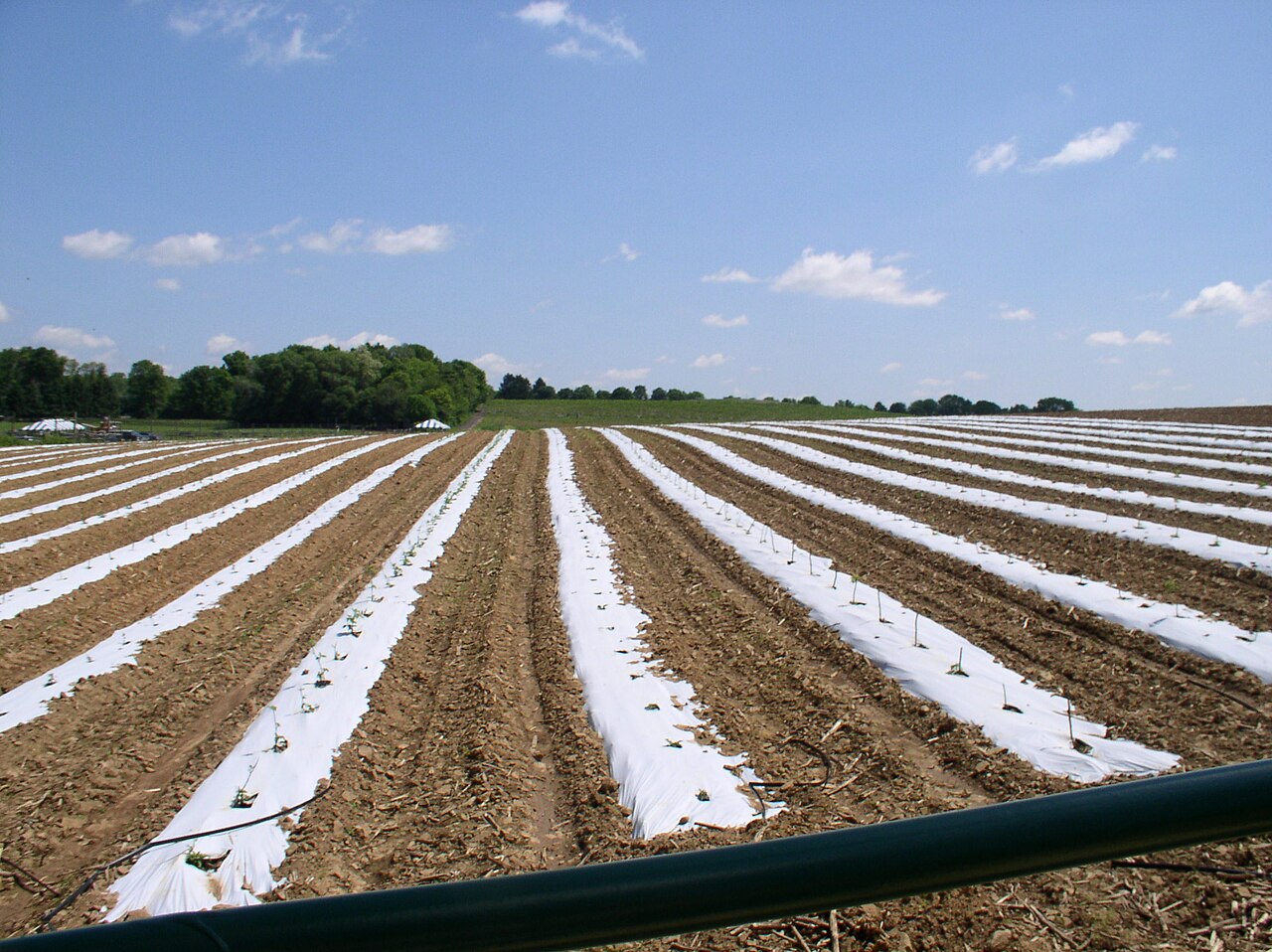
A mulch is any material laid directly on the surface of the soil. A 2022 review of mulch films in the journal Polymers describes the purposes as protecting seedlings and young shoots, reducing evaporation, controlling weeds and preventing soil erosion; the review notes that the word comes from the German "molsch", meaning easy to decay. Organic materials such as straw, crop residues, compost, bark and sawdust are the old mulches; plastic film is the modern one.
The same review traces the history of the practice. The first documented use of organic matter as mulch dates to around 500 BCE. Stones, pebbles and volcanic ash were used in dry regions in the 1600s, and in the 1800s market gardeners in Paris found straw useful for strawberries. Paper sheets were introduced as mulch in the 1920s, polyethylene film was commercialised in the late 1950s, and the first biodegradable plastic mulch film was sold commercially in 2006. The global mulch market was estimated at 3.5 billion US dollars in 2020.
The benefits the review lists are the ones the Jhenaidah farmer was after. Mulch raises the soil's capacity to hold water and reduces runoff, so the irrigation a crop needs can be reduced. Because the cover blocks sunlight, fewer weed seeds germinate beneath it, especially small-seeded weeds. It protects the soil from the beating of heavy rain and from wind and water erosion, and it keeps soil temperature steadier: studies cited in the review found mulched soil warmer on chilly days and cooler in hot spells. The review adds that mulched crops tend to suffer less stress, can give better yields and quality, and may be harvested earlier.
The Food and Agriculture Organization of the United Nations (FAO), in its December 2021 report "Assessment of agricultural plastics and their sustainability: a call for action", describes the benefits of plastic mulching film in similar terms: suppression of weed growth, higher soil temperatures, less evaporation from the soil and less runoff of nutrients in heavy rain. These, it says, increase yields, lengthen the growing season and reduce the need for irrigation, fertiliser and herbicide. The report notes that plastic greenhouse and mulching films used together with drip irrigation help fruit and vegetable growers raise yields and reduce water and herbicide use.
Watermelon is one of the crops most often grown this way abroad. An August 2014 extension fact sheet from the University of Florida's Institute of Food and Agricultural Sciences (UF/IFAS) states that in Florida watermelon is predominantly grown on raised plastic-mulched beds, and explains that covering soil with impermeable plastic reduces evaporation from the soil while increasing transpiration through the plants compared with open-field growing.
The plastic left behind
The same FAO report sets out the costs. It estimates that about 12.5 million tonnes of plastic products are used in agricultural production each year, and it names non-biodegradable mulching films as one of its priority products, with a relative risk score of 9.8 in its assessment. Conventional mulch films are made from low-density polyethylene (LDPE) or other flexible polymers. If they are wrongly specified, laid, managed or removed, the report says, they can leave large quantities of plastic in the soil, and residues of mulching film accumulating in surface soils have been shown to reduce yields.
The thickness of the film matters most, according to FAO: it decides whether the sheet holds together through the season and can be lifted after harvest. Film that tears, or that comes up heavily caked with soil and plant matter, is hard to recycle; in Europe the typical ratio of contaminants to plastic in used mulch film is 2:1, at which recycling is uneconomic. The report warns against burning used film on farms, because burning plastic, and polyvinyl chloride (PVC) film in particular, gives off toxic dioxins and furans. The Polymers review makes the same point from the other side: polyethylene mulch does not degrade naturally, has to be removed from fields after harvest, and the debris left in soil adds to soil pollution.
FAO's report lists alternatives and improvements:
- mulching with organic materials or cover crops, which avoids plastic altogether;
- biodegradable films made from paper-based materials or biodegradable polymers, while noting that how fast such films break down varies widely between soils and climates;
- stronger, thicker, tear-resistant film with smoothly cut planting holes, so that it can be retrieved whole after harvest;
- not using PVC in mulching film, to avoid dioxin releases if used film is burned; and
- reusable films that last several seasons, where the crop allows it.
Why trellises, and why watermelon out of season
In Bangladesh watermelon is normally a dry-season crop. The agriculture department, as reported by Prothom Alo from Teknaf on 14 September 2025, gives January to April as the watermelon growing period, with sowing from mid-February to early April for a good yield. In Teknaf, the department said, summer watermelon was sown in June and July and harvested in August and September, and a winter crop was sown in October and November; the upazila had grown watermelon on 113 acres the previous year, and in 2025 yellow-fleshed watermelon reached the Teknaf market for the first time.
The off-season crop grows through the monsoon, when wet ground and pests are the main risks, so trellises are used to lift the vines off the soil. On the fish-pond (gher) banks of Koyra upazila in coastal Khulna, Prothom Alo reported on 2 September 2025, trellises were made with bamboo and rope; the vines climbed over them and the ripe fruit hung beneath, each fruit wrapped in a net bag. A sub-assistant agriculture officer there said the method gave a good yield with less labour, that disease and pest attacks were lower, that the fruit could be marketed from just 70 days after planting, and that the yield that season was about 35 tonnes per hectare. More than a hundred farmers in three unions of Koyra had grown off-season watermelon on 224 bighas of gher banks; one farmer there had sown 1,500 seeds of a variety called Astha on 15 June on two bighas of pond bank and reported fruits of 7 to 7.5 kg.
In Bauphal upazila of Patuakhali, Prothom Alo reported on 23 September 2025, a young agricultural entrepreneur had grown watermelon with mulching in the rainy season for the third time, on five decimals beside his home, along with some muskmelon. He said pest attacks were lower in that season, so he spent less on pesticide. The Bauphal upazila agriculture officer said off-season watermelon was very profitable because demand in the market was high at that time of year and disease in the fields was lower, keeping costs down.
Summer watermelon in other districts in 2025
Jhenaidah's field was one of several reported in the autumn of 2025. On 31 October 2025, nine days before the Jhenaidah report, Jagonews24 reported from Mirsharai in Chattogram that a farmer originally from Jamalpur had grown summer watermelon on 50 decimals in Masjidia village of Khoiyachhara union, using mulching and organic methods at a cost of 50,000 taka. He said he had sown 65 days earlier with the help and advice of the upazila agriculture office, began marketing on 29 October, and expected about 4 tonnes, with fruits from 2.5 kg to 4.5 kg; he had sold the field to a wholesaler for 1.5 lakh taka. The varieties grown were named as Surjodim, Rosogolla, Big Bite, Leona, Jafran, Sweet Bite and King Super. The wholesaler said the fruit was selling at 70 to 80 taka a kilogram.
The Mirsharai field was a government demonstration. The sub-assistant agriculture officer of the Khoiyachhara-Masjidia block said five demonstrations of summer watermelon had been set up in the block in the 2024-25 fiscal year under the SACP project, and that the agriculture office had provided fertiliser, seed, mulching paper and a cash grant. The Mirsharai upazila agriculture officer said about eight farmers had grown summer watermelon of different varieties in the upazila and that the number of growers was rising gradually because the crop was profitable.
The largest off-season area was in Khulna. The Daily Star reported on 26 August 2025 that more than 6,000 farmers across Khulna's nine upazilas were growing off-season watermelon that year, mostly on the raised banks of fish enclosures, with expected combined earnings of more than 150 crore taka. In the dry summer, the paper explained, saline groundwater and surface water make irrigation costly, pushing production costs for one bigha to 30,000-35,000 taka; in the monsoon, rain refills the gher and dilutes the salt, the cost falls to 7,000-8,000 taka a bigha, and the pond banks, typically 3 to 4 feet high, keep plants safe from waterlogging.
The Department of Agricultural Extension's figures for off-season watermelon in Khulna, as published by The Daily Star, show how quickly the crop had grown before the Jhenaidah trial:
- 2021-22: 315 hectares, 8,820 tonnes;
- 2022-23: 374 hectares, 10,472 tonnes;
- 2023-24: 400 hectares, 13,280 tonnes;
- 2024-25: 929 hectares, 29,728 tonnes;
- 2025-26 target: 920 hectares and an expected 29,440 tonnes.
In Dacope upazila alone, according to the DAE, more than 350 farmers in at least 40 villages had grown off-season watermelon on 16 hectares of gher banks in 2025, and the upazila agriculture officer expected yields of 28 to 30 tonnes per hectare.
Watermelon in Bangladesh: output, seed and disease
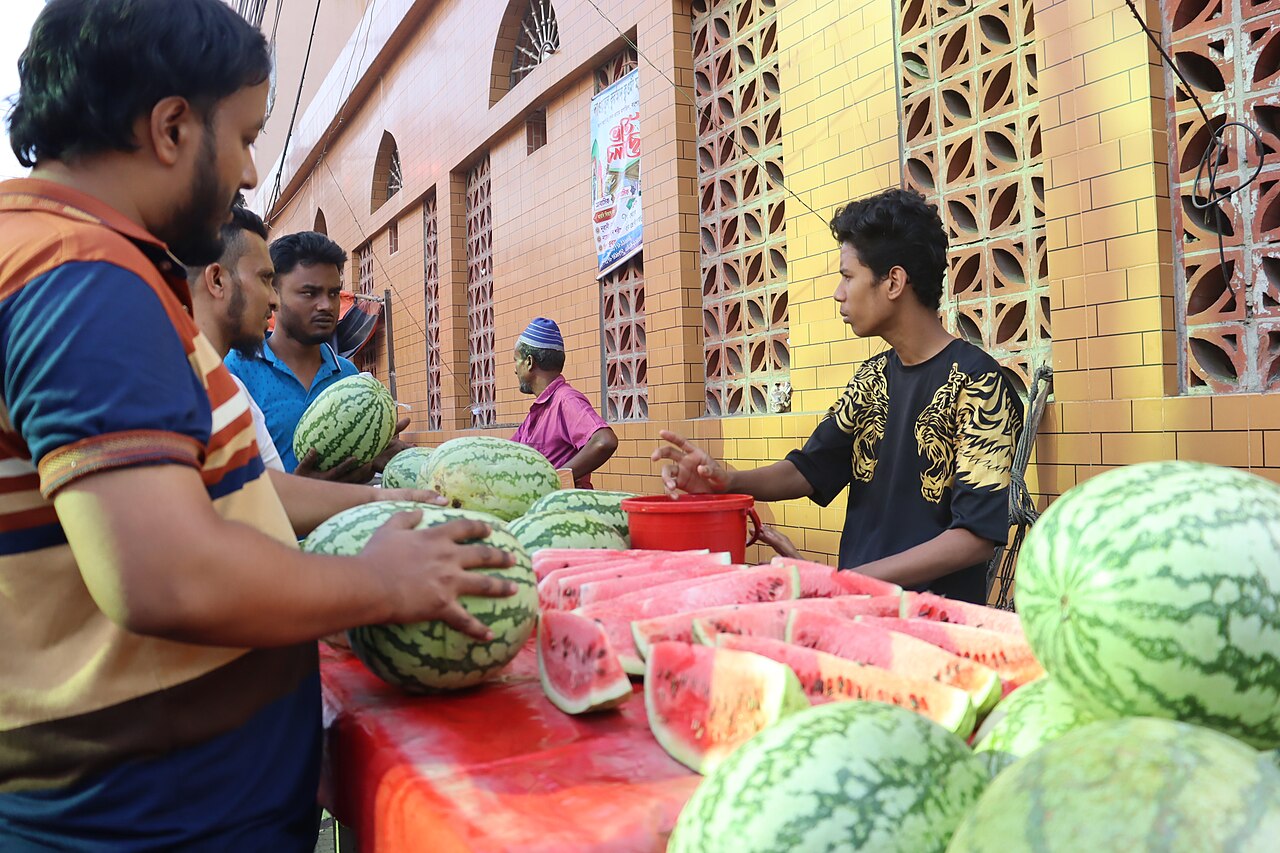
The main watermelon crop of Bangladesh is grown in the south. The Business Standard reported on 29 February 2024, citing the DAE, that the country produced a record 25.47 lakh tonnes of watermelon in the 2021-22 fiscal year. Patuakhali was the top contributor with 9.63 lakh tonnes (37.8 percent of the national yield), followed by Khulna with 5.59 lakh tonnes (22 percent), Bhola with 5.13 lakh tonnes (20.2 percent), Noakhali with 1.60 lakh tonnes (6.3 percent) and Barguna with 0.78 lakh tonnes (3.1 percent); the other 59 districts together produced 2.73 lakh tonnes (10.7 percent). In 2022-23 watermelon was grown on 64,183 hectares in Barishal division alone, producing 2.724 million tonnes. A DAE regional official told the paper that the crop takes about four months from land preparation to the end of the season. The paper also reported that watermelon entered Bangladesh's export basket on 14 March 2023, when a Chattogram company shipped 13.32 tonnes, worth 4,000 US dollars, to Malaysia.
Much of the seed is imported. In August 2020 The Daily Star reported that researchers at the Bangladesh Agricultural Research Institute's (BARI) regional station at Lebukhali in Dumki upazila of Patuakhali had developed seed for red- and yellow-fleshed watermelon that could be grown all year round on relatively high land. A scientific officer there said research had begun in 2015, that the country imported watermelon seed worth 250-300 crore taka every year from China, Japan, Thailand and India, and that 40 tonnes per hectare was possible with the new seed; the institute planned to submit the seed to the national seed board for approval, after which it would reach farmers through the DAE. In BARI's field the fruits were wrapped in polythene to protect them from pests.
Disease is the other limit. A field study published in PLOS ONE in 2024 surveyed 40 watermelon fields in Sylhet and Natore districts and found ten diseases, including anthracnose, Cercospora leaf spot, Fusarium wilt, gummy stem blight, downy mildew, Phytophthora fruit rot, bacterial fruit blotch, angular leaf spot, yellow vine and watermelon mosaic; the pathogens were identified at Sher-e-Bangla Agricultural University in Dhaka. Fusarium wilt was the most common disease in Sylhet, found in 47.5 percent of the plants examined, followed by gummy stem blight at 41.5 percent, while in Natore angular leaf spot (37.5 percent) and yellow vine (33 percent) led. The authors note that Fusarium wilt and Phytophthora fruit rot are the most destructive diseases of watermelon, that farmers in Natore's Gurudaspur and Baraigram grow watermelon as an intercrop with garlic, and that farmers in Sylhet's Jaintiapur and Gowainghat grow early watermelon to escape floods and earn higher off-season prices. The study gives no treatment doses; control measures for a particular field are a matter for the local agriculture office.
The plant and where it came from
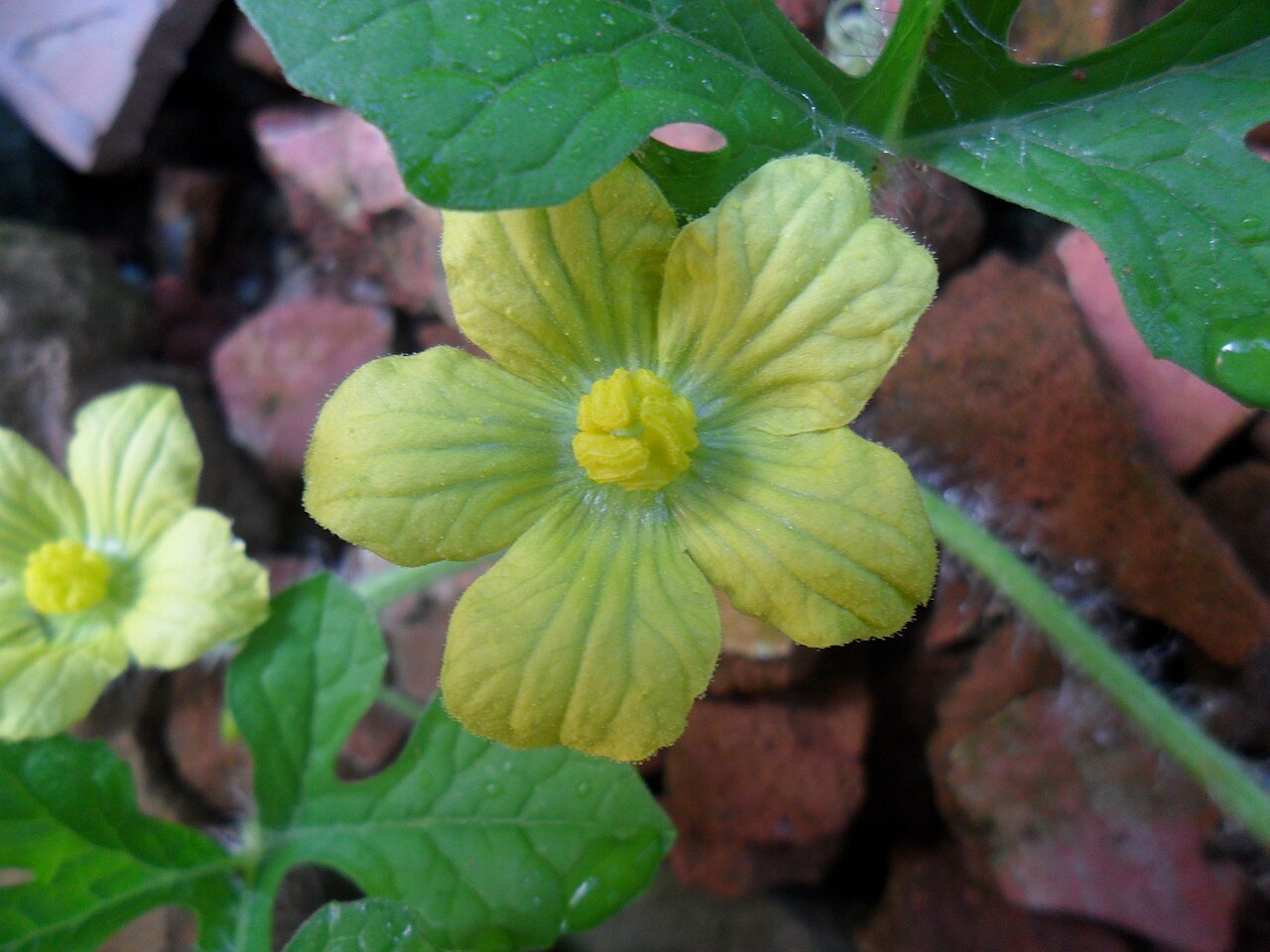
Watermelon, Citrullus lanatus, is a crop of the gourd family, Cucurbitaceae, to which cucumber also belongs. A 2021 study in the Proceedings of the National Academy of Sciences (PNAS) found that a Sudanese form with non-bitter whitish pulp, the Kordofan melon, appears to be the closest relative of the domesticated watermelon and a possible progenitor. Egyptian tomb paintings, as newly interpreted in that study, suggest that watermelon may have been eaten as a dessert in the Nile Valley by 4,360 years before the present. All wild Citrullus species have white pulp that cannot be eaten raw because of bitter compounds called cucurbitacins; the study found that the loss of bitterness was already present in the Kordofan melon, but that red flesh became fixed only in the domesticated watermelon, and that sweetness increased gradually over the course of domestication.
The fruit is mostly water. In the US Department of Agriculture's food composition data (SR Legacy), 100 grams of raw watermelon contain 91.45 grams of water and 30 kilocalories of energy, with 7.55 grams of carbohydrate, 0.61 grams of protein, 0.15 grams of fat and 0.4 grams of dietary fibre. The same portion provides 8.1 milligrams of vitamin C, 112 milligrams of potassium and 10 milligrams of magnesium, and 4,532 micrograms of lycopene, the red pigment of the flesh. Anyone planning a diet around a particular food should take advice from a doctor or a qualified nutritionist.
Jhenaidah and its Sadar upazila
Jhenaidah is a district of Khulna division covering 1,964.77 square kilometres. According to Banglapedia, it is bounded by Kushtia district on the north, Jessore district and India's West Bengal on the south, Rajbari and Magura districts on the east, and Chuadanga district and West Bengal on the west. It was a police outpost at the start of British rule, became a thana in 1793 and a subdivision in 1862, and was made a district in 1984. The 2011 census counted 1,771,304 people in the district, with a literacy rate of 48.4 percent. Agriculture was the main source of income for 67 percent of households, with commerce at 14.24 percent.
The district's rivers include the Gorai, Kumar, Nabaganga, Chitra, Bhairab, Kobadak, Betna and Kaliganga, and it has baors (oxbow lakes) such as Baluhar, Marjat, Sarjat, Majdia and Barphar. Of its six upazilas, Jhenaidah Sadar is the largest at 470.11 square kilometres, with 455,932 people at the 2011 census. Banglapedia lists the Begabati and Nabaganga as its main rivers; paddy, jute, sugarcane, wheat, barley, betel leaf, potato and vegetables as its main crops; mango, jackfruit, litchi, banana, papaya and date as its main fruits; and paddy, jute, betel leaf, banana, date molasses and vegetables as its main exports. In the upazila, agriculture was the main source of income for 60.12 percent of people. Halidhani (Holidhani) is one of the 17 unions Banglapedia lists for the upazila. Watermelon does not appear among the upazila's main crops or main fruits in that record.
Photo: Zeynel Cebeci / Wikimedia Commons (CC BY-SA 4.0)
Sources: Jagonews24 (district correspondent, Jhenaidah), BSS, Prothom Alo, The Daily Star, The Business Standard, Food and Agriculture Organization of the United Nations (FAO), Polymers (MDPI), PLOS ONE, Proceedings of the National Academy of Sciences, UF/IFAS Extension, US Department of Agriculture FoodData Central, Banglapedia
Comments
(0)