
Kamrul Hasan, who passed his SSC, went to Singapore to seek his fortune, working as an electrical supervisor while his uncle worked as a piling specialist. Both earned well, but the coronavirus sent Kamrul home after ten years, and he could not return to a salary of over 100,000 taka. His father and grandfather were farmers, so he chose farming, bringing modern methods from abroad, and has succeeded.
A different-looking field
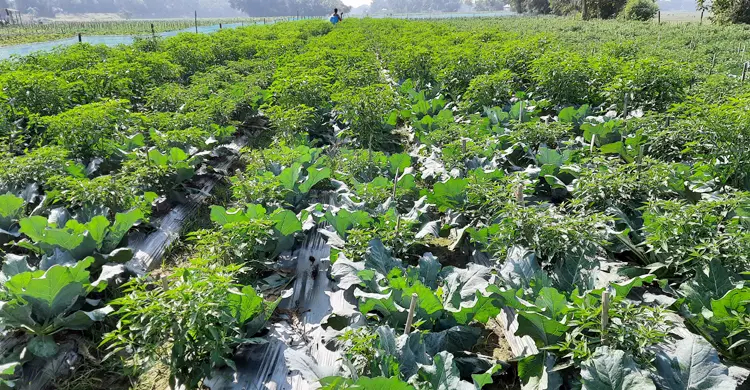
At Borer Char in Mymensingh Sadar, known as a vegetable paradise, vegetables stretch as far as the eye can see along the Brahmaputra. Kamrul's sturdy chilli field looked different from the others.
"This is a mulching field," he said. "With mulched beds, less fertiliser and pesticide are needed, plants grow well and yield early. No labour is needed for weeding, and one mulch lasts four or five crops." He and his uncle saw the method in Malaysia and Thailand, where farmers use little pesticide and more biological control, and began importing mulch from India.
How mulching works
Experts explain that beds are covered with a plastic mulch sheet, black on one side and silver on the other. With the black side down and silver up, soil moisture is kept even in strong sun, so less water is needed; covered soil grows no weeds; and the silver surface reduces insect pests. With no weeds, the plants take all the fertiliser, Kamrul said, and water in the drains is drawn up by the plants.
Costs and returns
Mulching costs 11,000 to 12,000 taka a bigha; a roll costs 5,000 taka and covers 15 decimals. This year he grew cauliflower and chilli on about four bighas, comparing one bigha with mulch and one without. On the mulched bigha a few seedlings died, while hundreds died on the unmulched one, which also needed four or five workers for weeding. The mulched bigha cost 26,000 taka against more than 60,000 taka without, with less irrigation and fertiliser.
From two bighas of chilli planted in September, he expects 54 maunds per picking every seven to ten days for six to seven months. Early chilli sold at 4,700 taka a maund, falling to 2,100; he expects over 300,000 taka in seven months against costs of 80,000 to 90,000 taka. He lost 500,000 taka on tomatoes last season and complains that poor roads cause trucks to get stuck or overturn.
Official views
Mymensingh Sadar upazila agriculture officer Tahmina Islam said vegetables covered 1,284 hectares at Borer Char last year and 985 so far this year; mulching has only begun on 10 to 12 hectares, used by innovative farmers, and is becoming popular because it removes weeding and protects crops in winter. Md Motiuzzaman, DAE deputy director in Mymensingh, said the results are very good.
Source: Jagonews24. First published in Bengali on The Agro News.
Comments
(0)