
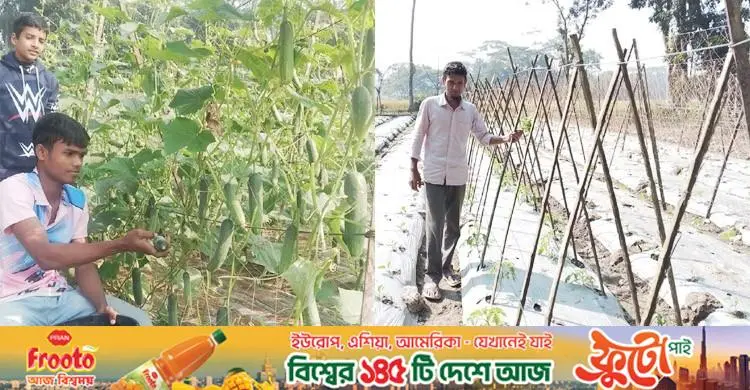
Barishal is a low-lying, rain-prone region where farmers face heavy rain, drought, waterlogging, weeds, disease and high labour costs every year. Mulching, a modern farming technology, is opening new possibilities. Because it retains soil moisture, controls weeds, saves irrigation water and reduces labour, interest is growing across the district in growing vegetables and high-value crops under mulch.
Farmers are using it for cucumber, tomato, chilli, aubergine, snake gourd, bitter gourd, bottle gourd, watermelon and other crops, especially for early vegetables and seasonal crops.
How mulching works
Beds are made at set spacing and covered with special mulching paper or an environmentally friendly plastic sheet. Holes are made where needed and seedlings planted through them. Sunlight cannot reach the soil, so weeds grow less, moisture is held for longer and frequent irrigation is not needed. More stable soil temperature and moisture also help crops grow.
Farmers' experience
- Taijul Islam of Muladi Sadar upazila grows tomato, bitter gourd, aubergine and bottle gourd on one acre under mulch. After the initial extra cost, weeding and irrigation costs fell sharply, fewer labourers were needed, and both yield and profit improved.
- Sujan Mia of Wazirpur upazila grows bottle gourd, bitter gourd, aubergine and snake gourd with mulch. He spends less time and labour, costs are lower and yields better, and several neighbours have started using the method after seeing his results.
Rakib Hossain, owner of Akaid Agro at Lakutia Bazar in Barishal Sadar, said farmers' interest had grown considerably and that training is being provided. Demand for mulching paper is rising: covering 20 decimals needs a sheet about 4 feet wide and 1,685 feet long, costing about Tk 6,500, which farmers recover through lower irrigation, fertiliser and labour costs.
Siddiqui Sumon of Delwar Agro Training Centre in Chandpasha union, Babuganj, said soil moisture management is vital in a rainy, low-lying area like Barishal, and mulching helps both after heavy rain and in dry spells, especially for early vegetables.
What officials say
Agriculture officials say irregular rainfall, temperature swings and water shortages linked to climate change will make technologies like mulching more important, but quality mulching paper, correct application and farmer training are essential.
Md. Mamunur Rahman, additional deputy director (plant protection) of the Department of Agricultural Extension (DAE) in Barishal, said mulched vegetable and fruit cultivation is increasing and farmers are being encouraged, though DAE has no separate figures yet on how many farmers in the southern region use it.
DAE deputy director Mosammat Mariam told Jagonews24 that Barishal has strong potential for mulching, particularly for early vegetables in the winter and Kharif seasons. With field training, quality inputs and more public and private initiatives, she said, its use could expand further, cutting production costs, saving water and labour and helping farmers cope with climate risk.
Source: Jagonews24. First published in Bengali on The Agro News.

Comments
(0)