
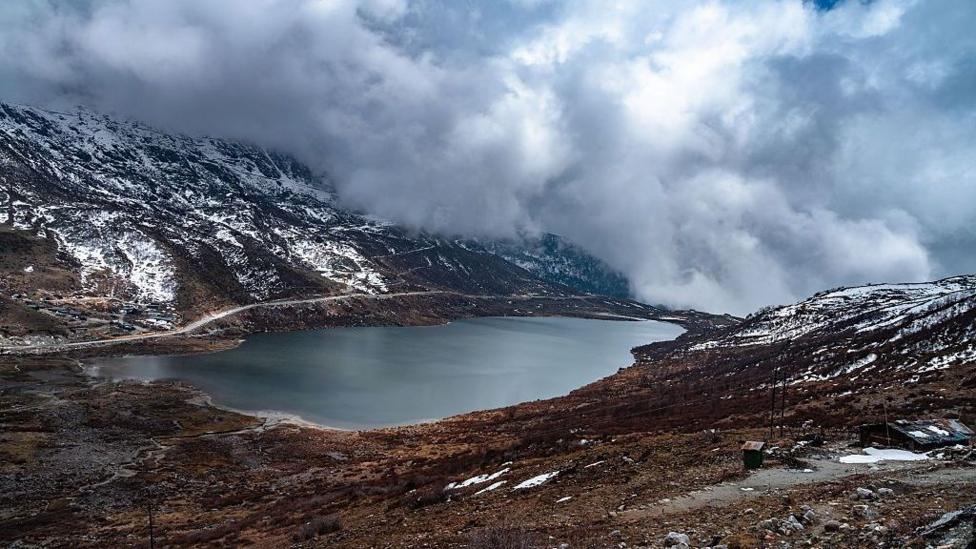
Glacial lakes in the Himalayas are becoming more unstable as the region's glaciers melt faster, according to new research. The findings were published after catastrophic floods in Nepal and Tibet that killed more than 1,300 people and caused widespread destruction.
The report, by the global consultancy Systemiq, says Himalayan glaciers are now losing mass 65 percent faster than they were a decade ago. It was produced jointly with the Integrated Mountain Initiative, with technical support from the International Centre for Integrated Mountain Development (ICIMOD) and the G B Pant National Institute of Himalayan Environment.
The report is candid about its own limits. Of an estimated 40,000 glaciers across the Himalaya-Karakoram region, only 21 have been monitored in detail and continuously — the basis for these findings. That leaves a great many glaciers unobserved at a time when conditions on the ground are changing quickly.
The scale of the risk is already clear in India. The report says the Himalayan region accounts for about 18 percent of India's land area but around 35 percent of the country's disasters. In July the Indian government told parliament that a scientific assessment of 189 high-risk lakes in the Indian Himalayan region in 2025 had classified 56 glacial lakes as "very high risk". The Central Water Commission is monitoring 2,485 glacial lakes larger than 10 hectares.
Recent history shows what happens when a natural dam fails. A glacial lake outburst in Sikkim in 2023 killed at least 70 people and caused heavy damage to roads, bridges and hydropower projects. In 2021 more than 200 people died in Uttarakhand when a vast flood swept down the Rishiganga and Dhauliganga valleys.
For farming, the longer-term question matters more than any single flood. ICIMOD says most river basins in the Hindu Kush-Himalaya region are likely to reach "peak water" — the maximum flow of glacial meltwater — around the middle of this century, after which flows will decline as glacier mass shrinks. Hundreds of millions of people across South Asia draw their irrigation and drinking water from those rivers.
The study also sets out the economics of that dependence. It estimates that Himalayan water underpins about 20 percent of India's gross domestic product and sustains wheat, rice, tea, hydropower and pilgrimage-based economies. Yet the mountain states themselves retain only about 5 percent of that value.
Source: BBC Bangla

Comments
(0)