
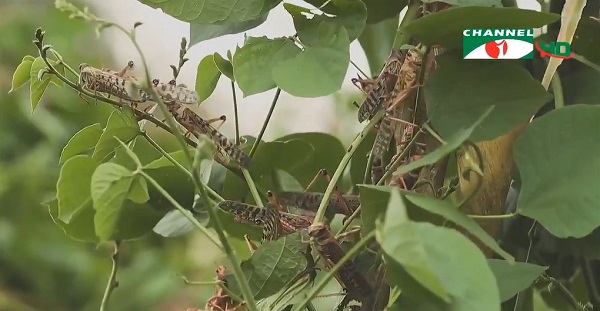
Locusts have struck Central Africa a second time. While the world struggles against the coronavirus, fear has grown that crop-devouring locusts are heading for Bangladesh. This time the fear began in Teknaf, Cox's Bazar, where teams of scientists and experts made several visits over two days.
A global swarm
Locusts began their rampage in Africa in late 2019. After Ethiopia, Eritrea and Djibouti, they spread to Somalia, Kenya, Uganda, South Sudan and Tanzania. The second wave of swarms is 20 times larger and more aggressive than the first, and researchers fear they could be 400 times larger by June.
Dominique Burgeon, director of emergencies and resilience at FAO, said the world economy is already stalled by lockdowns, and with locusts spreading from parts of Africa to parts of Asia, future food security is truly under threat. In Pakistan, locusts have destroyed crops on hundreds of thousands of hectares, and there were fears they would enter Bangladesh through the Middle East, Pakistan and India.
What was found in Teknaf
A swarm of leaf-eating insects in the garden of young man Sohel Sikder at Lombaripara, Teknaf Sadar, raised the alarm. All the insects were killed on Thursday and samples collected. DAE deputy director Abul Kashem said they were not insects that could seriously damage crops, no attacks were seen on nearby fields or trees, and all had died.
On Saturday, researchers from Dhaka analysed the matter closely and brought samples for further study. A DAE deputy director said the insects feed mainly on the leaves of forest and fruit trees and are grasshoppers, not locusts, a species already present in Bangladesh. BRRI scientific officer Dr Md Nazmul Bari said they do little harm and there is no reason to panic. BRRI scientific officer Dr Panna Ali said blocks in the area have been instructed to monitor crops and trees for the insect.
There is no need to panic, but no room to dismiss it entirely either; a close watch must be kept.
Source: Shykh Seraj. First published in Bengali on The Agro News.

Comments
(0)