
By Dr. M. Abdul Momin
Agriculture drives Bangladesh's economy, and because so many people depend on it, the country ranks high among those at risk from climate change. Though small, Bangladesh is divided into 30 agro-ecological zones, each with its own weather, climate and land: floods in some places, drought in others, severe salinity, cyclones, tidal surges and river erosion on the coast, heavy rain in the south-east and too little in the north.
Farm productivity depends on temperature, rainfall and radiation, so developing location-specific rice varieties and technologies is essential to raise output, cropping intensity and productivity. Rice production has grown more than fourfold in 50 years, but growth has slowed as land shrinks and the population rises. According to projections by the Bangladesh Rice Research Institute (BRRI), the country will need 46.9 million tonnes of rice in 2030, 54.1 million tonnes in 2041 and 60.9 million tonnes in 2050.
The LSTD project
To secure long-term food and nutrition security, BRRI is implementing the Location-Specific Rice Variety and Technology Development (LSTD) project under the Ministry of Agriculture. Its targets include:
- six new regional offices and six satellite offices in the main rice areas, with 15 technology villages where BRRI varieties and technologies are demonstrated;
- six rice varieties for favourable and unfavourable environments, 20 new technologies and 1,000 advanced breeding lines;
- collection, characterisation and conservation of 300 new rice germplasm accessions and production of 500 tonnes of quality seed;
- 15,375 adaptive trials to show more than 650,000 farmers modern crop management, adaptation strategies, timely cultivation, post-harvest work and processing;
- 325 one-day training sessions for 13,000 farmers or entrepreneurs, and 75 five-day courses for extension field staff.
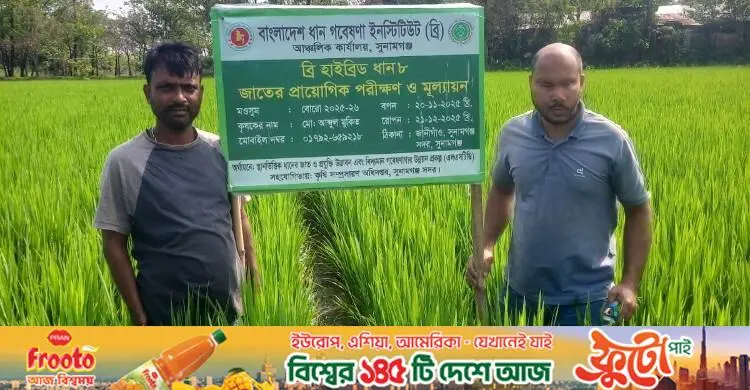
Regional offices have been set up in Dinajpur, Sunamganj, Khagrachhari, Tangail, Netrokona and Cox's Bazar, and satellite stations in Panchagarh, Mymensingh, Sylhet, Chattogram, Patuakhali and Khulna. Research results and climate-resilient seed are first sent to the satellite stations, where scientists train farmers hands-on.
Varieties for each region
- **Dinajpur:** fertile loam, hot humid summers and foggy winters suit aromatic rice. A regional office (Fine Rice Research Institute) and technology village focus on stress-tolerant varieties, irrigation for drought-hit Aman, blast-resistant aromatic rice and premium types such as Kataribhog, basmati and jasmine.
- **Sunamganj:** the haor district needs short-duration, submergence-tolerant rice because of flash floods, heavy rain and waterlogging.
- **Khagrachhari:** in the hills, modern varieties BR3, BR20, BR21 and BR26 and NERICA rice are being grown under the project alongside jhum cultivation, and hill-suited varieties are being developed.
- **Sirajganj and Gopalganj:** floods and waterlogging are the main constraints; ten more acres are being added for research at each.
- **Habiganj:** varieties tolerant of floods and hailstorms are being developed.
- **Netrokona:** early floods in the haor call for resilient varieties.
- **Cox's Bazar:** salinity, disasters and pests are being tackled; the project has helped turn single-crop land into triple-crop land and bring saline land into production.
Working with BRRI's main research, the regional offices and satellite stations are producing new location-specific varieties and technologies that strengthen agriculture and the economy.
The writer is an agriculturist and agricultural journalist and senior communication officer at the Bangladesh Rice Research Institute.
Source: Jagonews24. First published in Bengali on The Agro News.

Comments
(0)